

Commentary
Russia is testing the waters of NATO’s mutual defense clause. What do strikes in Romanian territorial waters mean for the alliance’s posture toward Moscow?
Dimitar Bechev
{
  "authors": [
    "Claudia Major"
  ],
  "type": "commentary",
  "blog": "Strategic Europe",
  "centerAffiliationAll": "",
  "centers": [
    "Carnegie Endowment for International Peace",
    "Carnegie Europe"
  ],
  "collections": [
    "EU Integration and Enlargement"
  ],
  "englishNewsletterAll": "",
  "nonEnglishNewsletterAll": "",
  "primaryCenter": "Carnegie Europe",
  "programAffiliation": "",
  "programs": [],
  "projects": [],
  "regions": [
    "Europe",
    "Western Europe",
    "France",
    "Germany"
  ],
  "topics": [
    "EU",
    "Security",
    "Military"
  ]
}
Source: Getty
Together, France and Germany can live up to the daunting responsibility of coordinating their growing defense budgets in a way that benefits Europe.
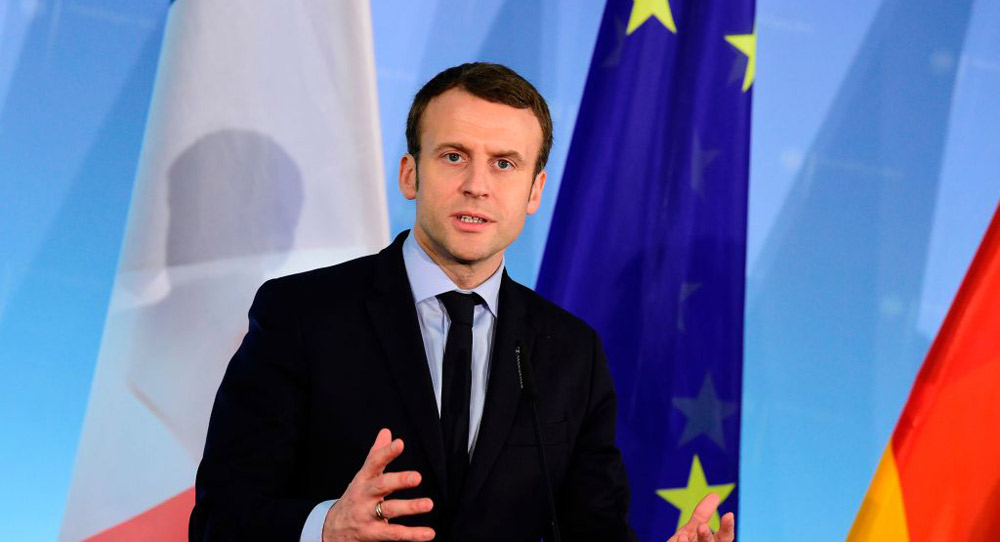
A new deal for Europe: that is what French presidential election front-runner Emmanuel Macron called for during his March 16 visit to Berlin. Aside from the fact that French politicians are traditionally fond of grand designs, he has a point. Europe needs a new deal, particularly on defense. And France and Germany should take the lead.
The opportunity for cooperation is born out of distress and necessity, not enthusiasm. Citizens’ appetites for more Europe are vanishing, and populist and nationalist movements are giving European grand bargains a hard time. As for defense, Europe has not yet recovered from the double paradigm shift it has experienced since 2014: first, Russia smashed the European security order and brought back the importance of NATO, territorial defense, and deterrence; and second, U.S. President Donald Trump has questioned NATO’s utility and is ready to moderate the U.S. commitment to European security if Europeans don’t show more vigor.
Pressure is therefore mounting on Europeans not only to address external threats—from Russia to the self-proclaimed Islamic State—but also to tackle them alone. Europeans, including Germans, are reacting by refocusing on defense: slowly, they are investing again in equipment and personnel. Most importantly, there is political will to do more.
This is where Macron’s new deal comes in. His victory in France’s May 7 presidential election would allow Paris and Berlin to relaunch a dialogue on cooperation. Developing a defense dimension would not only be useful to address Europe’s defense problems. It would also allow France and Germany to balance their bilateral relationship by taking it beyond economic issues, which are usually unpleasant for France, into a domain where France feels confident: defense. A smart move by Paris would be to engage quickly with Germany, to have a process up and running by the time Germany has elected a new government in fall 2017.
Germany has signaled its interest in cooperation. Paris can take Berlin at its word and should consider that ultimately, Germany is too big a partner to lose. Berlin is already implementing its own vision of European defense cooperation anyway, for example through the Framework Nation Concept, which Germany launched in 2013 as a systematic approach to solving the problem of Europe’s ever-shrinking national armed forces. The core idea is to set up multinational units in which armed forces that are powerful enough, such as the German Bundeswehr, serve as a backbone that smaller armies plug into. Jointly, larger units arise that are more capable and deployable for longer periods of time.
Paris can choose to be Berlin’s priority partner. Together, France and Germany can live up to the daunting responsibility of coordinating the use of their growing defense budgets in a way that benefits Europe. To start with, a new French president could propose three steps to reenergize Franco-German defense relations.
First, the two countries could make better use of the Franco-German Brigade (FGB), which is composed of German and French units and belongs to the EU’s Eurocorps. The FGB is an ambiguous symbol. Usually cited as an example of failed cooperation, the brigade has recently become more active. Paris and Berlin have to nurture this recent success story by constantly deploying elements of the brigade in NATO, EU, and UN missions. So far, French and German soldiers have been deployed in operations, but only in small numbers.
In the future, the brigade should be deployed fully. Though not the standard military option, employing the FGB in full could help overcome long-standing criticism of it. Germany and France can also use the FGB to address NATO’s East-South divide by deploying the brigade in the alliance’s deterrence measures in the East, under French command, and operations in the South, under German command, to enable Paris and Berlin to swap perspectives.
Second, France and Germany could consolidate their defense industries and strengthen their defense-industrial bases. France and Germany make up about 40 percent of the industrial and technological base in Western and Central Europe. This is a great potential to drive Europe’s industrial development. In the maritime domain, the states’ strong involvement and some intercultural misunderstandings currently hinder consolidation. A fresh approach by a new French government could help overcome this barrier.
French and German stakeholders should establish a common understanding of the strategic and economic importance of free passage at sea and the relevance of strategic spaces. A common approach could involve joint use of French bases abroad. As the importance of the maritime domain grows, Germany needs to decide whether to invest in a blue-water navy—a maritime force capable of operating globally, across the deep waters of open oceans—or adopt a burden-sharing approach. If Germany opts for a blue-water navy, it would have to enhance its capabilities, which also means investing in shipbuilding. This could be a twenty- to thirty-year program for which the two countries could join forces.
Third, France and Germany could define a joint practice for defense exports. Defense exports remain a key source of revenue for defense industries and allow states to maintain a defense-industrial base. Governments have to decide how to authorize exports in case of industrial cooperation. Two current cooperation projects—KANT, a merger between French and German land warfare equipment producers, and the European drone system MALE UAV—are under pressure to find export solutions that both countries can accept. The success of KANT will depend on what regulations are adopted for the export of joint products (like next-generation main battle tanks) that are manufactured partly in Germany or under German licenses.
These suggestions target the industrial and material dimensions, because European defense cooperation needs tangible results, not yet another declaration. If France and Germany cooperated seriously, it would make a difference to Europe’s security: the two countries represent about 40 percent of Europe’s overall capabilities and of Europe’s combined defense budgets. The impact on Europe’s single set of forces would be considerable. A Franco-German approach does not always have to be accessible to all other European states from Estonia to Malta. But it does have to refer to its final objective: strengthening Europe’s security.
Claudia Major is a senior associate for international security at the German Institute for International and Security Affairs (SWP) and a member of Women in International Security (WIIS) Berlin.
Claudia Major

Russia is testing the waters of NATO’s mutual defense clause. What do strikes in Romanian territorial waters mean for the alliance’s posture toward Moscow?

Dimitar Bechev

With its public finances in shambles, the far right polling at 35 percent ahead of the 2027 presidential election, and a growing protest movement, is France’s crisis a threat to the EU’s geopolitical awakening?

Rym Momtaz, ed.

Ahead of a tough winter for Ukraine, Donald Trump’s swing back toward Russia bodes ill. But instead of panicking, Kyiv’s European allies are focusing on action.
Rym Momtaz

While the EU and European governments are embracing the much-lauded middle-power moment, this entails three difficult conundrums.

Richard Youngs

Much has been said of the changes Brussels is trying to make to the EU enlargement process. Here’s why gradual integration might—or might not—be the answer.
Dimitar Bechev