

Commentary
Judy Dempsey
{
  "authors": [
    "Judy Dempsey"
  ],
  "type": "commentary",
  "blog": "Strategic Europe",
  "centerAffiliationAll": "",
  "centers": [
    "Carnegie Endowment for International Peace",
    "Carnegie Europe"
  ],
  "collections": [
    "EU Integration and Enlargement",
    "Brexit and UK Politics"
  ],
  "englishNewsletterAll": "",
  "nonEnglishNewsletterAll": "",
  "primaryCenter": "Carnegie Europe",
  "programAffiliation": "",
  "programs": [],
  "projects": [],
  "regions": [
    "Europe",
    "Western Europe",
    "Germany"
  ],
  "topics": [
    "Foreign Policy",
    "EU"
  ]
}
Source: Getty
Britain’s decision to withdraw from the European Union will have a profound effect on the bloc’s realignment, starting with Germany.
When the Berlin Wall was torn down in November 1989, the then British prime minister Margaret Thatcher had no doubts about what that meant for Europe’s future. She was adamant—and shrill—in her warnings. For Thatcher, who almost always had a confrontational relationship with Brussels, a reunified Germany would dominate Europe. The continent’s center of gravity would shift away from sleepy Bonn, West Germany’s post–World War II capital, to Berlin, which was soon to be the new seat of the reunited German government. Thatcher believed that Germany would unfortunately set the pace of Europe’s political and economic integration.
It did, but under France’s terms. Helmut Kohl, who was German chancellor at the time, gave up the much-cherished deutsche mark in favor of a common European currency. He did it to further European integration. François Mitterrand, who was president of France, was more than ambiguous about a reunified Germany. He thought the disappearance of such a hard currency as the deutsche mark was a way of keeping Germany down economically and politically. His prediction and wish did not quite materialize.
Thatcher pursued a different track. She embraced enlargement. She and her ministers campaigned hard to get the newly independent, former Communist countries of Eastern and Central Europe admitted to the EU. It wasn’t just that she believed in making Europe whole and free. A bigger Europe was good economically and for making the union stronger as a trading bloc.
But an enlarged EU would also become more cumbersome when it came to making collective decisions. As a consequence, it would be more difficult for Germany to pursue its goal of a more integrated Europe, something that successive British governments consistently opposed.
Now, Britain has started the process of leaving the EU. The implications for a union without Britain are immense. The Eastern members have undoubtedly lost a valuable ally. Poland, for one, identified with Britain’s successful (but fading) liberal Anglo-Saxon economic model and special (but also fading) relationship with the United States. And Britain, given its political weight, its military tradition, and its weltanschauung, was a counterbalance to German influence.
Germany has lost an ally, too. For Berlin, the political, economic, and psychological impact of Brexit should not be underestimated. Unless France makes a radical, fundamental decision to reform, Brexit will mean that the shift in the EU’s geostrategic and political compass makes Germany the unquestioned leader in Europe.
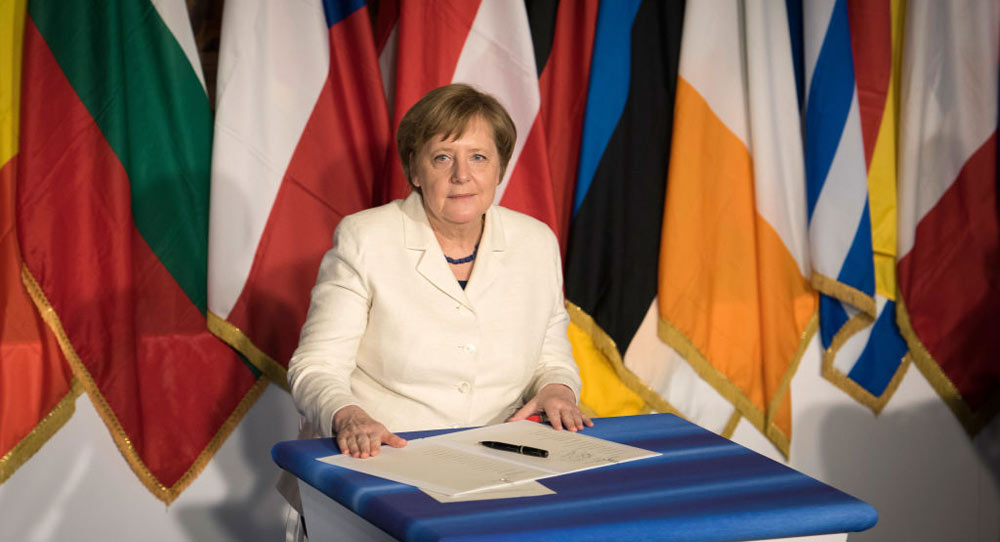
This role has been in the making for some time. Even before the British voted in a referendum in June 2016 to leave the EU, Germany under Chancellor Angela Merkel was reshaping Europe’s foreign and economic policies.
In a feat of patience, diplomacy, and integrity, she brought all the other 27 EU governments together to impose sanctions on Russia for its annexation of Crimea and invasion of parts of eastern Ukraine in 2014. In doing so, she changed the perception, certainly held by Poland and the Baltic states, of Germany’s special relationship with Russia. For Merkel, Ostpolitik—the Eastern policy pursued by previous German governments with the aim of bringing Russia closer to Europe—had run its course. Berlin did not have to remain beholden to Moscow.
With extraordinary persistence, Germany’s finance minister, Wolfgang Schäuble, has been imposing a special German way of running the economy across most eurozone countries: tight budget constraints, fiscal reforms when it comes to tax collection, and the reduction of bloated bureaucracies.
The deep opposition of ordinary Greeks to the German method has revived an equally deep anti-German feeling that harks back to 1941, when the Nazis invaded Greece. The Polish and Hungarian governments have not hesitated to refer to Germany’s Nazi past, either—or to use cartoons of Merkel dressed in a Nazi uniform. That shows how easily leaders can tap into grievances and history to try to demonize Germany—and deflect attention from those countries’ own problems.
Germany has set the agenda for the EU’s refugee and migrant policies, too. These issues are far from resolved. And Germany, which took in over 1 million refugees and migrants in 2015, is now discovering the bureaucratic, security, and practical hurdles of integrating so many people in such a short space of time.
Yet as this realignment takes shape, German leadership is neither hegemonic nor unqualified. Britain’s exit from the EU will leave a military, intelligence, and security gap. Germany is in no position to fill this void—not that it wants to. Nor, for that matter, is any one EU country. For this reason, Berlin, with Paris and other capitals, has to push for much greater defense, security, and intelligence cooperation. Europe’s Southern and Eastern neighborhoods have exposed the vulnerability of EU member states to terrorist attacks. No member state can go it alone, even though Britain may think otherwise.
This is why the emerging realignment taking place in the EU, led by Berlin, needs strong political support from France to the West and from Poland to the East. This support is about taking the EU forward after Brexit, instead of becoming interminably bogged down over what speeds to adopt.

Nonresident Senior Fellow, Carnegie Europe
Judy Dempsey is a nonresident senior fellow at Carnegie Europe
Recent Work
Judy Dempsey
Judy Dempsey
Carnegie does not take institutional positions on public policy issues; the views represented herein are those of the author(s) and do not necessarily reflect the views of Carnegie, its staff, or its trustees.

While the EU and European governments are embracing the much-lauded middle-power moment, this entails three difficult conundrums.

Richard Youngs

Much has been said of the changes Brussels is trying to make to the EU enlargement process. Here’s why gradual integration might—or might not—be the answer.

Dimitar Bechev

The European Commissioner for Trade is headed to China. But after President Xi’s bridge-building visit to Washington, can a more isolated EU overcome Beijing’s stranglehold on critical raw materials? Who will blink first?

Rym Momtaz, ed.

The domestic impacts of how long it is taking to end the war in Ukraine have pushed the French electorate to the political extremes and compromised the country’s diplomatic capacity.
Rym Momtaz

Before the next wave of EU enlargement takes place, the union needs to grapple with thorny questions of how power is distributed among its members.


Emil Sondaj Hansen, Ditte Brasso Sørensen