

Commentary
Europe isn’t as weak in the new geopolitics of power as many would believe. But to leverage its assets and claim a sphere of influence, Brussels must stop undercutting itself.
Dimitar Bechev
{
  "authors": [
    "Claudia Major"
  ],
  "type": "commentary",
  "blog": "Strategic Europe",
  "centerAffiliationAll": "",
  "centers": [
    "Carnegie Endowment for International Peace",
    "Carnegie Europe",
    "Carnegie Russia Eurasia Center"
  ],
  "collections": [],
  "englishNewsletterAll": "",
  "nonEnglishNewsletterAll": "",
  "primaryCenter": "Carnegie Endowment for International Peace",
  "programAffiliation": "",
  "programs": [],
  "projects": [],
  "regions": [
    "Western Europe",
    "Germany",
    "Europe"
  ],
  "topics": [
    "Security",
    "Military",
    "EU"
  ]
}
Source: Getty
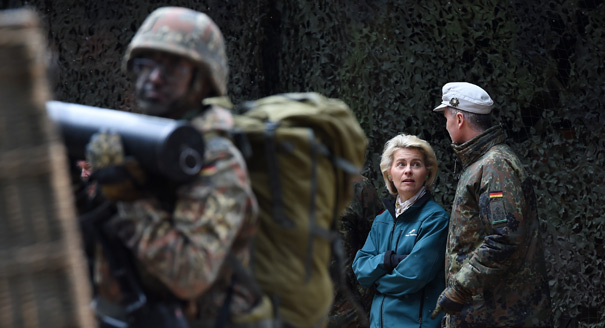
Slowly, Germany is taking on more responsibility in security and defense as Europe faces major internal and external threats.
Which European country is one of four allies to lead a battalion of NATO’s Enhanced Forward Presence in the Baltic countries and Poland, is the biggest European contributor to NATO’s deterrence measures in Eastern Europe, and has soldiers deployed in twelve operations from Mali to Iraq?
It’s Germany. The country usually portrayed as a civilian and economic power par excellence, but rather allergic to military issues. Almost silently, Germany has changed its defense policy over the last four years. In 2013, the incoming government—led for a third term by Chancellor Angela Merkel—defined the leitmotif of a new security policy. Now, at the end of the legislative period, it’s time to take stock.
At the 2014 Munich Security Conference, then German president Joachim Gauck, then German foreign minister Frank-Walter Steinmeier, and German defense minister Ursula von der Leyen called on Berlin to live up to a “new responsibility” in foreign and security policy.
The central message was that Germany should be ready to engage in international affairs earlier, more decisively, and more substantially. The traditional German culture of military restraint persists, but it should no longer serve as an excuse to do nothing. Military instruments will not be the first course of action, but should not be excluded in principle.
Make no mistake: the new line is not about Berlin becoming trigger happy. It is about Germany accepting that as a central European power and dependent on global networks, it should be ready to do more for security and stability that others have been providing for decades and from which the country benefits so greatly. If Berlin rejected such influence, it would mean reneging on an opportunity and responsibility to help shape the international order in a way that corresponds to its own values and interests.
In this context, Russia’s annexation of Crimea in 2014 and the Ukraine crisis not only jolted the rule-based European security order unequivocally supported by Berlin. It pushed Germany to put its rhetoric into action.
What followed was a remarkable political commitment by Germany, such as in the Minsk accords and Normandy format aimed at stopping the fighting in Ukraine. Berlin then substantially shaped the political and military course of NATO’s return to territorial defence, which the alliance decided at its 2014 Wales summit. In fact, Germany reestablished itself as a discreet backbone of NATO.
It wasn’t always plain sailing. Steinmeier accusing NATO of saber rattling on the alliance’s Eastern border damaged the newly gained trust in Germany.
For the Bundeswehr, this required substantial changes: over the last decade, it had concentrated on crisis management, mainly in Afghanistan. Suddenly, the German armed forces had to relearn territorial defence, which required considerable modifications of and investments in personnel, doctrines, and equipment. This was even more difficult given that, over time, budget and capability cuts combined with bad management had left the Bundeswehr in bad shape.
Berlin is now reversing those downward trends. The number of main battle tanks and armored personnel carriers will increase. Improved maintenance will also improve readiness. After several years of decline, Germany’s defense budget will rise in 2017 for the second year in a row to reach €36.6 billion. While this increase is set to continue, it still does not reach NATO’s goal of spending 2 percent of GDP on defense (Germany currently spends 1.2 percent) but does come close to the 20 percent investment line.
Change is most visible in Germany’s military missions. Berlin now participates in operations more often, in different forms, and more offensively, particularly its strong participation in NATO’s defense and deterrence activities. A new approach was the introduction of the Enable and Enhance Initiative, in which Germany trains and equips regional actors, including in Iraq and Mali, to help build capacity to provide their own security.
Another noticeable development was Germany’s quick decision to participate in the anti-IS coalition following the November 2015 Paris attacks, which, like the Iraq mission, stretched the legal framework for Bundeswehr deployments because the missions do not operate in collective security systems (such as the UN) but as part of an ad-hoc coalition. Within a short timeframe, Berlin crossed traditional red lines, thereby moving the points of reference for military deployments.
Yet, it is not all sunshine and roses.
Germany’s partners were waiting for the conceptual underpinning of the new policy to see whether Berlin would put in writing what it announced in Munich. Germany’s 2016 White Paper on security policy did not entirely convince mainly because it was a consensus document. But at least it spelt out the need to defend interests and values and the need for a stronger European defense. Armament policies also remain an issue, with the planned reform of the export rules still lacking.
And while the results in bilateral defense cooperation are promising (such as between Dutch and German land forces), bigger clusters, such as the Framework Nation Concept, have yet to deliver.
Overall, Germany has become most active when partners or events created the necessary pressure, such as in the Ukraine crisis, which forced Berlin to take over diplomatic and military leadership. In other cases, like the fight against the Islamic State, Germany only became active when the crisis turned into a domestic issue (for instance, as refugees flows to Europe grew), or when it was critical for an important partner (for example, following the November 2015 Paris attacks).
It is easy to talk the changes to Germany’s defense policy down, not least because Berlin struggles to develop a systematic policy of its new security responsibilities. Yet the rapidly changing security environment combined with the West’s current internal problems—from Trump to Turkey to populism—will not allow Germany to take a break. The challenge for the next government is not only to continue assuming greater responsibility for European security, but to increase it and make it sustainable.
Claudia Major is a senior associate for international security at the German Institute for International and Security Affairs (SWP) and a member of Women in International Security (WIIS) Berlin.
Claudia Major
Europe isn’t as weak in the new geopolitics of power as many would believe. But to leverage its assets and claim a sphere of influence, Brussels must stop undercutting itself.

Dimitar Bechev
Europe’s reaction to the war in Iran has been disunited and meek, a far cry from its previously leading role in diplomacy with Tehran. To avoid being condemned to the sidelines while escalation continues, Brussels needs to stand up for international law.

Pierre Vimont
France and Germany’s failure to agree on the Future Combat Air System (FCAS) raises questions about European defense. Amid industrial rivalries and competing strategic cultures, what does the future of European military industrial projects look like?

Rym Momtaz, ed.
France has stopped clinging to notions of being a great power and is embracing the middle power moment. But Emmanuel Macron has his work cut out if he is to secure his country’s global standing before his term in office ends.
Rym Momtaz
Integrating AI into the workplace will increase job insecurity, fundamentally reshaping labor markets. To anticipate and manage this transition, the EU must build public trust, provide training infrastructures, and establish social protections.
Amanda Coakley