

Commentary
Judy Dempsey
{
  "authors": [
    "Judy Dempsey"
  ],
  "type": "commentary",
  "blog": "Strategic Europe",
  "centerAffiliationAll": "",
  "centers": [
    "Carnegie Endowment for International Peace",
    "Carnegie Europe"
  ],
  "collections": [
    "EU Integration and Enlargement"
  ],
  "englishNewsletterAll": "",
  "nonEnglishNewsletterAll": "",
  "primaryCenter": "Carnegie Europe",
  "programAffiliation": "",
  "programs": [],
  "projects": [],
  "regions": [
    "Europe",
    "Western Europe",
    "France"
  ],
  "topics": [
    "Foreign Policy",
    "EU",
    "Political Reform"
  ]
}
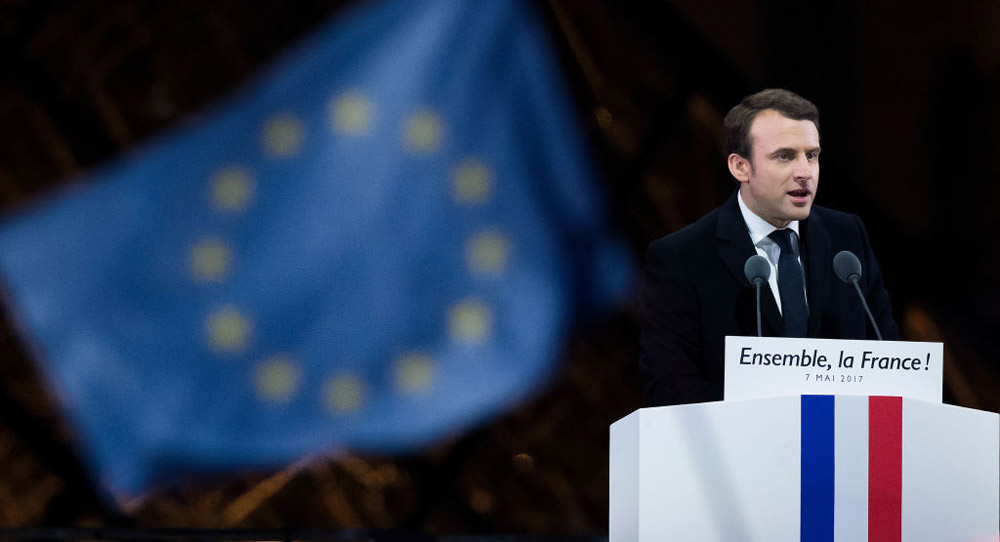
Source: Getty
France’s new president has five years to put his country and Europe on a new trajectory. The challenges he faces are huge.
The election of Emmanuel Macron as France’s next president is extraordinary and challenging for his country and for Europe.
It is extraordinary in part because at thirty-nine years old he is the youngest person since Napoleon Bonaparte to lead France. Macron’s voters (and those who supported the far-right National Front leader, Marine Le Pen) rejected the established parties of the Left and the Right. The leaders of France’s traditional party system were booted out because they were steering France into a cul-de-sac. They could not deliver on growth, employment, reforms, or steps to restore France’s place in Europe.
The other extraordinary aspect of Macron’s victory—by 66 percent to 34 percent—is that he campaigned for Europe because he believed in it. It’s hard to think of another leading politician in Europe who would go on the stump as Macron did. In the Netherlands, Prime Minister Mark Rutte was reelected on March 15 by playing the populist card instead of defending Europe. So much for his convictions. Macron didn’t deviate from his.
The challenges Macron faces, however, are immense. Not only will he have to mobilize the maximum of support for his one-year-old En Marche ! (On the Move!) movement to secure a mandate in the National Assembly, which will be elected in June, for his reforms. He also has to prevent France from being permanently divided between those who embrace a more open and competitive France that is anchored to the EU and Le Pen’s supporters, who reject globalization and what the EU represents. Support for the National Front in the second round of the presidential election on May 7 doubled compared with the 2002 contest, when Le Pen’s father Jean-Marie was the party’s leader.
Macron also has to win over the 11 percent of voters, or close to 4 million, who spoiled their ballots. They couldn’t endorse either candidate. That is why his victory speech was important. He reached out to Le Pen’s supporters and those skeptical about his goals. “I know the divisions of our country that have driven some to the extreme. I respect them. I know the anger, anxiety, and doubts that many have expressed,” Macron said. He vowed to look after the “most fragile” in society.
His speech was also important because France’s economic and political woes are shared by several other EU countries. But France matters because of its size, its potential, and the way in which it has shaped the EU’s course in the past.
Those qualities are going to be even more important as Europe has to deal with a U.S. administration that is protectionist in a way that is attractive to antiglobalization movements in Europe. No surprises that U.S. President Donald Trump and Russian President Vladimir Putin wanted Le Pen to win in France.
Macron’s victory does not put paid to these populist or nationalist trends either in France or in the rest of Europe. Instead, his victory shows why leaders have to reach across the divide, to the other side, to prevent parts of society from becoming deeply alienated or frustrated. Le Pen was able to tap into that sense of being left behind or ignored by the status quo.
Yet Le Pen’s solutions to France’s ailing economy provided no panacea. Countries cannot close their borders and close up shop. They never could, not even under Communism. Leaders cannot lock change into a cage.
And that is going to be Macron’s biggest challenge: how to change France and, with the support of Germany, how to change Europe. The EU is on the threshold of irrelevance unless Macron and German Chancellor Angela Merkel recognize that the traditional Franco-German motor, which kept pushing Europe forward, has to be restarted—and quickly. This cannot be done unless Macron moves ahead with reforms that will make it easier for young people to enter the labor market, that will reduce the top-heavy bureaucracy, and that will open France’s economy to the biggest challenge facing all EU countries: digitization.
The other challenge is to wrap up the Brexit negotiations quickly. London should not hold the EU hostage, and the EU should not use Britain’s impending exit from the bloc as an excuse to continue muddling through. Indeed, for the past two decades, France has been on autopilot to the detriment of its status in Europe, if not the world. Macron’s victory means that muddling through is no longer an option.
This blog post is the seventh in a set of contributions providing insights into the 2017 French presidential election.

Nonresident Senior Fellow, Carnegie Europe
Judy Dempsey is a nonresident senior fellow at Carnegie Europe
Recent Work
Judy Dempsey
Judy Dempsey
Carnegie does not take institutional positions on public policy issues; the views represented herein are those of the author(s) and do not necessarily reflect the views of Carnegie, its staff, or its trustees.

Are Germany’s economic, industrial, and political struggles becoming a liability for the EU’s ability to rise to the geopolitical moment?

Rym Momtaz, ed.

European Commission President Ursula von der Leyen is about to give her annual address on the state of the EU. Here’s what she won’t—but should—say.
Rym Momtaz

The aftermath of the Ceuta crisis shows Europe has drawn the wrong lessons. Rather than doubling down on failed migration policies, the EU needs to address the underlying roots of such episodes.

Richard Youngs

An overwhelming victory by a far-right-wing party in a small state in eastern Germany will have major repercussions for Chancellor Friedrich Merz’s coalition.
Judy Dempsey

Canadian Prime Minister Mark Carney has twice inspired praise for standing up to U.S. President Donald Trump: at the 2026 World Economic Forum in Davos and on Canada-U.S. trade negotiations. Is Carney showing a third way better than the EU has in dealing with the Trump administration?
Rym Momtaz, ed.