

Commentary
Judy Dempsey
{
  "authors": [
    "Judy Dempsey"
  ],
  "type": "commentary",
  "blog": "Strategic Europe",
  "centerAffiliationAll": "",
  "centers": [
    "Carnegie Endowment for International Peace",
    "Carnegie Europe"
  ],
  "collections": [
    "Brexit and UK Politics"
  ],
  "englishNewsletterAll": "",
  "nonEnglishNewsletterAll": "",
  "primaryCenter": "Carnegie Europe",
  "programAffiliation": "",
  "programs": [],
  "projects": [],
  "regions": [
    "Europe",
    "Western Europe",
    "United Kingdom"
  ],
  "topics": [
    "EU",
    "Political Reform"
  ]
}
Source: Getty
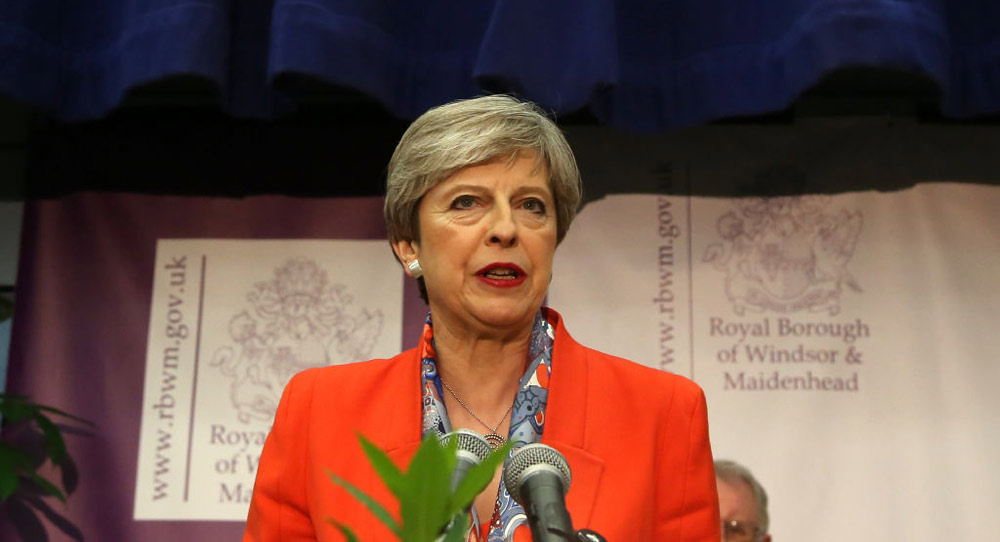
A snap general election has turned into a political debacle for Britain and its leader, Prime Minister Theresa May.
What a result! With votes in all but one of the parliamentary seats counted, Britain’s governing Conservatives have failed to win the majority that their leader, Prime Minister Theresa May, had so hoped for when she called a snap general election for June 8. Despite her repeated mantra during the campaign that Britain needed strong Conservative leadership and stability that would give her a firm hand in the negotiations to withdraw the UK from the EU, she has achieved neither.
Britain has emerged with a hung parliament, in which no party has a majority. The UK is now in for a period of uncertainty, hardly a good omen for a country that is opting out of the EU, that cannot rely on the United States, and whose strategic vision has been strangled by the arrogance of power. None of these factors is good for Europe. The Brexit negotiations, which are scheduled to start on June 19, could be delayed. At least the nasty rhetoric of both sides might give way to a more sober atmosphere.
A quick recap of the election results. The Conservatives won 42.4 percent of the vote and 318 parliamentary seats. The Labour Party under Jeremy Corbyn won 40.0 percent and 261 seats. The Liberal Democrats won twelve seats. The Scottish National Party lost a staggering 21 seats, many going to the Conservatives. Out goes the possibility that its leader, Nicola Sturgeon, could win the referendum she seeks to pull Scotland out of the UK.
As for the populist and deeply anti-European UK Independence Party (UKIP), it won 1.8 percent of the vote—down from the 12.6 percent it won in the 2015 election. This is good news. But then again, May moved her party to the Right, relentlessly hammering home the need to control immigration and cut the deal of all deals with the EU. UKIP voters found a home in May’s refashioned Conservative Party.
The Conservatives did badly for several reasons. As revealed by the Financial Times interview with May on June 3, there was a real sense of self-denial by the prime minister and her tight circle of advisers. In some ways, it was a reminder of Tony Blair’s last years as Labour prime minister: he was isolated from the public mainly because of Britain’s involvement in the Iraq War plus a belief that the leader knows best.
May was tripped up several times during the campaign. She zigzagged over social welfare, particularly care for the elderly. She flip-flopped over what terms Britain would set for leaving the EU—a hard deal or even no deal—as if it were up to Britain alone to set the agenda. And she challenged the fundamentals of human rights to deal with terrorism. What a gift to the self-proclaimed Islamic State and its supporters. Weakening democratic values has been one of the goals of terrorists.
Above all, May completely misjudged the mood among voters. That is what Corbyn tapped into. Written off as a zealous left-winger who wanted to reintroduce state ownership for certain key sectors such as railroads (which might not have been a bad thing), was hypocritical over human rights, and supported nasty regimes, Corbyn defied his critics. He homed in on poverty, on the growing social inequality plaguing British society, on the deteriorating quality of the health service, education, and security, and on the lack of access to state housing that the former Conservative prime minister Margaret Thatcher had sold off.
Corbyn struck a chord. So much so that he overturned May’s 20 percentage point lead in the polls—one of the reasons why she called an election in the first place. She believed Labour would hand her a handsome majority that would secure her political future and give her the leverage she needed in dealing with the EU. Now, everything is in doubt.
The coming days are going to test the Conservative Party. May and her cabinet emerge from this election humiliated and seriously weakened. The prime minister has pledged to form a government with the support of Northern Ireland’s Democratic Unionist Party (DUP). But there are enough rivals in May’s party who would like her out of Downing Street. Britain’s general election is over. But it has brought no clarity to the UK’s future, or to May’s.

Nonresident Senior Fellow, Carnegie Europe
Judy Dempsey is a nonresident senior fellow at Carnegie Europe
Recent Work
Judy Dempsey
Judy Dempsey
Carnegie does not take institutional positions on public policy issues; the views represented herein are those of the author(s) and do not necessarily reflect the views of Carnegie, its staff, or its trustees.

The EU had to compromise to adopt a twenty-first sanctions package against Russia, exposing growing cracks in the union’s resolve. Is this latest, weaker round worth it to keep pressure on Moscow?

Rym Momtaz, ed.

Trump is distracted and Ukraine wants Europe to step up. The continent’s leaders must find their voice and assert it in talks with Russia.

Alissa de Carbonnel

Mounting economic strain and battlefield losses will not necessarily make the Kremlin less dangerous. They could instead push Moscow toward a more aggressive hybrid campaign designed to test NATO’s Eastern flank, exploit allied hesitation, and fracture European resolve.

Maksym Beznosiuk

Over the past ten years, NATO has held almost as many summits as it did during the entirety of the Cold War. Are they still useful, or is it time to stop holding annual meetings?
Rym Momtaz, ed.
Nearly a year and a half after Europeans leaned into sucking up to Trump, the strategy has produced some benefits when it comes to Ukraine.
Rym Momtaz