

Article
Marc Pierini
{
  "authors": [
    "Marc Pierini"
  ],
  "type": "commentary",
  "blog": "Strategic Europe",
  "centerAffiliationAll": "",
  "centers": [
    "Carnegie Endowment for International Peace",
    "Carnegie Europe"
  ],
  "collections": [
    "Turkey’s Transformation"
  ],
  "englishNewsletterAll": "",
  "nonEnglishNewsletterAll": "",
  "primaryCenter": "Carnegie Europe",
  "programAffiliation": "",
  "programs": [],
  "projects": [],
  "regions": [
    "Europe",
    "Türkiye",
    "Middle East"
  ],
  "topics": [
    "Foreign Policy",
    "EU"
  ]
}
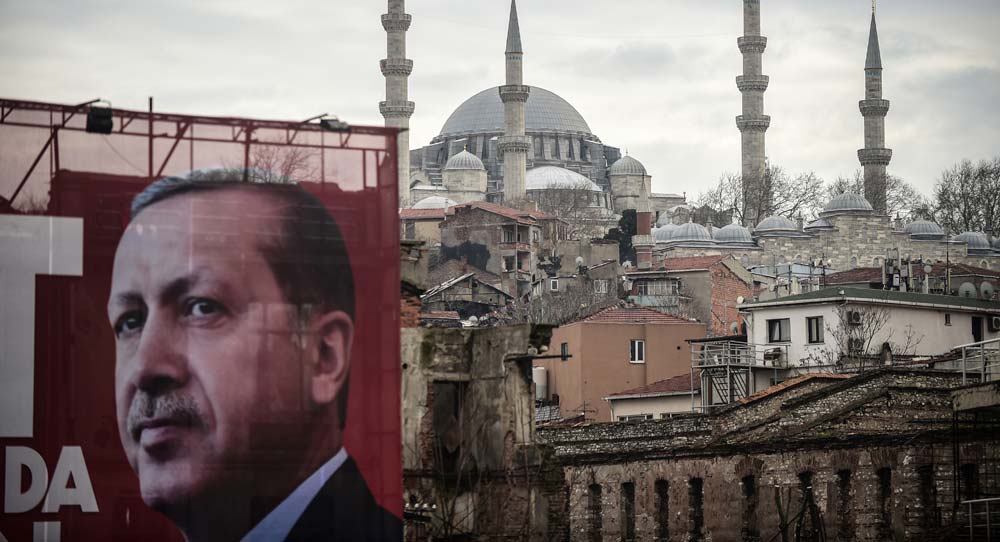
Source: Getty
Turkey’s quandary will only be resolved by the country’s politicians and citizens. How much courage, consistency, and resilience they show will be of the essence.
In recent weeks, Turkey’s leadership has been kicking in two different (but interlinked) directions: one international, the other domestic.
An ever-deepening conspirational mindset has led Ankara (depending on the subject matter) to accuse, threaten, jail, or lecture both its citizens and foreigners, irrespective of the real situation the country finds itself in.
As a result, Turkey’s leadership seems to be trapped in a self-engineered echo chamber, where the same words keep being repeated for the attention of the nationalist audience, but with less and less connection to the real world.
On the international stage, Turkey has recently taken new initiatives, such as threatening to close trade flows with the Kurdistan Regional Government and sending troops to Iraqi Kurdistan and Syria’s Idlib province.
Ankara’s preferred foreign policy method seems to be based on brisk moves, although there has been little real impact so far in Moscow, Washington, Tehran, Damascus, Erbil, or Baghdad. Russia still controls the Syrian scene, the Kurdistan Regional Government still talks to the Iraqi central government, and the Syrian Kurds are poised to have a part in a future Syrian settlement.
Similarly, with regard to the United States, Turkish government officials keep saying publicly that the extradition of Fethullah Gülen is an obligation that must be met, while the prosecution of Reza Zarrab by a New York court is unfair.
In both circumstances, Turkey is disregarding the realities of the U.S. judicial system.
In the first case, a key factor in any decision to extradite an individual is the assurance that the person in question will benefit from a fair trial—an obviously distant prospect in today’s Turkey.
In the second case—to Ankara’s embarrassment—the indictment of Reza Zarrab is linked to the gold trade between Turkey and Iran that resulted in the evasion of international sanctions—a serious enough issue for the United States. Furthermore, the trade may also have jeopardized American national security interests depending on where exactly the hundreds of millions at stake were dispatched by Tehran.
With Russia, Ankara keeps repeating that the country’s purchase of S-400 missiles is imminent and includes technology transfer. The mood in Moscow is different: no technology transfer and a low level of confidence in Ankara’s policies—despite the appearance of cohesion between the two parties during the Astana talks on Syria.
The EU, for its part, is now refraining from any dialogue with Turkish President Recep Tayyip Erdoğan in order to avoid further provocations. The union is taking concrete measures to contain Ankara’s interference in European political affairs, while redirecting some of its funds to the defense of human rights in Turkey.
Overall, Ankara’s two-pronged international strategy—accusing the United States and/or the EU of supporting the Gülen movement and the Kurdistan Workers’ Party (PKK); and endlessly trying to provoke Europeans leaders to cancel negotiations while at the same time pretending (against all the evidence) that Turkey is fulfilling the necessary political criteria for accession—has led to an impasse. That strategy has simply failed to advance Turkey’s medium- and long-term strategic, political, and economic interests. It has also sapped Ankara’s credibility in other capitals that it wanted to court for opportunistic reasons, such as Moscow, Tehran, or Baghdad.
Domestically, the political situation is dire—according to the president’s own admission. The current alliance between the Justice and Development Party (AKP) and the Nationalist Movement Party (MHP) is shaky to say the least. There is a degree of muted dissidence within the AKP, while the formation of a new party, led by former minister and MHP dissident Meral Aksener, is bound to eat into both AKP and MHP constituencies.
In concrete terms, the March 2019 municipal elections may act as a prelude to difficult presidential and legislative elections the following November. The president has launched a vast rejuvenation operation in view of the municipal elections, sacking the long-standing AKP mayors of the highly symbolic bastions of Istanbul and Ankara. This is a demonstration of force, but not necessarily proof of solid control.
Were the AKP to lose the mayorships of both Istanbul and Ankara, the consequence for the November 2019 elections would be ominous.
Some Turkish experts estimate that the margin by which the AKP could be defeated in all three 2019 elections could be so wide that tinkering with campaigning and ballot counting may not do the trick this time around. It even appears possible that the much sought-after constitutional reform leading to a super-presidential regime may in fact morph into a deadly political trap for its promoters. Betting Turkey’s political future on one single person, while at the same time mercilessly fighting all forms of opposition—both dissent and free-thinking—with increasingly absurd methods, may well end up being the “bridge too far” in an otherwise extraordinary fifteen-year political journey.
In such a tense context, the “international conspiracy” toolbox is wielded abundantly against the country’s free thinkers, civil society activists, as well as foreigners.
Again, such a merciless campaign may seem useful to some entrenched nationalists at home, but its credibility has been worn extremely thin by the flimsy accusations and the almost caricatural defamation techniques at play. The net is being cast wider and wider against dissent journalists and simple citizens, and has reached such ludicrous levels that Ankara’s repressive techniques increasingly look like signs of political desperation more than the standard authoritarian practices of the past.
Foreign leaders and observers should make no mistake, however. Those who think they can entertain a meaningful dialogue with Turkey’s leadership will at best be used as pawns against their own country. At worst they will be singled out as yet another “foreign conspirator.” In addition, currying favor and exerting international pressure on Ankara will not work either. Containment is probably the best bet.
Ankara’s leaders have now led Turkey toward a not-so-well-frequented league of nations. The damage is huge, especially for the Turkish president more than the country itself. Yet, things will get a lot worse because this is the logic of conspiracy-based power systems: blame everybody else other than yourself.
Turkey’s quandary will only be resolved by its politicians and citizens. How much courage, consistency, and resilience they show will be of the essence. As ever, all politics is local.

Senior Fellow, Carnegie Europe
Marc Pierini is a senior fellow at Carnegie Europe, where his research focuses on developments in the Middle East and Turkey from a European perspective.
Recent Work
Marc Pierini
Marc Pierini
Carnegie does not take institutional positions on public policy issues; the views represented herein are those of the author(s) and do not necessarily reflect the views of Carnegie, its staff, or its trustees.

Are Germany’s economic, industrial, and political struggles becoming a liability for the EU’s ability to rise to the geopolitical moment?

Rym Momtaz, ed.

European Commission President Ursula von der Leyen is about to give her annual address on the state of the EU. Here’s what she won’t—but should—say.
Rym Momtaz

The aftermath of the Ceuta crisis shows Europe has drawn the wrong lessons. Rather than doubling down on failed migration policies, the EU needs to address the underlying roots of such episodes.

Richard Youngs

An overwhelming victory by a far-right-wing party in a small state in eastern Germany will have major repercussions for Chancellor Friedrich Merz’s coalition.

Judy Dempsey

Canadian Prime Minister Mark Carney has twice inspired praise for standing up to U.S. President Donald Trump: at the 2026 World Economic Forum in Davos and on Canada-U.S. trade negotiations. Is Carney showing a third way better than the EU has in dealing with the Trump administration?
Rym Momtaz, ed.