

Commentary
With its public finances in shambles, the far right polling at 35 percent ahead of the 2027 presidential election, and a growing protest movement, is France’s crisis a threat to the EU’s geopolitical awakening?
Rym Momtaz, ed.
{
  "authors": [
    "Claudia Major",
    "Christian Mölling"
  ],
  "type": "commentary",
  "blog": "Strategic Europe",
  "centerAffiliationAll": "",
  "centers": [
    "Carnegie Endowment for International Peace",
    "Carnegie Europe"
  ],
  "collections": [],
  "englishNewsletterAll": "",
  "nonEnglishNewsletterAll": "",
  "primaryCenter": "Carnegie Endowment for International Peace",
  "programAffiliation": "",
  "programs": [],
  "projects": [],
  "regions": [
    "Western Europe",
    "France",
    "Europe"
  ],
  "topics": [
    "Security",
    "Military",
    "Foreign Policy",
    "EU"
  ]
}
Source: Getty
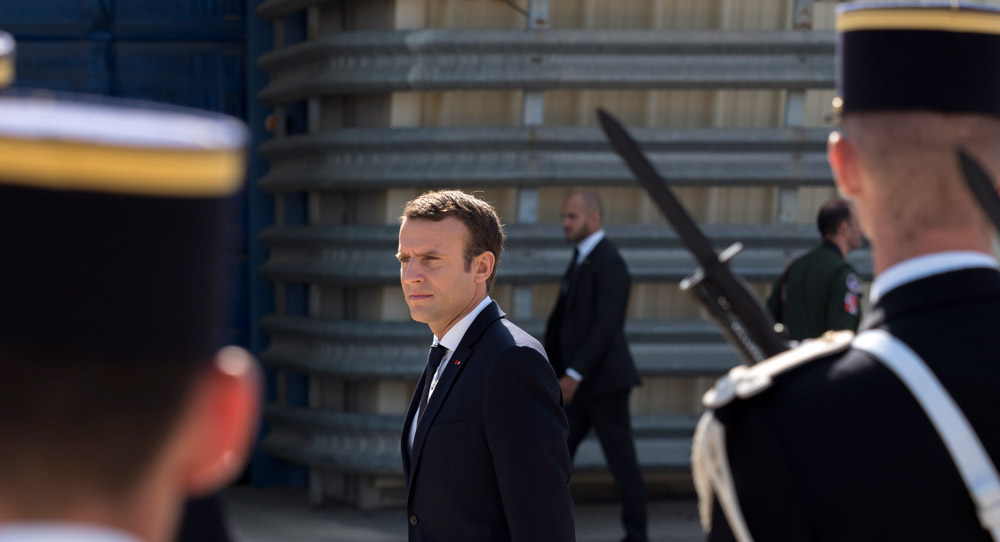
While the EU is celebrating PESCO, Paris is preparing for closer defense cooperation outside the union.
Two parallel developments are currently taking place in European defense.
One is the highly publicised expectation that the tiny Common Security and Defense Policy (CSDP) will transform into a comprehensive and powerful EU defense project. The EU and its member states have been celebrating the most recent steps in this direction: the launch of the Permanent Structured Cooperation (PESCO), to deepen defense cooperation; the launch of the European Defense Fund (EDF), to finance joint research and capability projects; and finally, the Coordinated Annual Review on Defense (CARD), which is supposed to synchronize EU defense planning.
The second development is receiving far less attention. Paris is launching defense cooperation initiatives outside the EU format, thus moving from an EU-focused to a European-oriented defense approach. The centerpiece is the European Intervention Initiative (EII). It should enable European states that are willing and able to act militarily to do so independently from the existing institutional frameworks of the EU or NATO.
The objective is operational readiness. This means having the right stuff at the right moment to get things done, without being constrained by political or institutional obstacles. While there is not much noise being made about this development, its contribution to European defense might materialise more quickly, is likely to be more substantial than what’s currently being done in the EU, and could hamper EU defense efforts.
French President Emmanuel Macron launched the idea in his September 2017 Sorbonne speech. The French Strategic Review of Defense and National Security, released in October 2017, put the EII on Paris’s priority list. There were three reasons for this.
First, France considers its Southern neighbourhood as the most important challenge for its national security—as well as for Europe’s—but does not feel that Paris gets sufficient support to handle defense challenges in the region. Second, France is no longer able to cope with these challenges on its own: the military is overstretched and the funding is not in line with the size of the task. Paris needs partners—beyond the United States, whose political leadership raises uncertainty, and beyond the United Kingdom, which risks becoming a militarily dwarf if the country’s planned budget cuts are implemented. Finally, Paris fears that the current EU defense announcements will once again be all talk and no action.
France is therefore seeking solutions outside the EU framework. European defense has to deliver on capabilities and operations, not on institutional aesthetics, and it needs to do so quickly.
In short, the EII is the opposite of PESCO. It is flexible, linked to operational readiness, and exclusive, as it is supposed to be comprised only of states that are truly interested in defense. It takes place outside EU and NATO, thus seeking to circumvent their slow and cumbersome processes and the miniscule contribution of some members that are symbolically valuable, but of little military use. It also has a flexible and voluntary opt-in format, where states gather around a bigger and experienced backbone state like France and plug in their contributions, allowing all of them to increase their power. Natural partners would include EU countries, like Spain, but also non-EU NATO countries, such as Norway.
For France, the EII is an element in a grand design: the development of a common European strategic culture, to be forged via common operations and cooperation in view of reaching operational autonomy and assuring European sovereignty. Yet many Europeans fear that Paris is just trying to use Europe for its own goals. Because Paris cannot accomplish the things that it wants to get done on its own, it is seeking support. And because the EU might not deliver, and NATO is too much of a headache, Paris is looking for alternatives. France’s strategic review thus pragmatically calls for France to seek the “optimal combination of different formats of European cooperation […] in a differentiated logic.”
Europeans should watch this space closely. If one of the strongest and (operationally) most willing military actors in Europe is turning away from the current EU defense hype, these new settings might not be as promising as many observers think they are. This means, in turn, that the Europeans are faced with two competing options: cooperating within the EU or outside of it. If all goes well, all formats will be mutually reinforcing. If not, and the capable and the willing act outside EU frameworks, they risk devaluing the union.
The choice of the framework has wide political implications. It is about having security and politics within a single framework—the EU—or having security distinct from it.
To reconcile EU and European defense, there is mainly one option. France and Germany need to team up. Everything else will leave the Europeans with fewer choices and less security. One option is to effectively link the EII and the Framework Nations Concept (FNC), a German idea to organize defense cooperation in Europe.
The logic is similar. One larger state offers the backbone and the others plug in. While Germany focuses on capabilities, the EII is about operations. Many Europeans want the operational element of the FNC, which is sorely lacking, to be developed. The would create an operational FNC. It would provide a much needed sign of strength if Berlin and Paris were to act together and accept that operations and capabilities are two sides of the same coin of Europe’s security needs.
Berlin, however, still needs to deliver in the EU. It is among the few members that can generate results in PESCO. And delivering relevant capabilities in the EU is the only thing that could keep France interested in EU defense.
Claudia Major is a senior associate for international security at the German Institute for International and Security Affairs (SWP) and a member of Women in International Security (WIIS) Berlin. Christian Mölling is the research director at the German Council on Foreign Relations (DGAP).
Claudia Major
Christian Mölling
Carnegie does not take institutional positions on public policy issues; the views represented herein are those of the author(s) and do not necessarily reflect the views of Carnegie, its staff, or its trustees.

With its public finances in shambles, the far right polling at 35 percent ahead of the 2027 presidential election, and a growing protest movement, is France’s crisis a threat to the EU’s geopolitical awakening?

Rym Momtaz, ed.

Ahead of a tough winter for Ukraine, Donald Trump’s swing back toward Russia bodes ill. But instead of panicking, Kyiv’s European allies are focusing on action.
Rym Momtaz

While the EU and European governments are embracing the much-lauded middle-power moment, this entails three difficult conundrums.

Richard Youngs

Much has been said of the changes Brussels is trying to make to the EU enlargement process. Here’s why gradual integration might—or might not—be the answer.

Dimitar Bechev

The European Commissioner for Trade is headed to China. But after President Xi’s bridge-building visit to Washington, can a more isolated EU overcome Beijing’s stranglehold on critical raw materials? Who will blink first?
Rym Momtaz, ed.