

Article
Stefan Lehne
{
  "authors": [
    "Stefan Lehne"
  ],
  "type": "commentary",
  "blog": "Strategic Europe",
  "centerAffiliationAll": "",
  "centers": [
    "Carnegie Endowment for International Peace",
    "Carnegie Europe"
  ],
  "collections": [],
  "englishNewsletterAll": "",
  "nonEnglishNewsletterAll": "",
  "primaryCenter": "Carnegie Europe",
  "programAffiliation": "",
  "programs": [],
  "projects": [],
  "regions": [
    "Europe",
    "Western Europe",
    "France",
    "Germany"
  ],
  "topics": [
    "Foreign Policy",
    "EU"
  ]
}
Source: Getty
Progress on European defense needs to go hand in hand with upgrading soft power. In this regard, the EU has not been up to the mark.
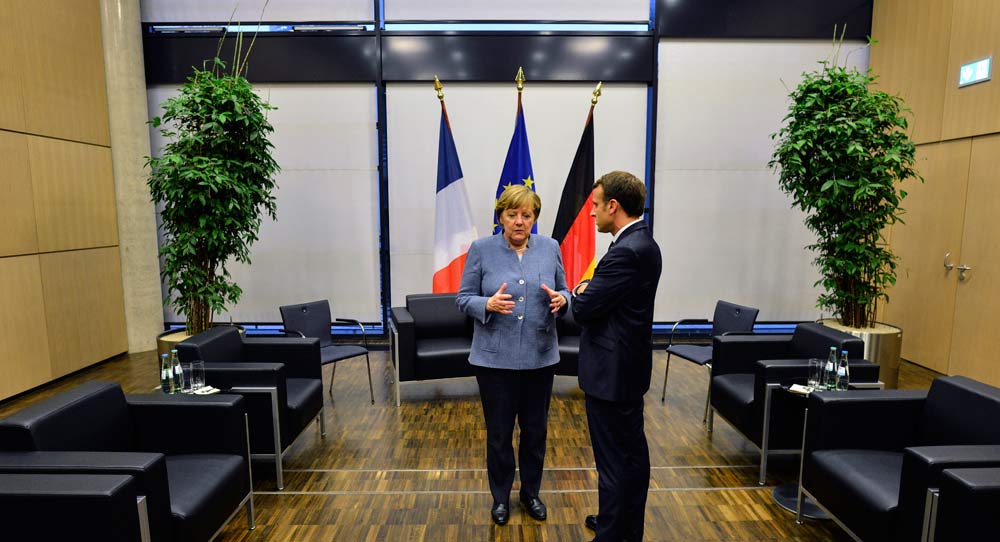
In his speech at the Sorbonne, French President Emmanuel Macron set out an ambitious vision for the future of the EU with proposals for just about every aspect of European integration ranging from carbon to culture. But he had nothing to say about making European diplomacy more effective. This attitude is typical of leaders of bigger EU member states. They take great pride in their country’s international role and see the EU at best as a forum to promote national initiatives. German Chancellor Angela Merkel, however, doesn’t seem to agree. She recently said that forging a coherent foreign policy was the biggest challenge facing the EU.
And Merkel is right, of course, because ten years after the signing of the Lisbon Treaty, EU foreign policy remains underdeveloped. The reforms of this treaty have brought some progress, but the upgrades could not keep up with the rapid deterioration of the regional security environment. The EU has responded to rising challenges mainly by lowering ambitions and by shifting toward realpolitik. The over-optimistic promises to transform the neighborhood in its own image have been corrected. The new emphasis in policy documents is on stability and resilience, and efforts to strengthen military capabilities have gained momentum. But progress on the “hardware” of defense needs to go hand in hand with upgrading the “software” of diplomacy. And in this regard, EU foreign policy has not been up to scratch.
This is not the fault of the EU institutions, though cooperation between the commission, the high representative, and the president of the European Council could be improved. The main problem lies with the member states. They remain in charge of the common policy and run their own national policy in parallel. On any given day, there is only so much common foreign policy that all member states happen to agree on. Divisions over solidarity, free riding, passivity, and fragmented leadership have severely hampered effective external action. As a result, EU influence in its neighborhood and on the global level has declined.
And this will probably continue. Given the inevitable long-term redistribution of economic and political weight away from Europe, individual member states, including the larger ones, will find it increasingly difficult to protect their interests on their own. According to recent analysis, no EU country will be in the G7 by 2050. Acting in isolation, EU countries risk being marginalized in the international arena over the coming decades. Only by joining forces, sharing assets, and engaging in effective collective action can Europeans hope to influence the regional and global decisions that will determine their future.
It is unlikely that EU foreign policy can be saved through institutional fixes. European Commission President Jean-Claude Juncker recently proposed qualified majority voting for foreign policy decisions. This would certainly remove a big obstacle to the EU’s effectiveness, but it is unlikely to happen. By accepting majority voting, member states would effectively subordinate their own national foreign policy to that of the EU, and few seem ready to do that.
Unlike a common currency, a common foreign policy cannot be introduced through timelines and objective criteria. Institutional arrangements matter, but the real key to overcoming the EU’s weakness in this area lies in strengthening mutual confidence and solidarity through a process of shared practical experience.
The EU’s foreign policy muscle will therefore only get stronger if it gets more exercise. Stepping up the level of activity through increased diplomatic and operational engagement is the best way to become more effective. Whether this concerns converting the EU’s capacity for reconstructing Syria into a political role, launching a major diplomatic and operational initiative to stabilize Libya, or replacing the deadlocked Minsk talks with a new diplomatic process on Ukraine, there are plenty of opportunities for greater EU engagement.
For good reasons, the EU remains strongly committed to rules-based cooperative structures in areas ranging from trade to climate change to nonproliferation to migration management. This has become an uphill struggle in the era of Putin and Trump. Fortunately, there are many other stakeholders in a functioning multilateral order, including Australia, Canada and Japan, but also—on some issues—India and China. They all see in Europe a crucial ally, because the EU is uniquely positioned to build and lead alliances for global governance.
Taking on these challenges in neighboring regions and on the global level will require a step-change in EU foreign policy. It can no longer be a sideshow of European integration but must turn into one of its central concerns. When EU leaders get together to discuss the future of the EU, strengthening its foreign policy should be high on their agenda.
For in-depth analysis on how Europe can step up its soft power, read Stefan Lehne’s latest paper, “Is There Hope for EU Foreign Policy?”

Senior Fellow, Carnegie Europe
Stefan Lehne is a senior fellow at Carnegie Europe in Brussels, where his research focuses on the post–Lisbon Treaty development of the European Union’s foreign policy, with a specific focus on relations between the EU and member states.
Recent Work
Stefan Lehne
Stefan Lehne
Carnegie does not take institutional positions on public policy issues; the views represented herein are those of the author(s) and do not necessarily reflect the views of Carnegie, its staff, or its trustees.
Europe isn’t as weak in the new geopolitics of power as many would believe. But to leverage its assets and claim a sphere of influence, Brussels must stop undercutting itself.

Dimitar Bechev
Europe’s reaction to the war in Iran has been disunited and meek, a far cry from its previously leading role in diplomacy with Tehran. To avoid being condemned to the sidelines while escalation continues, Brussels needs to stand up for international law.

Pierre Vimont
France and Germany’s failure to agree on the Future Combat Air System (FCAS) raises questions about European defense. Amid industrial rivalries and competing strategic cultures, what does the future of European military industrial projects look like?

Rym Momtaz, ed.
France has stopped clinging to notions of being a great power and is embracing the middle power moment. But Emmanuel Macron has his work cut out if he is to secure his country’s global standing before his term in office ends.
Rym Momtaz
Integrating AI into the workplace will increase job insecurity, fundamentally reshaping labor markets. To anticipate and manage this transition, the EU must build public trust, provide training infrastructures, and establish social protections.
Amanda Coakley