

Commentary
The aftermath of the Ceuta crisis shows Europe has drawn the wrong lessons. Rather than doubling down on failed migration policies, the EU needs to address the underlying roots of such episodes.
Richard Youngs
{
  "authors": [
    "Marc Bentinck"
  ],
  "type": "commentary",
  "blog": "Strategic Europe",
  "centerAffiliationAll": "",
  "centers": [
    "Carnegie Endowment for International Peace",
    "Carnegie Europe"
  ],
  "collections": [
    "Transatlantic Cooperation"
  ],
  "englishNewsletterAll": "",
  "nonEnglishNewsletterAll": "",
  "primaryCenter": "Carnegie Endowment for International Peace",
  "programAffiliation": "",
  "programs": [],
  "projects": [],
  "regions": [
    "Western Europe",
    "Europe"
  ],
  "topics": [
    "Security",
    "Military",
    "Foreign Policy",
    "EU"
  ]
}
Source: Getty
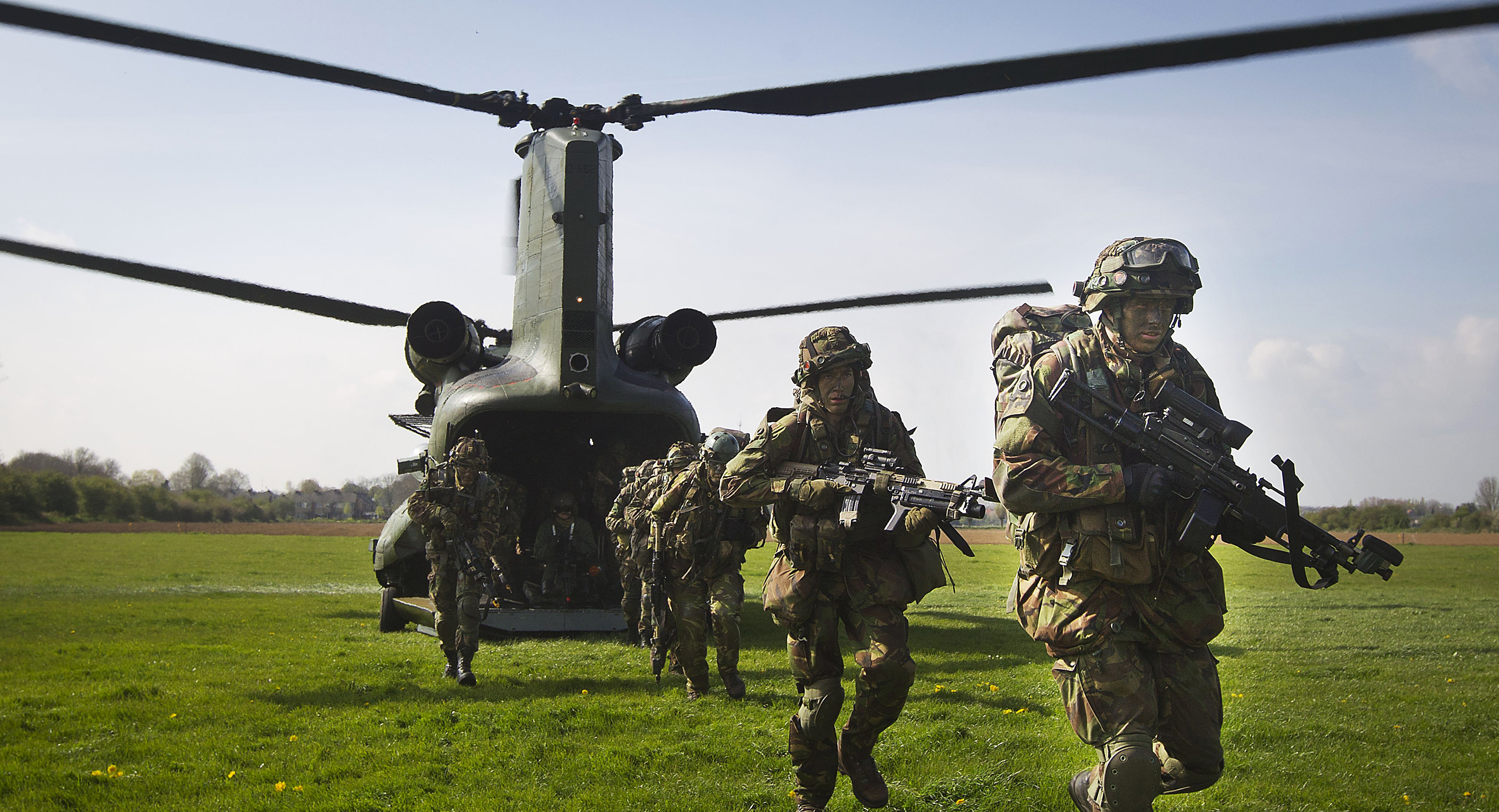
Years of spending cuts have left the Dutch armed forces unable to meet even NATO’s Article 5 commitments.
Amid all the hype about European defense, what’s happening back in the member states is sometimes forgotten. After all, they have to adopt defense budgets, procure military equipment, and send troops into combat.
Take the case of the Netherlands. Its previous defense minister had to concede in 2015 that the Dutch armed forces were not fully up to their Article 5 defense tasks. The Netherlands, by the way, was not alone.
Like other European militaries, the Dutch armed forces emerged diminished from the “peace dividend” era of the immediate post-Cold War years. Its active troop strength shrank from over 105,000 in 1989 to a mere 36,500 in 2016. Today they would be unable to simultaneously field a provincial reconstruction team in southern Afghanistan and deploy another 1,300 troops elsewhere in the world, as they did between 2006 and 2010. Such is the legacy of the peace dividend.
Since the early 1990s, the military has been a sitting duck for successive Dutch governments seeking to trim public finances. When dealing with the defense budget, The Hague studiously avoided taking into account the mounting evidence of a deteriorating security environment. Instead, it had a standard policy based on defense cuts.
A reappraisal finally came in 2016, when Mark Rutte’s second government (at the time) belatedly announced an incremental rise in spending. Rutte’s third government, which took office in October 2017, now seems to have bitten the bullet. It is planning to spend up to €1.5 billion per year on defense.
The extra money, however, will remedy only the worst shortcomings, such as readiness, firepower, and sustainability. It will not bring the Dutch defense effort—which was a mere 1.17 percent of GDP in 2016—in line with the European NATO average of 1.46 percent of GDP. And it falls far short of meeting the 2 percent of GDP spending goal agreed within NATO—an objective that the economically buoyant Dutch is expected to reach. Deliberately punching below one’s weight does entail political costs.
Ironically, it is the extra defense monies that now bring into starker relief the need to prioritize the missions and capabilities of the Dutch armed forces. The level of ambition will be set out in a white paper expected to be released soon. That ambition is complicated by the size of the Netherlands. As both the smallest of the big countries and the biggest of the small countries, this dilemma has traditionally complicated Dutch foreign, security, and defense policy. Decisionmakers have been generally appearing unable and/or unwilling to choose between either dimension.
Yet the Dutch are approaching a moment of truth.
They have to balance a deeply engrained loyalty to NATO with their more recent European defense commitments and their constitutionally mandated “defense of the international legal order.”
In short, the Dutch armed forces find themselves in the unenviable position of having to juggle the demands of a resurgent collective (NATO) defense, expeditionary (EU) crisis management, and cooperative security with insufficient means.
The army is mainly affected by these demands. It has sought to preserve the three brigades that make up its main maneuver formations; at the same time, it has had to accept their hollowing out to meet the cuts imposed by successive governments.
The army has tried to reduce the pressure by seeking integration with the German Bundeswehr. In addition to the already existing joint Dutch-German army corps headquarters, two of the three Dutch brigades now form part of the German rapid reaction division and the German first armored division respectively.
And by helping to spearhead the 2013 German Framework Nations Concept (FNC) ahead of other smaller European countries, the Dutch pursued two related objectives: retaining and rebuilding the capabilities of their existing formations, and contributing to the strengthening of European defense within NATO through participation in multinational divisions geared to deterring Russia.
Embracing the FNC does, however, mean a rethink of national autonomy. Yet until the day that Europeans are ready to redefine at the EU level what is left of their sovereignty in defense matters, Dutch politicians—like most of their European counterparts—are likely to remain sensitive to the dependencies that the FNC inevitably entail. At least these “clusters” might be one way to pool precious resources.
But ultimately (given the political-military uncertainties that will result from Brexit), the traditionally Atlanticist Dutch may feel the need to hedge against altogether regimenting themselves into a tank-heavy, Article 5 configuration in Central Europe at the expense of smaller, mobile units designed for actual expeditionary combat in Africa and elsewhere. Somewhat ironically, supporters of the latter within Dutch political and military circles find themselves aligned with the French on that score. But that’s another story.
Marc Bentinck is an independent international security advisor and a former Dutch diplomat.
Marc Bentinck
Carnegie does not take institutional positions on public policy issues; the views represented herein are those of the author(s) and do not necessarily reflect the views of Carnegie, its staff, or its trustees.

The aftermath of the Ceuta crisis shows Europe has drawn the wrong lessons. Rather than doubling down on failed migration policies, the EU needs to address the underlying roots of such episodes.

Richard Youngs

An overwhelming victory by a far-right-wing party in a small state in eastern Germany will have major repercussions for Chancellor Friedrich Merz’s coalition.

Judy Dempsey

Canadian Prime Minister Mark Carney has twice inspired praise for standing up to U.S. President Donald Trump: at the 2026 World Economic Forum in Davos and on Canada-U.S. trade negotiations. Is Carney showing a third way better than the EU has in dealing with the Trump administration?

Rym Momtaz, ed.

The EU’s responses to two recent incidents expose the gulf between European perceptions and capabilities. Unless the union can bridge that gap, it will never become a real geostrategic power.
Rym Momtaz

In supporting Europe’s far-right, MAGA and Russia both want the same thing: a weaker EU. Europe must defend itself without abandoning the openness these forces exploit.

Armida van Rij