

Paper
Erik Brattberg, Tomáš Valášek
{
  "authors": [
    "Tomáš Valášek"
  ],
  "type": "commentary",
  "blog": "Strategic Europe",
  "centerAffiliationAll": "",
  "centers": [
    "Carnegie Endowment for International Peace",
    "Carnegie Europe"
  ],
  "collections": [
    "EU Integration and Enlargement"
  ],
  "englishNewsletterAll": "",
  "nonEnglishNewsletterAll": "",
  "primaryCenter": "Carnegie Europe",
  "programAffiliation": "",
  "programs": [],
  "projects": [],
  "regions": [
    "Europe",
    "Eastern Europe",
    "Western Europe"
  ],
  "topics": [
    "EU",
    "Democracy"
  ]
}
Source: Getty
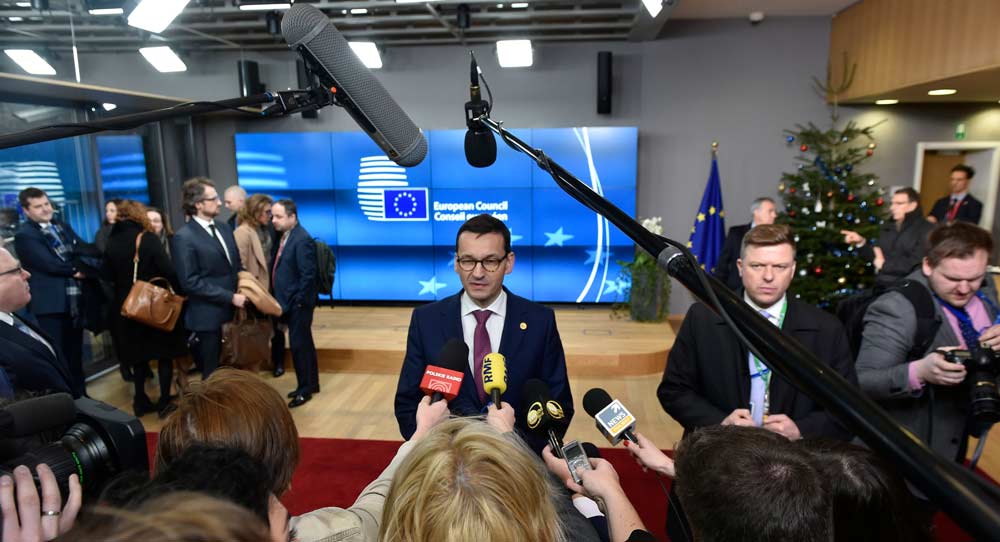
To protect the rule of law, the European Commission and EU member states need to change the way they talk to Poland.
Eternal vigilance is the price of liberty, but it is also the easy part. As the European Commission is finding out, the tricky bit is what comes next, after one spots rule-breaking. Having sensed foul play in the Polish government’s push for judicial reforms, the commission invoked Article 7 of the EU’s current treaty, which could strip Poland of its voting rights (Warsaw says the case is without merit).
But will censure work? Evidence suggests that messages being sent from the rest of the EU are not having the intended effect. If the goal is to protect the rule of law, a deeper reflection is required on how Polish voters view Brussels and vice versa.Let’s start with a simple observation: Article 7 is a means to an end. The intention is not for Poland to lose its voting rights (though things could, in theory, come to that). The actual objective is to give the Warsaw government reasons to alter course. For now, Poland has changed its rhetoric, but the substance of its decisions remains the same. Whether the government genuinely shifts approach depends on factors far beyond the Article 7 process. Do Polish officials—and voters—sense EU double standards? Do they suspect the European Commission of a hidden agenda? Do they believe they are getting a fair hearing?
Key to all this will be whether the Warsaw government feels that it has a majority of the people on board for whatever course it chooses. At present it does, and it is genuine support that cannot simply be attributed to closing media space. Polish voters’ view of “Brussels” is shaped by far more than the exchanges related to Article 7. Just as important are debates between the East and the West, both in the media and among officials, on migration, on abortion, on the right to work in other EU countries, and on double standards in food quality. These are bread-and-butter issues that command citizens’ hearts. It is entirely plausible that the European Commission and the rest of the EU could follow the treaty playbook to the letter yet lose the trust of Polish citizens—and with them, a chance to safeguard the rule of law—if the tone and substance of these other conversations, unrelated to Article 7, are misjudged.
A great majority of Poles continue to hold the EU in high regard, but not uncritically so. One of the subjects that grates is the tendency among liberals in Europe to conflate democracy with a values agenda. The necessary skepticism of Warsaw’s judicial reforms gets lumped together in parliamentary statements and tweets with criticism of the government’s plans to curtail abortion rights. What rankles here is the tacit assumption that the EU leaves little or no room for national differences on what is a sensitive issue in this conservative country—an issue, incidentally, that is not covered by the acquis, and where the practice among other EU member states varies greatly. Malta, for example, bans abortion under all circumstances.
The link between democracy and abortion does harm to the broader interest of safeguarding democracy. It unhelpfully blurs the line between facts (such as the power of ministers to sack judges) and values, which are assessed on a spectrum and change over time. The real risk is that a majority of Poles will see the link as overreach, and this will make it easier for the government in Warsaw to paint legitimate concerns about the rule of law as just another instance of Brussels not “getting” Poland and its traditions.
This, incidentally, is not an argument against the right to abortion. The point is that there are no shortcuts to it: Ireland and Portugal, other strongly Catholic countries, were given their own time on this issue, and so should Poland.
The East-West conversation is littered with similar examples of things said or unsaid outside the rule of law debates that make it difficult to have a sensible conversation on safeguarding democracy. Both sides are guilty: the Poles and the Hungarians, for example, tend to believe their own rhetoric on “victimization” by Western governments and corporations. They also have a way of packaging their often legitimate points on the rule of law or migration into anti-Brussels broadsides, which scores points at home but just about guarantees that the message will be ignored west of the border.
Over the next few weeks and months, Carnegie will map out a number of stereotypes that have plagued Europe’s East-West debates of late. This is not meant to be an academic exercise: proper rule of law is essential to the functioning of the European Union. If Poland and Hungary on the one hand, and the rest of the member states and institutions on the other, cannot have a sensible conversation about this, then the EU really is in trouble. Vigilance counts for little unless rule-breaking actually stops.
Former Director, Carnegie Europe
Valášek was director of Carnegie Europe and a senior fellow, where his research focused on security and defense, transatlantic relations, and Europe’s Eastern neighborhood.
Recent Work

Erik Brattberg, Tomáš Valášek
Tomáš Valášek
Carnegie does not take institutional positions on public policy issues; the views represented herein are those of the author(s) and do not necessarily reflect the views of Carnegie, its staff, or its trustees.

With its public finances in shambles, the far right polling at 35 percent ahead of the 2027 presidential election, and a growing protest movement, is France’s crisis a threat to the EU’s geopolitical awakening?

Rym Momtaz, ed.

Ahead of a tough winter for Ukraine, Donald Trump’s swing back toward Russia bodes ill. But instead of panicking, Kyiv’s European allies are focusing on action.
Rym Momtaz

While the EU and European governments are embracing the much-lauded middle-power moment, this entails three difficult conundrums.

Richard Youngs

Much has been said of the changes Brussels is trying to make to the EU enlargement process. Here’s why gradual integration might—or might not—be the answer.

Dimitar Bechev

The European Commissioner for Trade is headed to China. But after President Xi’s bridge-building visit to Washington, can a more isolated EU overcome Beijing’s stranglehold on critical raw materials? Who will blink first?
Rym Momtaz, ed.