

Commentary
Judy Dempsey
{
  "authors": [
    "Judy Dempsey"
  ],
  "type": "commentary",
  "blog": "Strategic Europe",
  "centerAffiliationAll": "",
  "centers": [
    "Carnegie Endowment for International Peace",
    "Carnegie Europe"
  ],
  "collections": [],
  "englishNewsletterAll": "",
  "nonEnglishNewsletterAll": "",
  "primaryCenter": "Carnegie Europe",
  "programAffiliation": "",
  "programs": [],
  "projects": [],
  "regions": [
    "Europe",
    "Western Europe"
  ],
  "topics": [
    "Foreign Policy",
    "EU"
  ]
}
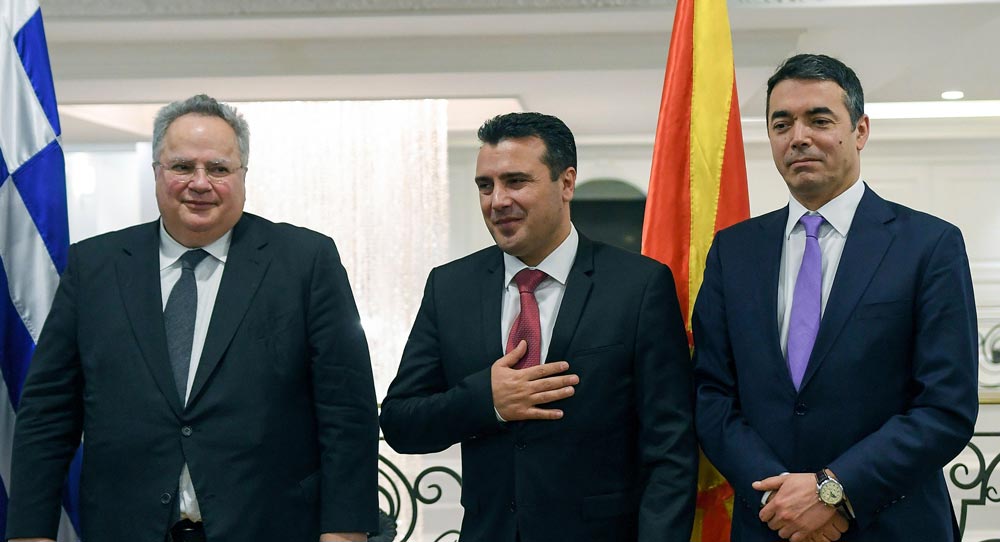
Source: Getty
Finally, the European Union is focusing on its neglected back garden.
It may not be big news for those unfamiliar with bitter disputes between neighbors. But earlier this month, Greek Foreign Minister Nikolaos Kotzias flew from Athens to Skopje, the capital of the Macedonia.
It is only a short distance that divides these two cities. But the journey had immense symbolic and political significance.This was the first time in 12 years that a Greek government delegation made the direct flight. It showed just how far the leaders of both countries have moved to end a dispute that has not only dogged bilateral relations. It has left a dangerous and glaring security vacuum in southern Europe.
Now, after so many failed attempts, Greece and Macedonia have a unique chance to change the strategic and political landscape of this part of the Western Balkans. It could pave the way for Macedonia to join NATO, leading to a seamless stretch of the alliance from Montenegro across to Turkey.
It has been a name that has plagued relations between Athens and Skopje for decades. Since the descent of the former Yugoslavia into civil war in 1991 and followed later by the EU's Western Balkans strategy—which now includes Albania, Bosnia-Herzegovina, Macedonia, Montenegro, Kosovo, and Serbia—Greece has never accepted that its neighbor be called “Macedonia.” Instead, it has been internationally referred to as “the Former Yugoslav Republic of Macedonia.”
Athens claimed the unqualified name of Macedonia, implied territorial claims on a region of the same name in Greece. The issue became so bitter that in 2008 that Greece—a member of both the EU and NATO— blocked Macedonia’s membership into NATO as well as the start of EU accession talks.
Since then, because of this uncertainty and lack of perspective, Macedonia has swung between reform and instability, facing nationalist tensions, corruption, and misrule. Last year, it pulled back from what could have turned into widespread violence after the former government was embroiled in a wiretapping scandal aimed at silencing the opposition and intimidating civil society.
Then, the EU was slow to react and understand the potential for instability that could spill over to other parts of the region.
But now, a pro-reform government led by Zoran Zaev has moved quickly to reach out to Athens in order to change his country’s narrative. Zaev, for example, changed the name of Skopje’s airport, which had been called after Alexander the Great. Other historical names and symbols that irked Greece have been removed as well. And the thorniest issue—the country’s name—could be resolved in the coming weeks.
“This is a very delicate phase of the process,” Nikola Dimitrov, Macedonia’s foreign minister said after holding talks with Kotzias. “We believe in an honest agreement that will benefit both sides and where there will be no winning and losing side but a compromise,” he added. “Greece desires a compromise,” Kotzias said.
Such language would have been unimaginable this time last year. Briefly, the compromise could consist of a new name for Macedonia that would be qualified geographically. It might be “Upper Macedonia.” Whether that new name, if agreed, should be included in the constitution or just used internationally is an open question. Furthermore, both Zaev and his Greek counterpart, Alexis Tsipras, have to sell any deal to their respective constituencies—particularly to nationalists.
Meanwhile, the EU is giving the region the perspective of joining the union by 2025.
No one is doubting the enormous challenge facing these countries. They are riddled with corruption and saddled with weak governance, poor education, and infrastructure neglect. But the fact that the EU’s new strategy for the Western Balkans has given 2025 “as a perspective” of membership is a boost to pro-European movements across this part of southern Europe.
Indeed, it just might help break the deadlock between Serbia and Kosovo with the help of deft diplomacy by Brussels. Belgrade is still not prepared to recognize Kosovo’s independence; neither is Cyprus, Greece, Romania, Slovakia, or Spain.
The EU’s shift of focus to the Western Balkans comes at a time when it faces increasing competition and influence in the region from Russia and China.
Yes, the EU is the Western Balkans’ biggest trading partner and provides substantial funding—nearly €10 billion since 2007. Neither Russia nor China can match these attractions, but they certainly can meddle in the media and academia.
According to Christopher Walker from the National Endowment for Democracy, these soft power efforts “should be seen as instruments of manipulation, distortion, and distraction that reflect the antidemocratic political systems of the authoritarian states that wield them.”
That is why the EU has to convince several skeptical member states why the Western Balkans needs to join the bloc.
The insidious attacks on the rule of law and media freedom in Poland and Hungary and the corruption and weak institutions in Bulgaria and Romania give enlargement a bad name. This is all the more reason that the upcoming EU-Western Balkans summit in Sofia on May 17, followed by a summit in London under the umbrella of the Berlin Process, home in on building strong institutions and civil society—and show China and Russia that the EU is in the Western Balkans and there to stay.

Nonresident Senior Fellow, Carnegie Europe
Dempsey is a nonresident senior fellow at Carnegie Europe
Recent Work
Judy Dempsey
Judy Dempsey
Carnegie does not take institutional positions on public policy issues; the views represented herein are those of the author(s) and do not necessarily reflect the views of Carnegie, its staff, or its trustees.
French President Emmanuel Macron has unveiled his country’s new nuclear doctrine. Are the changes he has made enough to reassure France’s European partners in the current geopolitical context?

Rym Momtaz, ed.
European reactions to the war in Iran have lost sight of wider political dynamics. The EU must position itself for the next phase of the crisis without giving up on its principles.

Richard Youngs
Europe isn’t as weak in the new geopolitics of power as many would believe. But to leverage its assets and claim a sphere of influence, Brussels must stop undercutting itself.

Dimitar Bechev
Europe’s reaction to the war in Iran has been disunited and meek, a far cry from its previously leading role in diplomacy with Tehran. To avoid being condemned to the sidelines while escalation continues, Brussels needs to stand up for international law.

Pierre Vimont
France and Germany’s failure to agree on the Future Combat Air System (FCAS) raises questions about European defense. Amid industrial rivalries and competing strategic cultures, what does the future of European military industrial projects look like?
Rym Momtaz, ed.