

Commentary
As we close out another season of Strategic Europe, it is worth taking stock of the deep shifts underway.
Rym Momtaz
{
  "authors": [
    "Dominik P. Jankowski"
  ],
  "type": "commentary",
  "blog": "Strategic Europe",
  "centerAffiliationAll": "",
  "centers": [
    "Carnegie Endowment for International Peace",
    "Carnegie Europe"
  ],
  "collections": [
    "Transatlantic Cooperation"
  ],
  "englishNewsletterAll": "",
  "nonEnglishNewsletterAll": "",
  "primaryCenter": "Carnegie Europe",
  "programAffiliation": "",
  "programs": [],
  "projects": [],
  "regions": [
    "Europe",
    "North America",
    "United States",
    "Western Europe"
  ],
  "topics": [
    "Security",
    "EU"
  ]
}
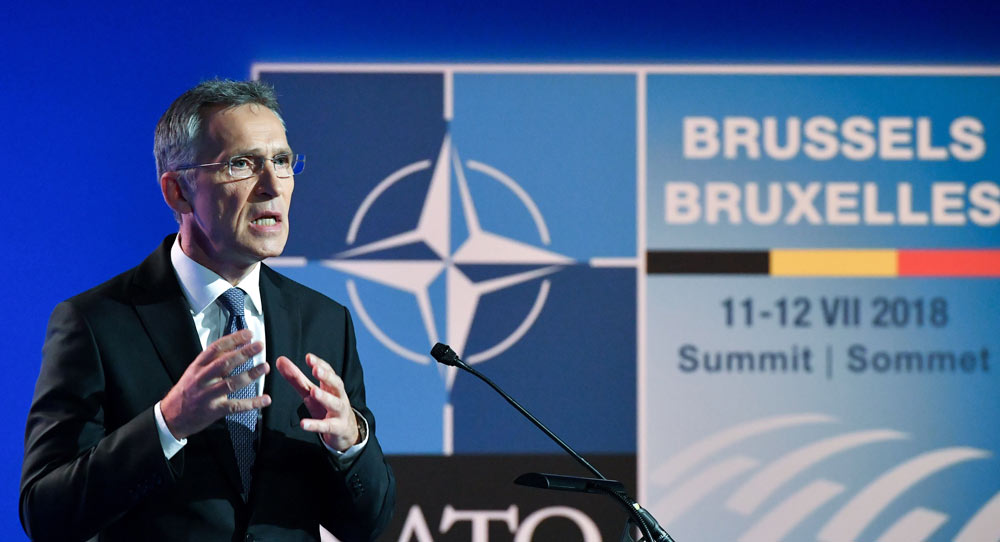
Source: Getty
Military substance has proven to be more important than fiery speeches and digital rhetoric. Let’s see if this NATO summit will prove it.
Carnegie Europe is on the ground at the 2018 NATO summit in Brussels, offering readers exclusive access to the high-level discussions as they unfold.
**
For months the 2018 NATO summit promised to be a typical meeting of heads of state and government. But in recent weeks a number of announcements from Washington have caused considerable nervousness among European allies. After the June G7 summit in La Malbaie and on the eve of the planned U.S.-Russia presidential meeting in Helsinki, there has been much media hype about the potential failure of the NATO summit in Brussels. Many claim that the biggest allied success will be to maintain coherence, unity, and solidarity. This is a difficult moment in the transatlantic relationship.
Yet, for at least two reasons one should be very cautious in predicting a failure of the NATO summit.
First, this is not a unique situation in NATO history; allies have had to overcome divisions before. In 1963, U.S. President John F. Kennedy concluded during a National Security Council meeting that the United States should look at the possibility that de Gaulle would make a deal with the Russians, break up NATO, and push the United States out of Europe. Three years later, France withdrew from NATO’s integrated military command structure. In 2003, the United States—together with a coalition of the willing—launched Operation Iraqi Freedom. This led to a major disagreement between the Unites States on one side and Germany and France on the other.
Second, the secret of a good NATO summit is to discuss old things in a new way or new things in an old way. This week’s meeting will not differ. In fact, it will offer military substance, which is the true glue of the alliance. On numerous occasions, this has proven to be more important than fiery speeches and digital rhetoric.
From the political and military perspective, the summit in Brussels has three core elements to address. NATO’s burden-sharing debate should be transformed into a commitment-sharing discussion. Spending 2 percent of GDP on defense by 2024—as agreed at the 2014 NATO summit in Wales—still holds and should be implemented by all allies. But beyond cash, there are capabilities and contributions to allied operations, missions, and exercises. There needs to be more discussion on what counts as defense spending, such as investing into dual-use transportation infrastructure (roads, railways) and hubs (harbors, airports) as elements of a wider defense-spending framework.
Then there is the challenge coming from the east. Since 2014, relations with Russia have deteriorated. Despite numerous attempts by allies, Russia has not halted its aggression against Ukraine, or become more transparent in its force posture and military maneuvers, or ceased its saber-rattling rhetoric, including regarding the potential use of nuclear weapons.
NATO-Russia Council meetings have not led to any practical de-escalation. On the contrary. In the last two years, Russia not only meddled into the electoral processes in the United States, France, Germany, and Spain, but also conducted a chemical weapon attack on a major NATO ally, the United Kingdom. Russia has continued to organize large-scale military exercises, including so-called snap drills, next to allied borders. Not surprisingly, Zapad-2017 turned out to be a 360-degree exercise during which Russia created three anti-access/area-denial bubbles—in the High North, the Kaliningrad Oblast, and Crimea—to limit NATO’s freedom of maneuver. There is no other way than to uphold the decisions from the NATO summit in Warsaw regarding a dual-track approach toward Russia, based on an ever stronger deterrence and defense posture and limited reciprocal dialogue.
Finally, allies need to address several military issues to ensure the credibility of NATO’s collective defense. NATO’s next stages of long-term adaptation should be based on six elements:
NATO’s traditional core business is preparing for large-scale conflict against a peer competitor. Yet, the peer competitor has adapted its own model to counter NATO’s past success. The key to survival of any business is ambidexterity, which can be defined as being able both to explore and exploit. The same logic could be successfully applied to NATO. The 2018 summit in Brussels offers the chance to do it—whatever President Donald Trump says.
Dominik P. Jankowski is the newly appointed political adviser and head of the Political Section at the Permanent Delegation of the Republic of Poland to NATO. The views and opinions expressed here are the author’s own and do not necessarily reflect the official positions of the institution he represents.

Dominik P. Jankowski
Carnegie does not take institutional positions on public policy issues; the views represented herein are those of the author(s) and do not necessarily reflect the views of Carnegie, its staff, or its trustees.

As we close out another season of Strategic Europe, it is worth taking stock of the deep shifts underway.

Rym Momtaz
The EU had to compromise to adopt a twenty-first sanctions package against Russia, exposing growing cracks in the union’s resolve. Is this latest, weaker round worth it to keep pressure on Moscow?
Rym Momtaz, ed.

Trump is distracted and Ukraine wants Europe to step up. The continent’s leaders must find their voice and assert it in talks with Russia.

Alissa de Carbonnel

Mounting economic strain and battlefield losses will not necessarily make the Kremlin less dangerous. They could instead push Moscow toward a more aggressive hybrid campaign designed to test NATO’s Eastern flank, exploit allied hesitation, and fracture European resolve.

Maksym Beznosiuk

Over the past ten years, NATO has held almost as many summits as it did during the entirety of the Cold War. Are they still useful, or is it time to stop holding annual meetings?
Rym Momtaz, ed.