

Commentary
Thomas de Waal
{
  "authors": [
    "Thomas de Waal"
  ],
  "type": "commentary",
  "blog": "Strategic Europe",
  "centerAffiliationAll": "",
  "centers": [
    "Carnegie Endowment for International Peace",
    "Carnegie Europe",
    "Carnegie Russia Eurasia Center"
  ],
  "collections": [
    "Europe’s Eastern Neighborhood"
  ],
  "englishNewsletterAll": "",
  "nonEnglishNewsletterAll": "",
  "primaryCenter": "Carnegie Europe",
  "programAffiliation": "",
  "programs": [],
  "projects": [],
  "regions": [
    "Europe",
    "Eastern Europe",
    "Ukraine"
  ],
  "topics": []
}
Source: Getty
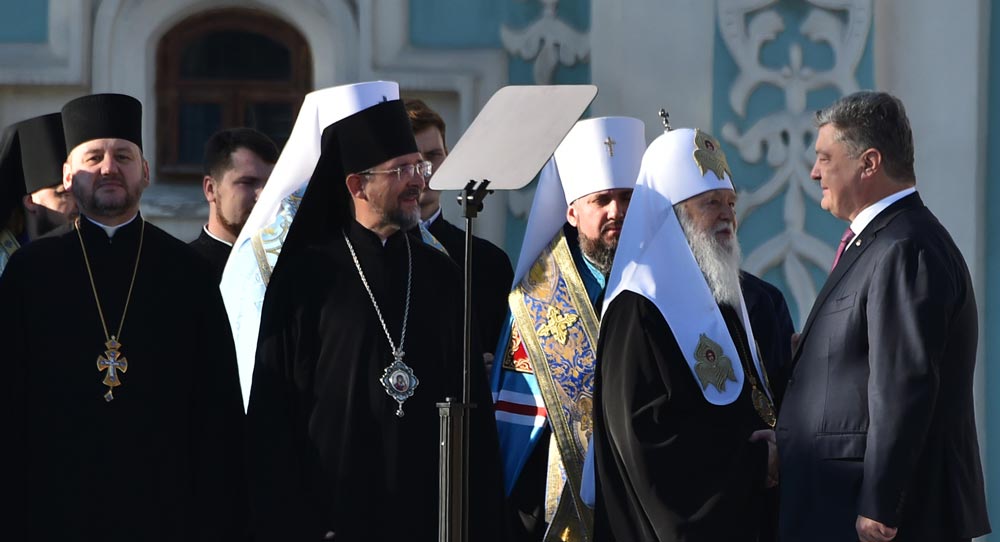
President Poroshenko hopes to win votes from the issue of church autonomy. But it is a risky strategy, and some commentators are warning about potential violence.
The story of the emergence of an independent, recognized Ukrainian Orthodox Church has been cloaked in impenetrable ecclesiastical language and talk of the Byzantine Empire. We hear about the “Tomos” (decree) issued by the Ecumenical Patriarch of Constantinople earlier this month recognizing Ukraine’s “autocephalous” (independent) church.
If you are short of time, don’t worry about Byzantium. This is all about contemporary politics. Though hardly an unexpected move, it is also a risky one. There are some 12,000 churches in Ukraine that could become a new Russian-Ukrainian battleground.
For more than 300 years, the church in Ukraine has been part of the Moscow Patriarchate of the Russian Orthodox Church. After independence in 1991, Ukraine could have followed the route taken by many other East European nations and announced the formation of an autocephalous church, such as that of Bulgaria or Romania.Indeed, if in the early 1990s the Russian church had declared it would accept Ukrainian autocephaly, nothing much might have happened, and it could all have been managed peacefully. After all, Ukraine’s new church will have the same doctrine and quite possibly the same language as the Russian church.
Why is it happening now? The split is obviously one more consequence of the Russian-Ukrainian conflict that began in 2014. Ukrainian President Petro Poroshenko, who initiated the move, openly says it is a matter of national security and “global geopolitics,” likening it to Ukraine’s ambition to join NATO and the EU.
Poroshenko should have added “electoral politics” to the list. He is running for reelection in a presidential vote due to be held next spring and has abysmal poll ratings. Poroshenko, who ran for the presidency in 2014 as a businessman and reformer, now wants to rebrand himself as the father of the nation and is employing the super-patriotic triple slogan of “Army, Faith, Religion” in his campaign. Forcing the church issue onto the agenda now will certainly win him some votes, but at what cost?
Having been in both Kyiv and Moscow in the last six weeks, I saw that the church split was the major topic of discussion.
Russian officials are saying less—it was noted that President Vladimir Putin did not mention the topic at all in his speech at the Valdai Forum. The words the Russians have uttered have been menacing nonetheless. Kremlin spokesman Dmitry Peskov said, “[J]ust as Russia defends the interests of Russians and Russian speakers— and Putin has spoken about this many times—Russia will defend the interests of the Orthodox.”
Some Russian commentators have criticized the Russian church for being inflexible and unable to compromise, especially with the Patriarch of Constantinople. One newspaper commentator said that the “leaders of the Russian Orthodox Church have managed to knock a few more nails into the coffin of Orthodox unity.”
But the Russian side does not need to do much. All the action henceforth will take place in Ukraine itself, and violence can be blamed on Ukrainian politicians and their backers. “If a single drop of blood is shed in Ukraine, then the guilt and responsibility for that drop of blood will be entirely on Constantinople Patriarch Bartholomew,” said the spokesman for the Russian Orthodox Church.
The Moscow Patriarchate still has millions of adherents in Ukraine (including until very recently President Poroshenko). It is the default mother church of many who also regard themselves as Ukrainian citizens. It has, however, has lost standing since the conflict with Russia began in 2014. Stories of priests refusing to bury Ukrainian soldiers killed in the Donbass conflict have angered the general public.
The new autocephalous church will only be able credibly to call itself Ukraine’s national church if it can persuade thousands of priests currently loyal to the Moscow Patriarchate to defect, along with their parishioners and churches.
This is where it could get ugly. It is rare for an academic to sound more alarmist than journalists, but Ukrainian scholar Vsevolod Samokhvalov has been warning of the dangers of a religious conflict for long before the wider world got interested.
In a paper published in February, Samokhvalov declared, “Even though ecclesiastical elites on both sides may not be as radical and conflict-prone as it might seem, it is possible that the situation on the ground can provoke violence and spark yet another conflict, which would be truly intra-Ukrainian and with a highly pronounced religious dimension. Unlike to war in Donbas, this type of conflict would be far less manageable and amenable to rational bargaining and negotiations. It can lead to a fragmentation of political space, the rise of radical far-right conservative politics and largescale violence and chaos.”
There are groups of muscular young men who are prepared to fight for both churches, including many veterans from the Donbas conflict who have been marginalized in the last couple of years. There are hundreds of potential flashpoints, from villages and towns in eastern Ukraine, where the Moscow Patriarchate is especially strong, to Kyiv’s most sacred monastery, the Lavra, half of which is owned by the Moscow church and the other half by the Ukrainian state.
As Samokhvalov notes, there was already one clash in February, when hundreds of protestors demanded that a newly-built church of the Moscow Patriarchate in Kyiv be removed from the museum site where it is located. The police had to intervene to stop a fire being lit.
Let us hope that conflict on the ground can be avoided and this remains only a war of words. But religious politics are now another reason to be worried about what 2019 will bring in Ukraine.

Senior Fellow, Carnegie Europe
De Waal is a senior fellow at Carnegie Europe, specializing in Eastern Europe and the Caucasus.
Recent Work
Thomas de Waal
Thomas de Waal, ed.
Carnegie does not take institutional positions on public policy issues; the views represented herein are those of the author(s) and do not necessarily reflect the views of Carnegie, its staff, or its trustees.
French President Emmanuel Macron has unveiled his country’s new nuclear doctrine. Are the changes he has made enough to reassure France’s European partners in the current geopolitical context?

Rym Momtaz, ed.
European reactions to the war in Iran have lost sight of wider political dynamics. The EU must position itself for the next phase of the crisis without giving up on its principles.

Richard Youngs
Europe isn’t as weak in the new geopolitics of power as many would believe. But to leverage its assets and claim a sphere of influence, Brussels must stop undercutting itself.

Dimitar Bechev
Europe’s reaction to the war in Iran has been disunited and meek, a far cry from its previously leading role in diplomacy with Tehran. To avoid being condemned to the sidelines while escalation continues, Brussels needs to stand up for international law.

Pierre Vimont
France and Germany’s failure to agree on the Future Combat Air System (FCAS) raises questions about European defense. Amid industrial rivalries and competing strategic cultures, what does the future of European military industrial projects look like?
Rym Momtaz, ed.