

Commentary
Judy Dempsey
{
  "authors": [
    "Judy Dempsey"
  ],
  "type": "commentary",
  "blog": "Strategic Europe",
  "centerAffiliationAll": "",
  "centers": [
    "Carnegie Endowment for International Peace",
    "Carnegie Europe"
  ],
  "collections": [
    "Transatlantic Cooperation"
  ],
  "englishNewsletterAll": "",
  "nonEnglishNewsletterAll": "",
  "primaryCenter": "Carnegie Europe",
  "programAffiliation": "",
  "programs": [],
  "projects": [],
  "regions": [
    "Europe",
    "North America",
    "Western Europe"
  ],
  "topics": [
    "Security"
  ]
}
Source: Getty
The differences between NATO allies seem to be about intentions, outcomes, and the meaning of values.
Carnegie Europe is on the ground at the 2019 Munich Security Conference, offering readers exclusive access to the debates as they unfold and providing insights on today’s immense threats to international peace and stability.
***
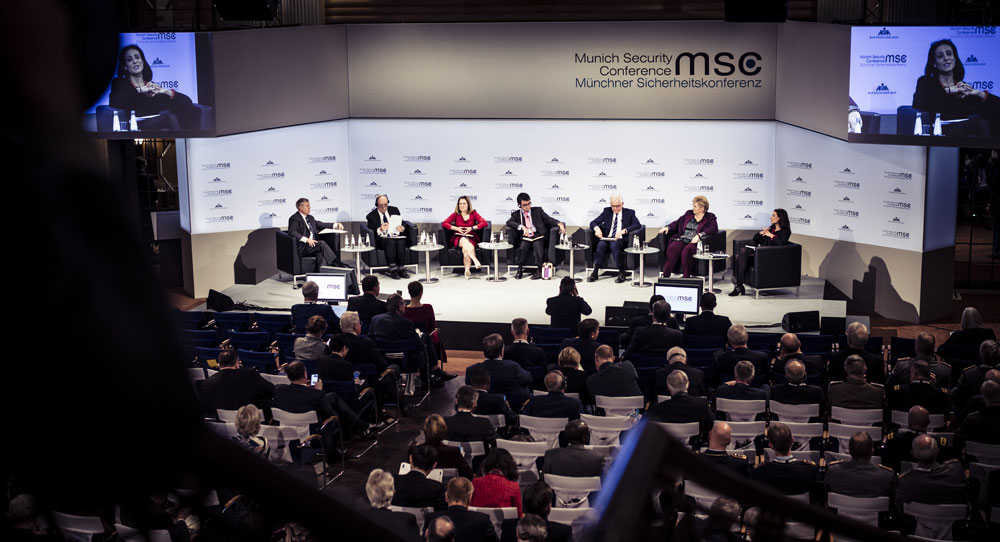
“Shared values are the core of this discussion,” so said Nathalie Tocci.
Tocci, director of the Istituto Affari Internazionali in Rome and special advisor to the EU’s Foreign Policy Chief Federica Mogherini, had the formable task of moderating a high-powered panel supposed to focus on defense cooperation.
The panel included the foreign ministers of Poland, France, Canada, and Japan, and the prime minister of Norway; and from the U.S. side, Senator Lindsey O. Graham. No stranger to the Munich Security Conference, Graham is known for his plain speaking and having President Donald Trump’s ear—as much as that is possible.
The panel picked up some of the messages that the German defense minister, Ursula von der Leyen, and her British counterpart, Gavin Williamson, had given in their presentations that opened the first session.
Surprisingly, von der Leyen, a strong Atlanticist, said that NATO was not just about burden sharing. It was about “upholding fairness in transatlantic relations” and also “taking decisions together.” In plain speak, it was a jab at the Trump administration. Essentially von der Leyen was saying that if you, the United States, pull out your troops from Syria and Afghanistan, couldn’t you at least consult with us since we are allies in these coalitions?
That criticism aside, von der Leyen and Williamson had fulsome praise for NATO, how important that interests and values coincided, and how both countries were spending on defense.
Naturally, spending on defense was one of the subjects of Tocci’s panel.
But it wasn’t so much about the allies meeting the 2 percent of GDP defense spending target, which has become the mantra inside NATO. It was about the value of defense.
Canada’s foreign minister Chrystia Freeland, weighted into the necessity of democracies to defend their values inside and outside the NATO alliance. But it was also about securing prosperity for her country’s citizens. “Security is about prosperity,” she said. In a broader NATO context, she added that “we could not be secure if Europe is not secure.” NATO is Europe’s security guarantor.
That’s what Polish Foreign Minister Jacek Czaputowicz wanted to hear. He didn’t have much truck for the European “strategic autonomy” buzzword. Poles are desperately afraid that this would lead to a Europe decoupled from NATO. “We need synergies not overlaps. When we use the term strategic autonomy, it might suggest something more,” Czaputowicz said.
So when Tocci asked French Foreign Minister Jean-Yves Le Drian to explain strategic autonomy because it was “such a fuzzy word,” Le Drian was dry in his response. “It’s not fuzzy.” It did not mean, he said, a European defense architecture that would compete or be independent of NATO. He said that debate was long over. He knows Europe isn’t up to going it alone even if there was political support for it.
But the debate about values was far from over. In fact, it was fascinating to see the unfolding of two very different views of this world. The European ministers and Canada placed great store on values. And Graham, well, he told the audience what values meant for Trump.
“I don’t care if the European defense force exists as along as it increases capability. If PESCO makes you more interoperable…count me in. I’ve always been an outcome guy. I don’t care how we get there, as long as we get there.” As for the U.S. decision to pull out of the Iran nuclear deal, “it was not a good deal.” And for pulling out of the Intermediate-Range Nuclear Forces Treaty, “the INF is not a very good deal. China is not in it. And it’s not a good deal when Russia cheats. They are not producing values.”
So while the Europeans and Canadians focus on values that are anchored in democracy, the rule of law, tolerance, and an independent media, the Trump administration sees values as transactional. You sign up and you stick to the agreement. If not, then, as Graham said, the president would, with leverage, try and go for a better deal. If not…?
As NATO allies went back and forth, Japan’s Foreign Minister Tarō Kōno praised Trump’s policies on North Korea. As for NATO, it was revealing what he said: “Japan, Europe, and other likeminded countries should increase burden sharing.” Japan, even more than the United States, fears the ineluctable rise of China and the fear of instability in North Korea.
By the way, whether it’s just for the MSC audience or not, Graham signed off by saying that he told the President that “the best investment in American foreign policy has been NATO.” So now we know.
Image source: MSC / Kuhlmann

Nonresident Senior Fellow, Carnegie Europe
Dempsey is a nonresident senior fellow at Carnegie Europe
Recent Work
Judy Dempsey
Judy Dempsey
Carnegie does not take institutional positions on public policy issues; the views represented herein are those of the author(s) and do not necessarily reflect the views of Carnegie, its staff, or its trustees.
The far right failed to win big in France’s municipal elections. But that’s not good news for the country’s left wing, which remained disunited while the broader right consolidated its momentum ahead of the 2027 presidential race.
Catherine Fieschi
Donald Trump has demanded that European allies send ships to the Strait of Hormuz while his war of choice in Iran rages on. He has constantly berated NATO while the alliance’s secretary-general has emphatically supported him.

Rym Momtaz, ed.
The EU is structurally incapable of reacting to today’s foreign policy crises. The union must fold the EEAS into the European Commission and create a security council better prepared to take action on the global stage.

Stefan Lehne
The war in Ukraine is costing Russia its leverage overseas. Across the South Caucasus and Middle East, this presents an opportunity for Europe to pick up the pieces and claim its own sphere of influence.

William Dixon, Maksym Beznosiuk
The war in Iran proves the United States is now a destabilizing actor for Europe and the Arab Gulf. From protect their economies and energy supplies to safeguarding their territorial integrity, both regions have much to gain from forming a new kind of partnership together.
Rym Momtaz