

Commentary
Judy Dempsey
{
  "authors": [
    "Judy Dempsey"
  ],
  "type": "commentary",
  "blog": "Strategic Europe",
  "centerAffiliationAll": "",
  "centers": [
    "Carnegie Endowment for International Peace",
    "Carnegie Europe"
  ],
  "collections": [],
  "englishNewsletterAll": "",
  "nonEnglishNewsletterAll": "",
  "primaryCenter": "Carnegie Europe",
  "programAffiliation": "",
  "programs": [],
  "projects": [],
  "regions": [
    "Europe",
    "Western Europe",
    "France"
  ],
  "topics": [
    "EU"
  ]
}
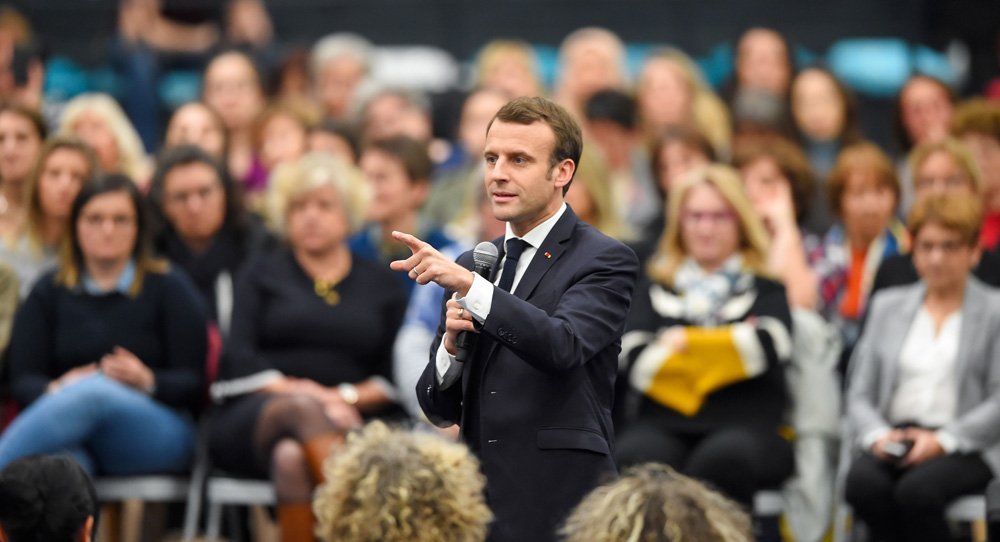
Source: Getty
The outcome of the European Parliament elections will be decisive for the EU’s future.
Emmanuel Macron has given several big speeches since become president nearly two years ago. They have homed in on two major issues: Europe’s future and how that future will be influenced by France and Germany working together.
His latest speech—it’s in fact an opinion piece published in several newspapers across the EU addressing the citizens of Europe—makes no mention of Germany or that special relationship, which over the years had driven the European project. It’s as if Macron has lost any hope in Chancellor Angela Merkel helping him pull Europe out of its deep malaise and lack of self-confidence.
Instead, without mincing his words, Macron spells out the danger of Brexit, the danger of scare mongers, and the danger of fake news that “promises anything and everything.” For Macron, Brexit symbolizes the crisis of Europe. “Never, since the Second World War, has Europe been as essential,” he said. “Yet never has Europe been in so much danger.”This danger is the trap of the status quo and resignation. This sense of malaise has allowed nationalists to sow divisions and encourage isolation. Macron doesn’t pull his punches about the Brexit trap. “The trap is in the lie and irresponsibility that can destroy [the European Union],” he said. “Who told the British people the truth about their post-Brexit future?” Macron asks rhetorically. He might as well have asked which EU leader apart from him recognizes the fragility of the European project and the need to fix it.
And because Europe is so fragile and may become even more so after the European Parliament elections, Macron has proposed a “renewal” of the bloc in three ways: defending its freedom, protecting the continent, and moving the EU much more toward convergence.
He has no doubt about how the European model of democratic freedom is being undermined by foreign powers who “seek to influence our vote at each election.” Macron proposes a European Agency for the Protection of Democracies (another agency) that will provide each member state with experts to protect their election process against cyberattacks and manipulation. In addition, funding of political parties by foreign powers should be banned. There should also be rules to ban on the internet all incitements to hate and violence.
Macron also proposes reforming the Schengen area. He’s right to say that citizens need to feel they are protected and safe. With a swipe at countries such as Hungary that are part of Schengen but have their own rules about how it functions, Macron wants stricter border controls, solidarity that entails one asylum policy with the same acceptance and refusal rules, and a common border force along with a European asylum office (yet another agency). Finally, without going into detail, Macron wants a European Council for Internal Security.
Linked to this is his call for a treaty on defense and security that would define the EU’s obligations with NATO. Macron proposes a “truly operational mutual defense clause” (in order words, the equivalent of NATO’s Article 5). And along with the European Security Council, he wants the UK on board to prepared collective decisions. No mention of a European army this time round.
He also links security and borders to fair competition. With China in mind, he asks “what power in the world would accept continued trade with those who respect none of the rules?” Macron proposes a reform of the EU’s competition policy. For him, this is about protecting Europe’s strategic industries. It is also about the EU rethinking its merger policy, something that Paris and Berlin have lobbied for as recently shown by the failed attempts by both France and Germany to merge Alstom’s and Siemens’ rail operations.
On social rights, Macron proposes a “social shield” for all workers, guaranteeing the same pay in the same workplace and a minimum wage appropriate to each country and discussed collectively every year.
To cap it all, by the end of 2019, the French president wants a Conference for Europe that would define “a roadmap” (that dreaded word) for the EU. Yes, he acknowledges, there will be disagreements. But Macron insists that it’s better to have a Europe that advances, sometimes at different speeds and that is open to all, rather than have a static Europe. Non-eurozone member states aren’t going to like that idea.
That aside, his hope is that the conference will be the impetus for a “renewed” Europe in which, he says, “the peoples will really take back control of their future. In this Europe, the United Kingdom, I am sure, will find its true place.” Watch this space.

Nonresident Senior Fellow, Carnegie Europe
Judy Dempsey is a nonresident senior fellow at Carnegie Europe
Recent Work
Judy Dempsey
Judy Dempsey
Carnegie does not take institutional positions on public policy issues; the views represented herein are those of the author(s) and do not necessarily reflect the views of Carnegie, its staff, or its trustees.

Are Germany’s economic, industrial, and political struggles becoming a liability for the EU’s ability to rise to the geopolitical moment?

Rym Momtaz, ed.

European Commission President Ursula von der Leyen is about to give her annual address on the state of the EU. Here’s what she won’t—but should—say.
Rym Momtaz

The aftermath of the Ceuta crisis shows Europe has drawn the wrong lessons. Rather than doubling down on failed migration policies, the EU needs to address the underlying roots of such episodes.

Richard Youngs

An overwhelming victory by a far-right-wing party in a small state in eastern Germany will have major repercussions for Chancellor Friedrich Merz’s coalition.
Judy Dempsey

Canadian Prime Minister Mark Carney has twice inspired praise for standing up to U.S. President Donald Trump: at the 2026 World Economic Forum in Davos and on Canada-U.S. trade negotiations. Is Carney showing a third way better than the EU has in dealing with the Trump administration?
Rym Momtaz, ed.