

Commentary
Gwendolyn Sasse
{
  "authors": [
    "Gwendolyn Sasse"
  ],
  "type": "commentary",
  "blog": "Strategic Europe",
  "centerAffiliationAll": "",
  "centers": [
    "Carnegie Endowment for International Peace",
    "Carnegie Europe"
  ],
  "collections": [
    "Europe’s Eastern Neighborhood"
  ],
  "englishNewsletterAll": "",
  "nonEnglishNewsletterAll": "",
  "primaryCenter": "Carnegie Europe",
  "programAffiliation": "",
  "programs": [],
  "projects": [],
  "regions": [
    "Europe",
    "Eastern Europe",
    "Ukraine"
  ],
  "topics": [
    "Democracy",
    "EU"
  ]
}
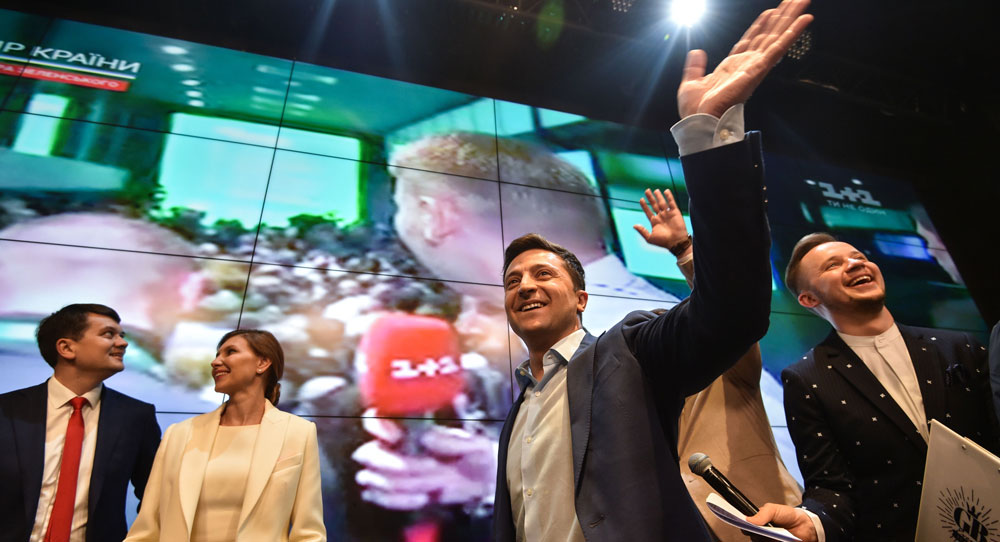
Source: Getty
The term “protest vote” does not really capture the full picture about the election result. It was a conscious vote against the incumbent and expressed hope for a new start in Ukrainian politics beyond identity cleavages.
On April 21, Volodymyr Zelenskiy won the second round of the Ukrainian presidential elections by a landslide. The official result has yet to be declared, but according to the near-final result, he won 73.2 percent of the vote, while the incumbent president, Petro Poroshenko, secured just 24.5 percent. Turnout was just over 62 percent, similar to the first round.
The main focus in international reporting about the Ukrainian presidential elections has been on the fact that a comedian without any political experience could and then did become president. His victory was preceded by an unconventional election campaign centered on his television series, public appearances that resembled stand-up shows, and social media messages—thereby keeping costs down and avoiding the need to formulate a clear program or answer tough questions by journalists. Even in the run-up to the second round, members of his team spoke more in public than the candidate himself.
A number of other facts, however, should not be overlooked when judging the election result.
Zelenskiy achieved the highest level of electoral support of any Ukrainian president since 1991—with the exception of the post-Maidan elections that saw Petro Poroshenko win outright in the first round of the elections with over 50 percent.
Moreover, these elections clearly broke with the usual regional divisions characterizing voting patterns in Ukraine. While his support was strongest in the southeast of the country, Zelenskiy won everywhere apart from the western region of Lviv.
Thus, there are two main messages from the elections. First, Ukrainians across the country chose to voice their disappointment with the Poroshenko presidency. The post-Maidan reform process had slowed down and had not delivered sufficient tangible benefits for the average voter. Corruption had been the main driver behind the Euromaidan protests against former President Viktor Yanukovych in late 2013 and now, once again, the issue of corruption became the critical measure to benchmark the government’s performance—this time the president was ousted at the ballot box.
Second, the broad support for Zelenskiy also reflects widespread discomfort with the securitization of Ukrainian domestic politics that had culminated in Poroshenko’s election slogan, “Army, Language, Faith.” Poroshenko’s response to the war in eastern Ukraine had been to define the Ukrainian nation in narrow ethnolinguistic terms. Language laws aimed at reducing schooling in minority languages (including Russian) and increasing Ukrainian language content in the media and public life proved out of sync with how the majority of Ukrainian citizens see themselves and their country.
Zelenskiy, aged 41, is a native Russian speaker who visibly struggles with Ukrainian when speaking in public. In his television series “Servant of the People,” Ukrainian is mostly spoken by corrupt bureaucrats and folklore ensembles. None of this affected the election result. There could not be a clearer proof that the language issue is not one that divides Ukrainian society.
Outside of Ukraine the reality of everyday bilingualism has often been misunderstood. Surveys that allow for mixed categories of language use have recorded the significance of bilingualism. A survey conducted in March 2019 by the Kiev International Institute of Sociology found that 32.4 percent of the population, not including Crimea and the non-government controlled areas in the Donbas region, speak only Ukrainian with their closest relatives, while 15.8 percent speak only Russian, and 25 percent speak Ukrainian and Russian equally. If varying degrees of bilingualism are included, i.e. those who speak “mostly” Ukrainian and “mostly“ Russian, bilingualism is part of everyday life for about 50 percent of the population—even without including language use in public.
Survey research has also documented a growing identification with the Ukrainian state in recent years. In particular from 2017 to 2018, the category “ethnic Ukrainian” was overtaken as the prime identity marker by the more inclusive category “Ukrainian citizen.”
Taken together, these data points put Zelenskiy’s defeat of Poroshenko in perspective. The term “protest vote” does not really capture the full picture. It was a conscious vote against the incumbent and expressed hope for a new start in Ukrainian politics beyond identity cleavages.
Now speculation abounds regarding the future outlook of Ukrainian politics. So far Zelenskiy’s team includes economic reformers, but it is light on expertise in foreign and security policy—one of the key policy domains the president can directly influence in Ukraine’s mixed constitutional system.
In the coming months, Zelenskiy has to define a working relationship with the Verkhovna Rada, Ukraine’s parliament, while building his own political party or movement in the run-up to the parliamentary elections in the autumn.
The real test of the Zelenskiy presidency comes after the parliamentary elections. The power balance between the president and parliament, ambivalently defined in the Ukrainian constitution, may well switch to a more balanced relationship or, indeed, to a greater de facto or de jure role for parliament.
Zelenskiy is a novelty in Ukrainian politics in more than one sense. For the moment, he has broken with traditional cleavages and the predominant official rhetoric. Whether he can turn this novelty effect and his broad support base into policies remains to be seen. Some European capitals that were secretly hoping for Poroshenko to be reelected to carry on with business as usual need to understand what the Zelenskiy victory really says about Ukrainian society.
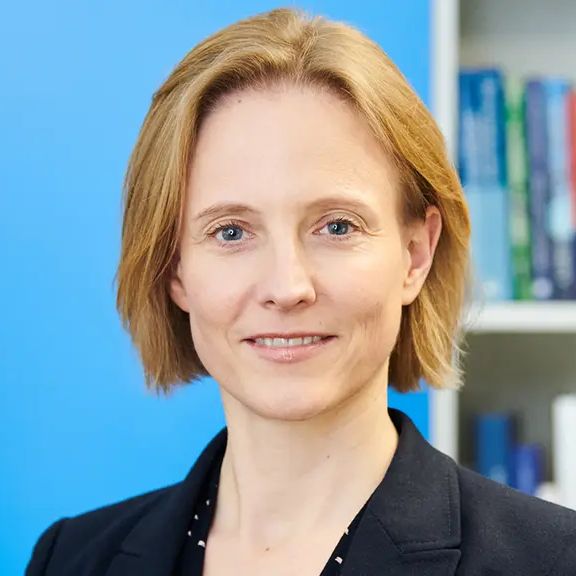
Gwendolyn Sasse is a non-resident senior fellow at Carnegie Europe and director of the Centre for East European and International Studies (ZOiS) in Berlin.
Nonresident Senior Fellow, Carnegie Europe
Gwendolyn Sasse is a nonresident senior fellow at Carnegie Europe. Her research focuses on Eastern Europe, with a particular focus on Ukrainian politics and society, EU enlargement, and comparative democratization.
Recent Work
Gwendolyn Sasse
Gwendolyn Sasse
Carnegie does not take institutional positions on public policy issues; the views represented herein are those of the author(s) and do not necessarily reflect the views of Carnegie, its staff, or its trustees.

The EU can impose sanctions but struggles to enforce them without the United States. With Washington increasingly disinterested in backing European interests, the bloc must now fend for itself.


Nicu Popescu, Tiago Antunes

Russia is testing the waters of NATO’s mutual defense clause. What do strikes in Romanian territorial waters mean for the alliance’s posture toward Moscow?

Dimitar Bechev

With its public finances in shambles, the far right polling at 35 percent ahead of the 2027 presidential election, and a growing protest movement, is France’s crisis a threat to the EU’s geopolitical awakening?

Rym Momtaz, ed.

Ahead of a tough winter for Ukraine, Donald Trump’s swing back toward Russia bodes ill. But instead of panicking, Kyiv’s European allies are focusing on action.
Rym Momtaz

While the EU and European governments are embracing the much-lauded middle-power moment, this entails three difficult conundrums.

Richard Youngs