

Commentary
Judy Dempsey
{
  "authors": [
    "Judy Dempsey"
  ],
  "type": "commentary",
  "blog": "Strategic Europe",
  "centerAffiliationAll": "",
  "centers": [
    "Carnegie Endowment for International Peace",
    "Carnegie Europe"
  ],
  "collections": [],
  "englishNewsletterAll": "",
  "nonEnglishNewsletterAll": "",
  "primaryCenter": "Carnegie Europe",
  "programAffiliation": "",
  "programs": [],
  "projects": [
    "Indian Ocean Initiative"
  ],
  "regions": [
    "Europe",
    "Western Europe",
    "France",
    "Asia"
  ],
  "topics": [
    "Security"
  ]
}
Source: Getty
As China asserts its growing military, political, and economic power, European countries should follow Paris’s lead by deepening ties with India and other democracies.
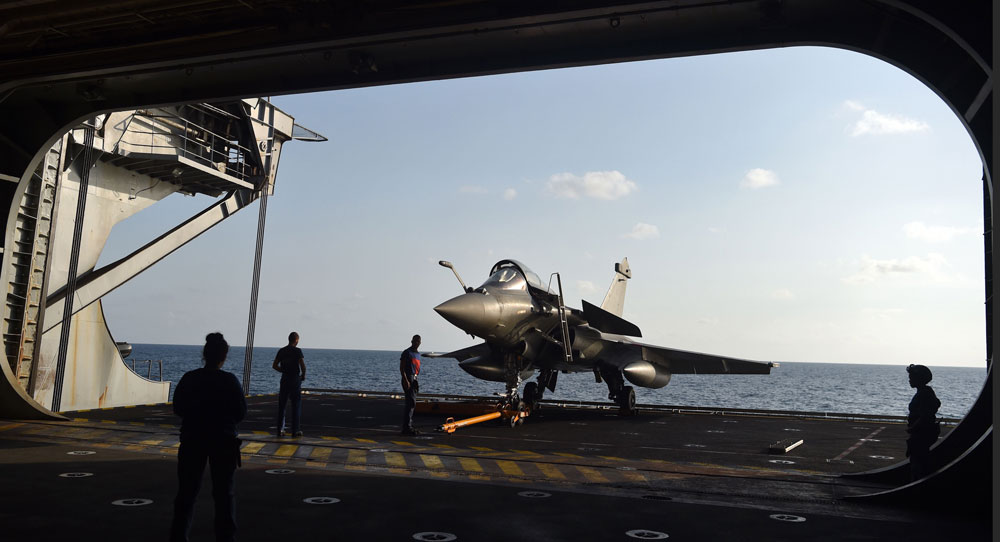
Sea lines of communication matter more and more to France. That’s one of the reasons why the country’s defense ministry has just wrapped up one of its biggest naval exercises with India. Led by the newly refitted aircraft carrier Charles de Gaulle, the exercises took place against the background of growing tension between Iran and the United States and an escalating trade war between Beijing and Washington.
The European Union and its big member states can only look on as the multilateral order takes a battering that could have a profound impact on stability and the global economy. As they do so, they lose sight of the bigger picture unfolding in the Indian Ocean: the increasing power of China and what the projection of that power means for the future security of global commerce and alliances.
France, however, has its eye firmly on the stability and importance of India in particular and the Indian Ocean in general. “We think we can bring more stability to a region that is strategic, that has huge stakes, notably for international trade,” said Rear Admiral Olivier Lebas, commander of the French fleet. Apart from China’s growing presence, France has also been preoccupied with nontraditional threats that include piracy, illegal fishing, and illegal migration.France’s military exercises with India began back in 2001. They have focused on civilian nuclear technology, space, counterterrorism, and defense. Such cooperation was partly linked to Paris’s presence in the Indian Ocean. The French overseas territories of Réunion and Mayotte are located in the southwest Indian Ocean. France also has a substantial military presence in Djibouti and the United Arab Emirates.
“In many ways, France’s presence in the Indian Ocean illustrates its ambition to be a middle power with global outreach,” argued Asia analyst Isabelle Saint-Mézard in a paper on French strategy in the Indian Ocean. The goal of these latest and biggest exercises with India—the seventeenth so far—is to enable India and France to work together militarily, or, as the French defense ministry stated, “to reinforce interoperability.”
There is also an underlying strategic aim. India and other countries in the region fear the growing economic, political, and military power of China. In fact, they are desperate for closer ties with with the EU and its big member states. Europe, if it had any strategic foresight, could exploit this situation at a time when India and other countries have serious doubts about U.S. President Donald Trump’s commitment to this part of the Indian Ocean region—and very few doubts about China’s global ambitions.
France understands the crucial importance of having allies in the Indian Ocean to protect strategic shipping lanes as well as the internet cables and other communication lines that run along the seabed. The global role of these sea lines of communication (SLOCs) should not be underestimated. Trade, especially between Europe, Asia, and the Middle East, relies on the security of the SLOCs. Any disruption to the movement of oil or goods across this part of the world would have a devastating impact on economies in the region and in Europe.
“The ties between India and France are becoming more important, especially for the security of the sea lines for international trade,” said François Heisbourg, senior adviser for Europe at the International Institute for Strategic Studies and special adviser at the Paris-based Foundation for Strategic Research.
India is not the only country on France’s radar. Over the past few years Paris has forged strategic partnerships with Australia and Japan, Indonesia and Vietnam, and has close military cooperation with Malaysia. As for Singapore, it has become “a partner of choice,” Saint-Mézard argued. It is, she added, “France’s second foreign partner in defence research and technology after the U.S.”
Yet where is Germany when it comes to protecting SLOCs, which are so important for the world’s third-largest economy? Berlin talks a great deal about partnerships, but its economic and trade ties with the countries in Southeast Asia and on the rim of the Indian Ocean lack any security content. Yes, Germany was involved in the EU’s antipiracy mission off the coast of Somalia and is working with France in Mali. But Berlin has provided no strategic input to its relations with India or Singapore, Japan or Australia.
Forging much closer political economic and security ties with these democracies or like-minded countries should be an opening for the Europeans to establish what Heisbourg termed “a new form of ad hoc multilateralism.”
Something of the kind already exists in the form of the D10, a group of democracies that comprises Australia, Britain, Canada, France, Germany, Italy, Japan, South Korea, and the United States, plus the European Union. The D10 will meet in a few weeks in Berlin to discuss how to protect a rules-based order. But given how France perceives the Indian Ocean region, the membership of the D10 seems too small and too narrow in scope.
The group should be more ambitious and include India, New Zealand, the Philippines, and Singapore and perhaps Indonesia and Malaysia. This could be the makings of a new form of multilateralism. As it is, the EU has been slow to complement its trade deal with Japan and its trade links with the region with strategic depth. So far, it has been left up to France to set the pace. Britain is close behind—and so is even small Denmark.
But the strategic laggard remains Germany. Since Berlin will be hosting the D10 and keeps saying it is committed to multilateralism, perhaps it could at least widen the group’s participation and promote a serious discussion about security and threats. In the meantime, as France increases its strategic presence in the Indian Ocean—to the benefit of Europe—isn’t it time the EU came on board in the region?

Nonresident Senior Fellow, Carnegie Europe
Judy Dempsey is a nonresident senior fellow at Carnegie Europe
Recent Work
Judy Dempsey
Judy Dempsey
Carnegie does not take institutional positions on public policy issues; the views represented herein are those of the author(s) and do not necessarily reflect the views of Carnegie, its staff, or its trustees.

The aftermath of the Ceuta crisis shows Europe has drawn the wrong lessons. Rather than doubling down on failed migration policies, the EU needs to address the underlying roots of such episodes.

Richard Youngs

An overwhelming victory by a far-right-wing party in a small state in eastern Germany will have major repercussions for Chancellor Friedrich Merz’s coalition.
Judy Dempsey

Canadian Prime Minister Mark Carney has twice inspired praise for standing up to U.S. President Donald Trump: at the 2026 World Economic Forum in Davos and on Canada-U.S. trade negotiations. Is Carney showing a third way better than the EU has in dealing with the Trump administration?

Rym Momtaz, ed.

The EU’s responses to two recent incidents expose the gulf between European perceptions and capabilities. Unless the union can bridge that gap, it will never become a real geostrategic power.
Rym Momtaz

In supporting Europe’s far-right, MAGA and Russia both want the same thing: a weaker EU. Europe must defend itself without abandoning the openness these forces exploit.

Armida van Rij