

Commentary
Judy Dempsey
{
  "authors": [
    "Judy Dempsey"
  ],
  "type": "commentary",
  "blog": "Strategic Europe",
  "centerAffiliationAll": "",
  "centers": [
    "Carnegie Endowment for International Peace",
    "Carnegie Europe"
  ],
  "collections": [],
  "englishNewsletterAll": "",
  "nonEnglishNewsletterAll": "",
  "primaryCenter": "Carnegie Europe",
  "programAffiliation": "",
  "programs": [],
  "projects": [],
  "regions": [
    "Europe"
  ],
  "topics": [
    "EU",
    "Climate Change"
  ]
}
Source: Getty
The outcome of the 2019 European Parliament elections shows the weakness of several EU governments, the complexity of the issues at stake, and the impatience of the bloc’s younger citizens for real change and accountability.
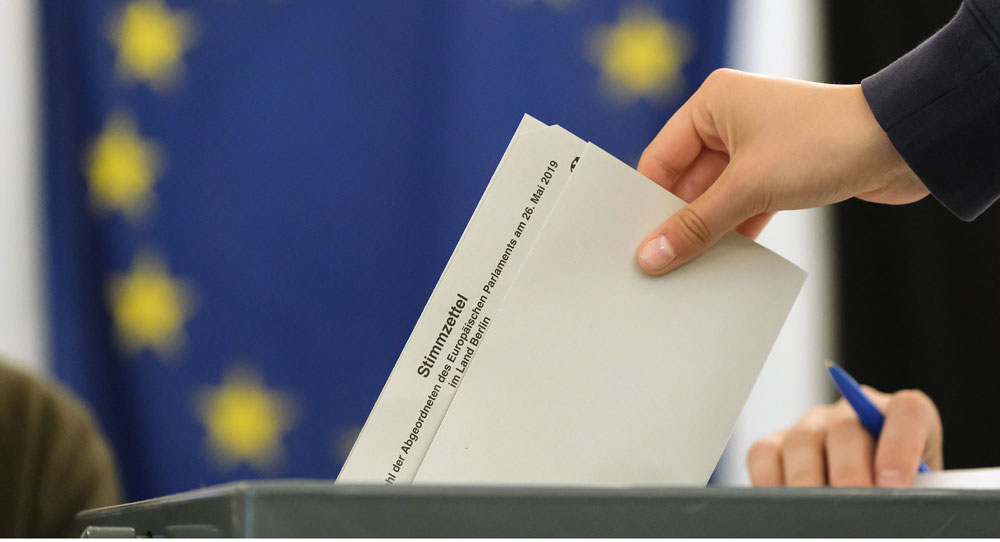
Let’s start with the good news. First, voter turnout in the European Parliament elections held on May 23–26 jumped to over 50 percent. This was the first time in a quarter of a century that more than half of eligible EU citizens, regardless of their political affiliation, went out to cast their ballots for the European Parliament.
Second, the far-right parties didn’t do as well as they had expected, except in France. There, Marine Le Pen’s National Rally won nearly 24 percent of the vote, edging President Emmanuel Macron’s Renaissance list into second place.
Third, the elections in most countries were about issues, particularly climate change. The Greens did extremely well in Germany. They surged ahead from 10.7 percent in the 2014 elections to over 20.6 percent this year, pushing the ever-beleaguered Social Democrats to a miserable 15.5 percent, down from 27.3 percent in 2014.The Greens scored well in other countries too, especially among young people (but also among the not-so-young). Green parties homed in on climate change, with many voters remembering last year’s scorching summer and floods across the bloc. Voters are also increasingly aware of the impact climate change is having not only on Europe but also on the rest of the world in terms of migration, agriculture, and desertification. And don’t discount the role of Greta Thunberg, the sixteen-year-old Swedish schoolgirl who has had a galvanizing effect on young people.
Fourth, the elections coincided with some referenda that had positive outcomes. Ireland voted to liberalize divorce laws, while in a nonbinding referendum in Romania voters rejected attempts by the government to pardon politicians indicted for corruption. Ireland confirmed it is a society that has embraced change and secularism at its own pace and in ways that have fundamentally changed the status quo. Romanians still yearn for the end of a status quo that has shown immense resilience to transformation.
And that is what these European Parliament elections mean. Aside from in Poland, Hungary, and a few other countries where the governing parties had comfortable wins, governments across the EU are now highly vulnerable.
Take Germany. The stability and endurance of Chancellor Angela Merkel’s center-right coalition of Christian Democrats (CDU) and Social Democrats (SPD) is no longer a given. The SPD’s support crashed not only in elections for the European Parliament but also in the state election in Bremen held on the same day. The SPD had held sway in this north German port for over seven decades. That seeming unassailability ended on May 26, when a Christian Democrat novice, Carsten Meyer-Heder, defeated the incumbent as mayor of the city-state.
Not only that. The chances are that the conservatives will form a coalition with the Greens in Bremen. On the federal level, it’s hard to see Andrea Nahles remaining leader of the SPD. It’s even harder to see the party remaining in Merkel’s coalition until the next federal election, which is due in 2021.
As for Merkel’s chosen successor, Annegret Kramp-Karrenbauer, unless she changes her policies, voters will continue to drift away from Germany’s post-1945 big parties. Indeed, over 1 million CDU voters and the same number of SPD voters defected on May 26 to the Greens. And it wasn’t just because of climate change. The two big parties have focused far too much on serving the older generation and raising pensions at the expense of involving younger voters.
Greek Prime Minister Alexis Tsipras is in trouble too. His far-left Syriza party was trounced into second place in the European Parliament elections, winning 24 percent of the vote, way behind the opposition New Democracy, which clinched 33 percent. Tsipras called a snap general election rather than wait until September, when it was due.
It’s not all rosy either for Matteo Salvini, leader of Italy’s far-right Northern League. His party won 34 percent of the vote, but its coalition partner, the Five Star Movement, came third with 17 percent, behind the opposition Democratic Party with 24 percent.
The upshot of all these trends is that the new leaders of the EU institutions who will be appointed over the coming months cannot continue business as usual.
At a special summit in Brussels on May 28, the bloc’s leaders will try to agree who should lead the European Commission, the European Council, the European Central Bank, and the European Parliament. Given the outcome of the elections, it’s hard to see Merkel or Macron getting their way on the commission or the central bank. The chances are that the European Parliament will exploit the high turnout to demand a much greater say in who will take over the reins of the institutions.
One thing is certain. High voter turnout meant the 2019 European Parliament elections were more than a poll about national leaders. They were about Europe and its future direction.

Nonresident Senior Fellow, Carnegie Europe
Judy Dempsey is a nonresident senior fellow at Carnegie Europe
Recent Work
Judy Dempsey
Judy Dempsey
Carnegie does not take institutional positions on public policy issues; the views represented herein are those of the author(s) and do not necessarily reflect the views of Carnegie, its staff, or its trustees.

Are Germany’s economic, industrial, and political struggles becoming a liability for the EU’s ability to rise to the geopolitical moment?

Rym Momtaz, ed.

European Commission President Ursula von der Leyen is about to give her annual address on the state of the EU. Here’s what she won’t—but should—say.
Rym Momtaz

The aftermath of the Ceuta crisis shows Europe has drawn the wrong lessons. Rather than doubling down on failed migration policies, the EU needs to address the underlying roots of such episodes.

Richard Youngs

An overwhelming victory by a far-right-wing party in a small state in eastern Germany will have major repercussions for Chancellor Friedrich Merz’s coalition.
Judy Dempsey

Canadian Prime Minister Mark Carney has twice inspired praise for standing up to U.S. President Donald Trump: at the 2026 World Economic Forum in Davos and on Canada-U.S. trade negotiations. Is Carney showing a third way better than the EU has in dealing with the Trump administration?
Rym Momtaz, ed.