

Commentary
Judy Dempsey
{
  "authors": [
    "Judy Dempsey"
  ],
  "type": "commentary",
  "blog": "Strategic Europe",
  "centerAffiliationAll": "",
  "centers": [
    "Carnegie Endowment for International Peace",
    "Carnegie Europe"
  ],
  "collections": [],
  "englishNewsletterAll": "",
  "nonEnglishNewsletterAll": "",
  "primaryCenter": "Carnegie Europe",
  "programAffiliation": "",
  "programs": [],
  "projects": [],
  "regions": [
    "Europe",
    "Western Europe",
    "Germany"
  ],
  "topics": [
    "EU",
    "Democracy"
  ]
}
Source: Getty
Regional victories show how German Christian Democrats and Social Democrats must engage with citizens if they want to weaken the appeal of the AfD before it’s too late.
What a Sunday night!
In Potsdam, the regional capital of Brandenburg, and in Dresden, Saxony’s wonderfully renovated capital, the relief of the incumbent parties was palpable as election results in the two German states began to pour in.
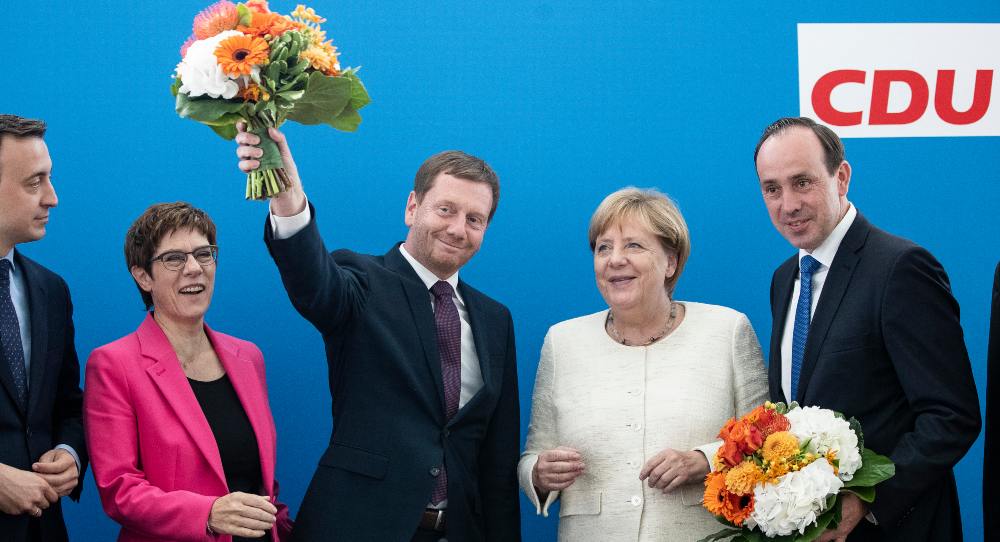
Dietmar Woidke, the Social Democratic Party (SPD) state premier of Brandenburg, clawed his way back to victory, seeing off the anti-immigrant, xenophobic Alternative for Germany (AfD). The SPD won 26.2 percent of the vote, the AfD 23.5 percent—up from 12.2 percent five years ago.Further south, in Saxony, known for its far-right movements but consistent Christian Democratic Union (CDU) leadership since reunification thirty years ago, CDU state premier Michael Kretschmer turned around imminent failure to success. He won 32.1 percent of the vote—a shadow of a party that dominated this state since 1990. The AfD romped home with 27.5 percent, almost triple from the last election in 2014.
Both incumbents have ruled out governing with the AfD. The two formerly East German states will probably end up with coalitions of CDU, SPD, and Greens. But whatever the outcome of such negotiations, the AfD has established itself in this part of Germany. And not only that. These two elections show that Eastern Germany is becoming divided between the traditional political parties and the far-right movement.
The traditional parties now have to find ways to curb the influence of a movement that has changed the political discourse in Germany because of its blatant anti-immigration, anti-Islamic, and anti-Semitic views. Those views clearly appealed to many voters in Brandenburg and Saxony, which since 1989 used to have a strong far-left support base.
The Left, which has its historic roots in the former East German Communist Party, was decimated. Have a look at the interactive links, which are really revealing: the Left is almost entirely absent. In both states, its supporters either opted for the AfD or reverted to tactical voting to prevent the AfD from becoming the largest party. In any event, the far-left vote disappeared from the political map.
Interestingly, the support for the AfD in both states nearly corresponds to the support the Left had until 2009, when the global financial crisis occurred.
What propelled the AfD onto the political stage was German Chancellor Angela Merkel’s decision to give shelter to over one million refugees fleeing the wars in Iraq and Syria. That decision changed the dynamics and language of German politics. The AfD provided a platform for those critical of Merkel’s policies.
Yet for all the speculation that the AfD could have become the largest party in either Brandenburg or Saxony, Woidke and Kretschmer did something that won over waverers: they campaigned. And how.
Kretschmer raced across Saxony, from meeting to meeting, grilling bratwursts and handing out beers in blistering heat. This man turned the vote around, determined to stop Saxons from dislodging him after a disastrous turn of events last year when Chemnitz, a post-industrial city, erupted into racial violence. And he didn’t want Merkel by his side. She is highly disliked in this part of Germany, despite her East German upbringing.
Woidke never gave up either. More importantly, neither leaders pandered to the far right. Above all, they managed to get reelected—in Woidke’s case even despite the current lack of leadership in the SPD on the federal level. As for the CDU, it’s not a given that Merkel’s successor as party leader, Annegret Kramp-Karrenbauer, who is now also defense minister, will one day enter the Chancellery. She wasn’t much in evidence on the campaign trail.
Indeed, the established parties lack leaders at the top that can reach out to the electorate, especially among the Eastern states.
So now what? With the results of the two regional elections, Merkel’s federal government coalition of Christian Democrats and Social Democrats has been given a reprieve. But this reprieve, and relief, should be used to tackle the influence of the AfD.
Much has already been written about the sense of alienation East Germans feel, the sense of being second-class citizens, the sense of having been taken over by West Germans.
But the root causes of the political discontent are the demographic, social, and economic upheavals that have taken place in the region since German reunification thirty years ago. The young, motivated, and educated—especially the women—have left.
It’s a phenomenon shared in other formerly communist countries of Central and Eastern Europe. Such an exodus of talent delays or prevents the emergence of new political elites and strong civil societies. It’s unrealistic to believe that those who left Brandenburg and Saxony will return.
These political, social, and economic deficits pose an immense challenge not only for Kretschmer and Woidke but for the German federal government as a whole. As these two leaders proved, the deficits can’t be overcome overnight, but they can be addressed by adopting a new style of politics.
Throughout the campaign, Kretschmer and Woidke engaged with citizens and listened to their grievances. That style of politics paid off. It’s a lesson for other regional leaders and for Merkel’s coalition if they want to weaken the appeal of the AfD.
Before it’s too late.

Nonresident Senior Fellow, Carnegie Europe
Judy Dempsey is a nonresident senior fellow at Carnegie Europe
Recent Work
Judy Dempsey
Judy Dempsey
Carnegie does not take institutional positions on public policy issues; the views represented herein are those of the author(s) and do not necessarily reflect the views of Carnegie, its staff, or its trustees.

Before the next wave of EU enlargement takes place, the union needs to grapple with thorny questions of how power is distributed among its members.


Emil Sondaj Hansen, Ditte Brasso Sørensen

Are Germany’s economic, industrial, and political struggles becoming a liability for the EU’s ability to rise to the geopolitical moment?

Rym Momtaz, ed.

European Commission President Ursula von der Leyen is about to give her annual address on the state of the EU. Here’s what she won’t—but should—say.
Rym Momtaz

The aftermath of the Ceuta crisis shows Europe has drawn the wrong lessons. Rather than doubling down on failed migration policies, the EU needs to address the underlying roots of such episodes.

Richard Youngs

An overwhelming victory by a far-right-wing party in a small state in eastern Germany will have major repercussions for Chancellor Friedrich Merz’s coalition.
Judy Dempsey