

Commentary
Thomas de Waal
{
  "authors": [
    "Thomas de Waal"
  ],
  "type": "commentary",
  "blog": "Strategic Europe",
  "centerAffiliationAll": "",
  "centers": [
    "Carnegie Endowment for International Peace",
    "Carnegie Europe",
    "Carnegie Russia Eurasia Center"
  ],
  "collections": [
    "EU Integration and Enlargement",
    "Brexit and UK Politics"
  ],
  "englishNewsletterAll": "",
  "nonEnglishNewsletterAll": "",
  "primaryCenter": "Carnegie Europe",
  "programAffiliation": "",
  "programs": [],
  "projects": [],
  "regions": [
    "Europe",
    "Western Europe",
    "United Kingdom"
  ],
  "topics": [
    "EU",
    "Political Reform"
  ]
}
Source: Getty
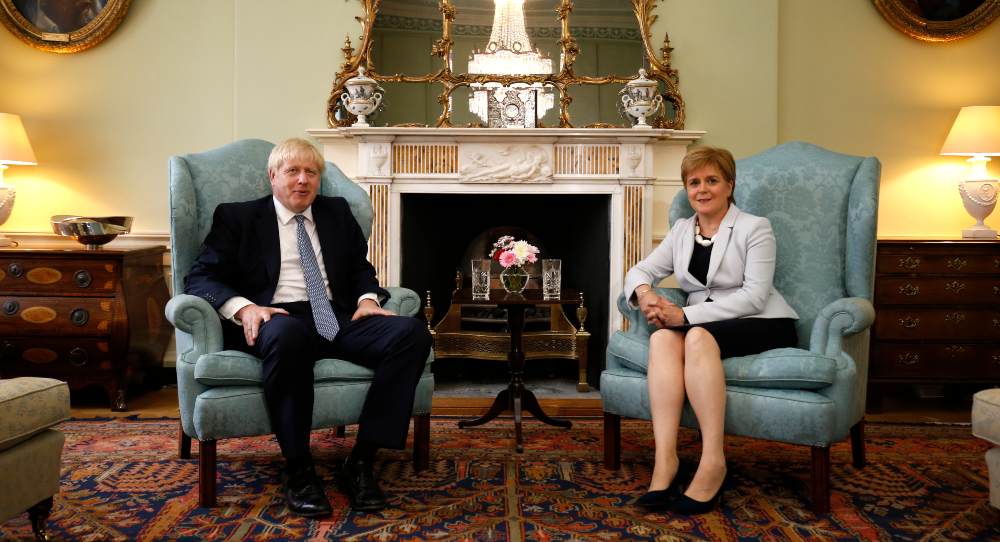
Boris Johnson could end up being the English leader who allowed the breakup of the UK to achieve Brexit. There are lessons in the dissolution of two other unions, the USSR and Czechoslovakia, and the role played by Boris Yeltsin and Václav Klaus.
“I don’t mind if Scotland breaks away.”
The words chilled me. I was talking over lunch in London to a businessman close to the Conservative Party. It was six months before the EU referendum of 2016, and, as an argument against Brexit, I raised the risk of Scotland voting again for independence and breaking up the United Kingdom. (The Scots had voted against independence in 2014, when Brexit was not on the agenda.) My interlocutor said he was not bothered. The Scottish economy was tiny, he said, the Scots would have to sink or swim, and the English would do fine without them.
For three years, the main line of the anti-Brexit argument in the UK has been that leaving the EU will badly harm the economy. A bigger danger, of another Scottish independence referendum and a messy breakup of the UK, has lurked further back in the shadows.Only now is the alarm being raised. Former prime minister Gordon Brown is warning starkly not just of the ambitions of the Scottish National Party, which advocates independence, but of the narrow “English nationalism” of Tories who, like my businessman, would be quite happy to see Scotland go. Even if he does not admit it, Boris Johnson’s Brexit strategy is leading Tory England in that direction.
The breakup in the 1990s of two union states, the Soviet Union and Czechoslovakia, is a lesson in how history can speed up and dissolve a country in almost the blink of an eye. In both cases, the decisive factor was the sudden withdrawal of support for the union by the leaders of the ‘big brother’ nation: the Russians, who dominated the Soviet Union, and the Czechs, the bigger nation of Czechoslovakia.
The Soviet Union could have lived on beyond 1991. In March of that year, then Soviet president Mikhail Gorbachev held a referendum on preserving the USSR in a looser federation in which a strong majority (more than 77 percent of all Soviet citizens who took part and 73 percent of voters in Russia) voted in favor. Six republics— Armenia, Estonia, Georgia, Latvia, Lithuania, and Moldova—boycotted the vote and could have achieved independence in time on their own with Western support, but the rest of the union still looked quite solid.
Lest we forget, it was then Russian president Boris Yeltsin, desperate to oust Gorbachev and the Soviet Communist Party, who dealt the killer blow in December 1991 together with the leaders of Belarus and Ukraine, with a triple declaration of independence. Yeltsin’s maneuver meant that the union lost its core member and could only be dissolved.
A few months later, in July 1992, Václav Klaus became prime minister of the Czech Republic, one of the two halves of Czechoslovakia. Vladimír Mečiar, his counterpart in Slovakia, was pushing for independence. Together, the two men oversaw the quick and unexpected dissolution of Czechoslovakia within six months. There was no referendum. Had there been, the people would undoubtedly have voted to keep the country together. In an opinion poll taken in September 1992, only 37 percent of Slovaks and 36 percent of Czechs said they would vote for a split.
Klaus consistently said he regretted the end of Czechoslovakia. His actions suggested otherwise. A free markets zealot, he regarded industrialized Slovakia as an economic burden, holding the Czech Republic back. Once he could not get the deal he wanted with Mečiar, Klaus pursued a divorce with ruthless determination.
Could another Boris—Boris Johnson—do for the United Kingdom what Boris Yeltsin and Václav Klaus did for their unions? In his first speech as prime minister, Johnson pledged his loyalty to “the awesome foursome” of the UK: England, Northern Ireland, Scotland, and Wales.
That masks the reality that Johnson was elected leader of a party whose members are now overwhelmingly English and worship the cause of Brexit with religious devotion. In a YouGov poll in June, an astonishing 63 percent of Conservative Party members said they would not mind Scotland leaving the UK if this was the price to pay for Brexit. (The corresponding figure for Northern Ireland was 59 percent.)
The parliamentary arithmetic is also compelling. The Conservative Party currently has 311 seats out of 650 in the UK Parliament. Given its current ideology and demographic bias, it is unlikely ever to win a majority again. But if Scotland were taken out of the equation, the Conservatives would have 298 seats out of 591 and a magic formula for keeping power.
In Scottish First Minister Nicola Sturgeon, Johnson may see a (much more benign) Scottish Mečiar, pushing for a Slovak-style divorce from the UK. Where Scotland might begin, Northern Ireland might follow—with much more mayhem. As Irish journalist Fintan O’Toole has persuasively argued, the main Irish republican party Sinn Féin appears to be welcoming the potential “Great Disruption” if a no-deal Brexit would cause to pursue their ambitions of a united Ireland.
The point is not to compare the democratic UK with the oppressive USSR. It is to say that a union state—free or unfree, decades- or centuries-old—needs renewing by an act of faith by every new generation. And that a state breakup will always be more traumatic and difficult than the splitters imagine.
The end of the USSR is not an event to regret, but it still caused huge economic disruption, territorial conflicts, and personal tragedies. As for Czechoslovakia, some Brexiteers will argue that its peaceful breakup is an example of how the same can be done for the UK—and also for leaving the EU.
But there was economic hardship and personal grief for millions who had mixed Czech and Slovak identity. What’s more, the reason why the Czech Republic and Slovakia have got on well and thrived is because both aspired, successfully, to do the very opposite of what Boris Johnson wants for his country—to join the European Union.

Senior Fellow, Carnegie Europe
Thomas de Waal is a senior fellow at Carnegie Europe, specializing in Eastern Europe and the Caucasus.
Recent Work
Thomas de Waal
Thomas de Waal
Carnegie does not take institutional positions on public policy issues; the views represented herein are those of the author(s) and do not necessarily reflect the views of Carnegie, its staff, or its trustees.

While the EU and European governments are embracing the much-lauded middle-power moment, this entails three difficult conundrums.

Richard Youngs

Much has been said of the changes Brussels is trying to make to the EU enlargement process. Here’s why gradual integration might—or might not—be the answer.

Dimitar Bechev

The European Commissioner for Trade is headed to China. But after President Xi’s bridge-building visit to Washington, can a more isolated EU overcome Beijing’s stranglehold on critical raw materials? Who will blink first?

Rym Momtaz, ed.

The domestic impacts of how long it is taking to end the war in Ukraine have pushed the French electorate to the political extremes and compromised the country’s diplomatic capacity.
Rym Momtaz

Before the next wave of EU enlargement takes place, the union needs to grapple with thorny questions of how power is distributed among its members.


Emil Sondaj Hansen, Ditte Brasso Sørensen