

Commentary
Judy Dempsey
{
  "authors": [
    "Judy Dempsey"
  ],
  "type": "commentary",
  "blog": "Strategic Europe",
  "centerAffiliationAll": "",
  "centers": [
    "Carnegie Endowment for International Peace",
    "Carnegie Europe"
  ],
  "collections": [
    "EU Integration and Enlargement"
  ],
  "englishNewsletterAll": "",
  "nonEnglishNewsletterAll": "",
  "primaryCenter": "Carnegie Europe",
  "programAffiliation": "",
  "programs": [],
  "projects": [],
  "regions": [
    "Europe",
    "Western Europe",
    "France",
    "Germany"
  ],
  "topics": [
    "EU",
    "Political Reform"
  ]
}
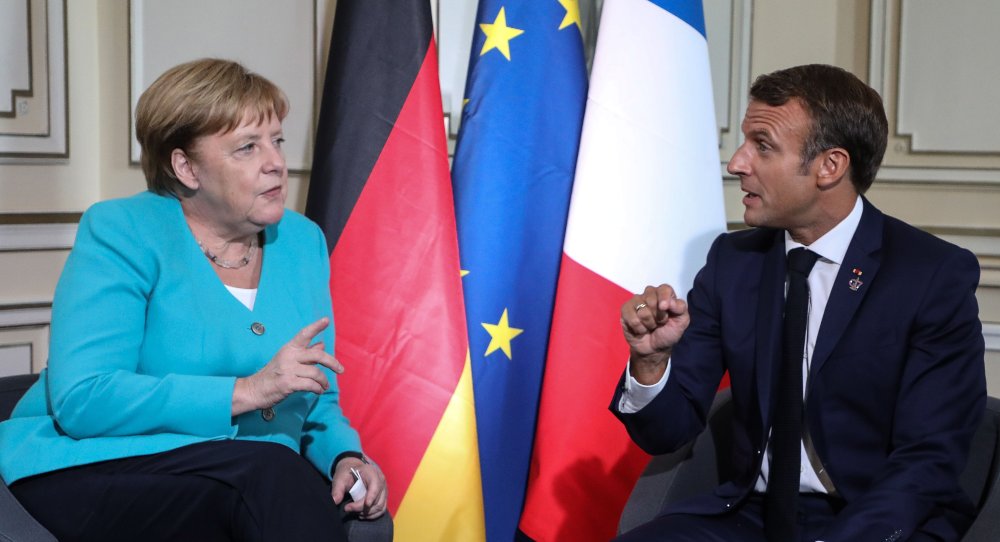
Source: Getty
If France and Germany managed to get along, Europe would look very different—and so would the Western Balkans.
This is not a good time for countries in the Western Balkans. Or for supporters of “more Europe” in general.
Both have become unwitting victims of a messy falling-out between French President Emmanuel Macron and German Chancellor Angela Merkel. The falling-out exposes the EU’s inability to pursue policies of integration, enlargement, and strategy.
In public, everything seems rosy between the French and German leaders. In reality, the relationship has become so debilitating that internal reforms and the bloc’s further enlargement have all but stopped.
Macron and Merkel are at odds over strengthening the euro, with France wanting a banking union, something which Germany opposes. Macron has reached out to Russian President Vladimir Putin arguing that Russia is essential for Europe’s security, a view not shared by Merkel. As for enlargement, Germany has consistently supported the expansion of the EU, while France has traditionally been more skeptical.It now seems that the incompatibilities between Paris and Berlin, which were always solved by compromises, are putting a brake on the EU’s future direction.
One of the countries immediately affected by the falling-out is North Macedonia. It was given to believe—as much as the EU can promise anything—that it could soon start accession negotiations.
This Western Balkan country had not only met the criteria for starting talks with Brussels. With immense leadership from Skopje and Athens, the dispute over what North Macedonia should be called was settled earlier this year. The historical deal finally unblocked North Macedonia’s path to NATO and the EU; Greece had exercised a veto for several years until the name issue was settled.
Now, membership with NATO is on track, but not with the EU. During a summit of EU leaders on October 17–18, Macron vetoed the start of EU accession talks with Albania and North Macedonia. The latter’s prime minister immediately announced his resignation. New elections were called. Nothing rekindles nationalist fires in this part of the Balkans more, since some political parties in North Macedonia and Greece still oppose the name deal.
A few EU countries support France’s opposition to further enlargement, especially regarding Albania. Macron’s argument is that the EU needs first to get its own house in order before taking in new members. That means dealing with the issues of more political and economic integration. He has a point.
Furthermore, the illiberal wave in Poland and Hungary, in addition to the corruption in Bulgaria, Croatia, Romania, and Slovakia (not that the older EU member states are pristine) can be easily used as excuses against further enlargement. This is despite the impressive spin-offs of foreign investment and free movement of labor, capital, and goods following the accession of these countries over the last fifteen years. There have been big gains all-round, which is often forgotten.
Yet for a region like the Western Balkans, which is struggling to strengthen rule of law, protect media freedom, and end trafficking in drugs, firearms, and humans, there is little enthusiasm among several EU member states for importing weak states. Not that they would join tomorrow. Accession talks take years. But it’s the psychological impact of such talks that is important for these countries’ feeling of being anchored to the EU. And above all, it’s the issue of trust: EU leaders promised these countries membership back in 2003.
Macron’s antipathy to further enlargement is not aimed at Merkel or the group of Nordic countries that oppose his bold views about Europe’s future.
It is about Macron trying to generate a much-needed debate about Europe’s relations with its neighbors and further afield. That kind of debate has to be anchored in what kind of Europe the member states want. The enlargement dispute is linked to this.
Macron has spent the past two years pushing for more integration of the EU, and he has little to show for it. No thanks to Germany.
Merkel seems uninterested in how the EU should look in the short- or long-term. Under her leadership, Germany has joined other countries in putting the interests of the member states first—often at the expense of the EU’s executive, the European Commission.
Whether it’s Merkel’s unqualified support for Nord Stream 2, or allowing Huawei, China’s telecoms giant, to bid for Germany’s 5G network, she has put Germany’s economic interests first. She has avoided any strategic discussion about Europe’s direction.
Then there are the other elephants in the room. It’s all very well for EU leaders to blame Brexit and U.S. President Donald Trump for robbing their time to discuss Europe’s future. This is intellectually disingenuous. Brexit and Trump should be the catalysts for European governments to stop making excuses and ask themselves the hard question: Is Europe ready to defend its political and economic system and act strategically?
In a nutshell, the issue of enlargement remains frozen, and the EU is at sea—unless the incoming commission under President-elect Ursula von der Leyen can stop the drift and shift the compass. Russia and China, already economic, political, and disruptive actors in Europe, can take comfort from this malaise. Surely, Berlin and Paris realize this.

Nonresident Senior Fellow, Carnegie Europe
Judy Dempsey is a nonresident senior fellow at Carnegie Europe
Recent Work
Judy Dempsey
Judy Dempsey
Carnegie does not take institutional positions on public policy issues; the views represented herein are those of the author(s) and do not necessarily reflect the views of Carnegie, its staff, or its trustees.
Europe has an interest in supporting Armenian leader Nikol Pashinyan as he tries to make peace with neighbors and loosen ties with Russia. But it is depersonalized support in the long term, not quickfire flash, that will win the day.

Thomas de Waal
Following Ursula von der Leyen’s gaffe equating Turkey to Russia and China, relations with Ankara risk deteriorating even further. Without better, more consistent diplomatic messaging, how can the EU pretend to be a geopolitical power?

Sinan Ülgen
Closer EU-UK ties could help address urgent European concerns. But is the EU ready for rapprochement with the United Kingdom?

Rym Momtaz, ed.
Europe has been standing by while its Southern neighborhood is being redrawn by force. To establish a path to peace between Israel and Lebanon, it’s time for Europeans to get involved with hard power.
Rym Momtaz
In Ukraine, Gaza, and Iran, AI warfare has come to dominate, with barely any oversight or accountability. Europe must lead the charge on the responsible use of new military technologies.

Raluca Csernatoni