

Commentary
Peter Kellner
{
  "authors": [
    "Peter Kellner"
  ],
  "type": "commentary",
  "blog": "Strategic Europe",
  "centerAffiliationAll": "",
  "centers": [
    "Carnegie Endowment for International Peace",
    "Carnegie Europe"
  ],
  "collections": [
    "EU Integration and Enlargement",
    "Brexit and UK Politics"
  ],
  "englishNewsletterAll": "",
  "nonEnglishNewsletterAll": "",
  "primaryCenter": "Carnegie Europe",
  "programAffiliation": "",
  "programs": [],
  "projects": [],
  "regions": [
    "Europe",
    "Western Europe",
    "United Kingdom"
  ],
  "topics": [
    "EU"
  ]
}
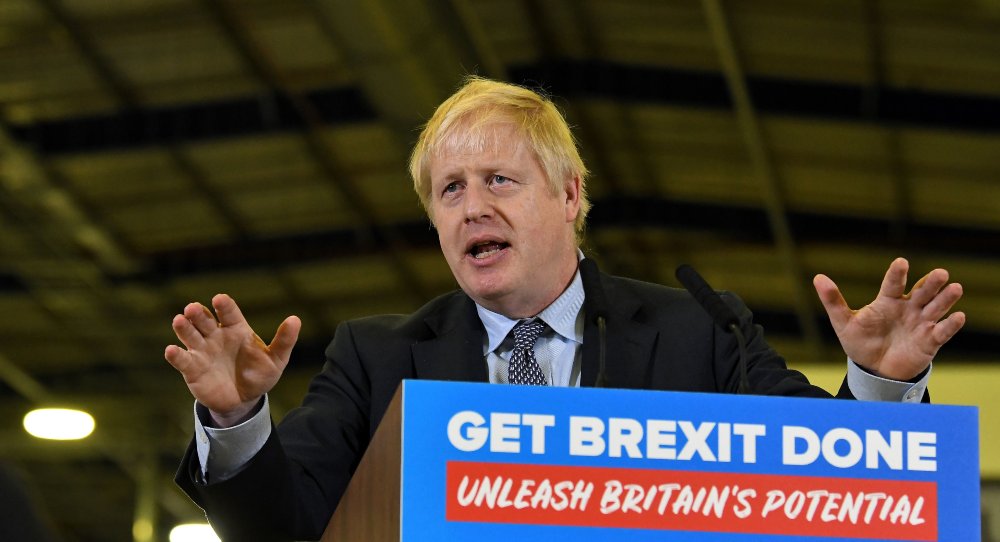
Source: Getty
With four weeks to go, the UK is experiencing not only its most important election in living memory, but its most unpredictable—and one in which a minority of voters could impose Brexit on the majority.
Comparisons are often made between UK Prime Minister Boris Johnson and U.S. President Donald Trump. Both are famously blond-haired, ego-driven populists who often struggle to stay close to the truth.
Here is a further similarity, one that might prove to be the most crucial of all: Three years ago, Trump became president, even though three million more Americans voted for Democratic candidate Hillary Clinton. On December 12, Johnson may well secure the parliamentary majority he needs to deliver Brexit, even though most Britons vote for parties determined to stop him.
In both countries, that is what can happen under their winner-takes-all voting systems. Clinton piled up massive majorities in solidly Democratic states such as New York and California, while Trump secured narrow victories in swing states such as Florida, Pennsylvania, and Michigan. As the winner in each of those states took all their electoral college votes, the system favored Trump.Britain’s multi-party politics operate differently, but the final outcome could be similar.
Three parties want Brexit to happen on or before the new deadline of January 31, 2020: the Conservatives, the Brexit Party, and the now tiny UK Independence Party (UKIP). An average of the latest polls puts their combined support at 47 percent. Five parties oppose this policy and want to reopen the decision to leave the European Union: Labour, the Liberal Democrats (Lib Dems), the Scottish National Party, the Green Party, and Wales’s Plaid Cymru. Their combined support averages 52 percent, a majority for the anti-Brexit parties.
However, the Conservatives could well overcome this and win a clear majority in the new Parliament. This is essentially because the Conservatives, led by Johnson, are likely to win up to 90 percent of the pro-Brexit vote, whereas Labour, the main opposition party, currently enjoys the backing of little over half the anti-Brexit vote.
Here is an example from the last general election of how this can play out in practice:
One of the constituencies that the Conservatives captured two years ago was Southport, in northwestern England. But in the Brexit referendum of June 23, 2016, 54 percent had voted to remain in the EU, while 46 percent voted to leave. In the 2017 general election, 59 percent voted Labour or Lib Dems, while 41 percent voted Conservative or UKIP.
So how come Southport ended up with a pro-Brexit member of Parliament?
Because the vote for pro-Brexit parties was divided between the Conservatives with 39 percent and UKIP with 2 percent, while the vote for anti-Brexit parties was divided between Labour with 33 percent and the Lib Dems with 26 percent. The biggest single voting block was Conservative; under Britain’s first-past-the-post, winner-takes-all voting system, Damien Moore, the Conservative candidate, emerged victorious.
That, or something like it, could happen in dozens of constituencies at the December 12 general election.
On both sides, modest attempts are being made to prevent perverse results. The Brexit Party has decided not to field candidates against incumbent Conservative MPs. In May 2019, the party came top in the UK election to the European Parliament with 31 percent of the vote, although the latest polls show that its support has fallen below 10 percent. Its decision to give incumbent Conservatives a free run will probably make little difference.
However, the Brexit Party’s greatest support tends to be in Labour-held areas that voted to leave the EU in 2016 and that the Conservatives are targeting. By still standing in these seats, the Brexit Party will siphon off some pro-Brexit votes, mainly from the Conservatives. If the Brexit Party wins only 5 or 10 percent in these areas, it could help Labour retain seats it would otherwise lose to the Conservatives.
On the anti-Brexit side of the scales, the Lib Dems have agreed an election pact with the Greens and Plaid Cymru in sixty seats (out of the total 650 seats in the House of Commons) where only one of the three parties will field a candidate. As with the Brexit Party’s decision, this pact is likely to affect the outcome in very few of these seats.
This means that in virtually every constituency there will be at least two anti-Brexit parties—Labour and either the Lib Dems, Greens, or Plaid Cymru. In Scotland, the Scottish National Party, another anti-Brexit Party, will also stand, giving anti-Brexit voters there a choice of three candidates.
The upshot is that through the United Kingdom, in its first-past-the-post system, the anti-Brexit vote will be more divided than the pro-Brexit vote.
One factor could prevent a clear Conservative majority in the new Parliament: tactical voting. If all anti-Brexit voters back their preferred party, Johnson can look forward to a comfortable victory next month. However, there are non-party campaigns to prevent this by trying to persuade millions of anti-Brexit voters not to vote for their preferred party, but for the local candidate with the best chance of defeating the Conservatives. If these campaigns succeed, they could deprive the Conservatives of twenty to forty seats.
But that’s a huge “if,” and one that speaks to a larger truth: with four weeks to go, the United Kingdom is experiencing not only its most important election in living memory, but its most unpredictable—and potentially one in which a minority of voters will manage to override the wishes of the majority on the central issue of our times.

Former Nonresident Scholar, Carnegie Europe
Kellner was a nonresident scholar at Carnegie Europe, where his research focused on Brexit, populism, and electoral democracy.
Recent Work
Peter Kellner
Peter Kellner
Carnegie does not take institutional positions on public policy issues; the views represented herein are those of the author(s) and do not necessarily reflect the views of Carnegie, its staff, or its trustees.

As we close out another season of Strategic Europe, it is worth taking stock of the deep shifts underway.

Rym Momtaz

The EU had to compromise to adopt a twenty-first sanctions package against Russia, exposing growing cracks in the union’s resolve. Is this latest, weaker round worth it to keep pressure on Moscow?
Rym Momtaz, ed.

Trump is distracted and Ukraine wants Europe to step up. The continent’s leaders must find their voice and assert it in talks with Russia.

Alissa de Carbonnel

Mounting economic strain and battlefield losses will not necessarily make the Kremlin less dangerous. They could instead push Moscow toward a more aggressive hybrid campaign designed to test NATO’s Eastern flank, exploit allied hesitation, and fracture European resolve.

Maksym Beznosiuk

Over the past ten years, NATO has held almost as many summits as it did during the entirety of the Cold War. Are they still useful, or is it time to stop holding annual meetings?
Rym Momtaz, ed.