

Commentary
Judy Dempsey
{
  "authors": [
    "Judy Dempsey"
  ],
  "type": "commentary",
  "blog": "Strategic Europe",
  "centerAffiliationAll": "",
  "centers": [
    "Carnegie Endowment for International Peace",
    "Carnegie Europe"
  ],
  "collections": [
    "Coronavirus"
  ],
  "englishNewsletterAll": "",
  "nonEnglishNewsletterAll": "",
  "primaryCenter": "Carnegie Europe",
  "programAffiliation": "",
  "programs": [],
  "projects": [],
  "regions": [
    "Europe",
    "Western Europe"
  ],
  "topics": [
    "EU"
  ]
}
Source: Getty
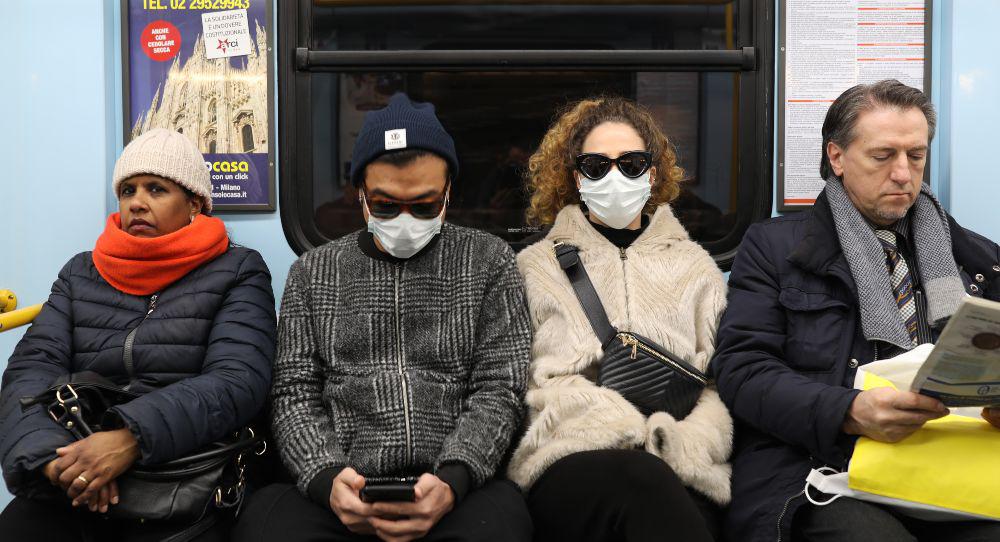
The spread of the coronavirus will test the resilience of European countries and governments’ ability to communicate without sowing panic among the population.
Students of philosophy and literature know that natural disasters can have a big impact on the way we look at the world. Such was the case of the Lisbon earthquake of 1755, of Voltairian and Enlightenment fame.
The COVID-19 (coronavirus) outbreak may have a similar effect on our Weltanschauung. By decoupling even only temporarily and partially the economy of China from the rest of the world, the budding pandemic will signal the potential end of globalization as we have known it since the 1980s when the Soviet bloc disappeared and China chose to enter the international marketplace.
The idea that “globalization is no longer global,” that it is fated to be replaced by an assemblage of Grossraumwirtschaft blocs (transnational economic blocs) reminiscent of the 1930s may be the conceptual outcome of the coronavirus. Trump’s attacks on the international trading system have prepared the ground for this shift.
Will the EU rise to the immediate challenge? Given its remarkable unity in the face of Brexit, one would like to answer “yes” with confidence. However, the apparent initial lack of EU cohesion in the face of the virus’s surge in Italy does not inspire confidence. What is clear is that public opinion will not forgive a perceived collective failure.
All countries should follow current World Health Organization advice, which is to actively control outbreaks if possible and to prepare for wider spread should it occur.
All response activities should be based on national risk assessment and a tailor-made, blended response. This includes the consideration of risk mitigation measures such as postponing any gatherings that are felt to cause a risk of increasing transmission—as a precautionary measure—and preparing the health system if community transmission occurs.
National Pandemic Influenza Plans are considered a good format to follow.
No. The EU proclaims free movement as the core of its existence, but, in truth, uncontrolled movement has caused Europe endless problems. Movement of EU citizens into the UK after the 2004 enlargement was the main driver in Brexit.
Movement of refugees in 2015 from the warzones of Iraq, Syria, and Libya following regime change interventions by European leaders like former UK prime ministers Tony Blair and David Cameron and former French president Nicolas Sarkozy led to the rise of ugly, rightist, racist politics, sometimes violent. French President Emmanuel Macron does not like the free movement of Polish lorries and their drivers undercutting the road haulage industry in France.
Now, the free movement of COVID-19 is sparking panic from Tenerife to Italian borders with Switzerland, where right-wing Swiss politicians are calling for the border to be controlled. 70,000 Italians cross every day to work in non-EU Switzerland.
The EU has turned a blind eye to the lack of democracy in China, where there is next to no primary care or basic health rules in live animal markets. If people and whole towns have to go into quarantine, why not regions or whole countries?
Can rigid EU rules on public spending be sustained as panic spreads?
There is no sense of control or effective communication from the EU. Who speaks for Europe as this crisis grows in intensity?
“I have no idea what’s awaiting me, or what will happen when this all ends. For the moment I know this: there are sick people and they need curing.”
This was the rational attitude suggested by French writer Albert Camus in his 1947 classic novel The Plague. Google Trends, the barometer of our collective souls, registers a renewed interest in Camus while Europe deals with the threatening coronavirus pandemic.
The virus, alas, has so far been tackled by a divided continent, just like the plague isolates people in Camus’s plot. Austria scrapped trains from Italy, Italy broke with the European Union, too hastily grounding flights from China, only to see the disease spread faster with passengers arriving unchecked from other airports. The jingoist press had a ball in the United Kingdom, Germany, and France, while Romania quarantined Italians from Lombardy and Veneto—muted revenge after being disparaged in Italy so often.
Schengen held, thanks to Macron and German Chancellor Angela Merkel’s cool heads. As European Parliament President David Sassoli mentioned in his lecture at Luiss University in Rome on February 21, in the twenty-first century the EU needs to be a “moral leader,” not just an economic giant. Camus would have agreed.
European countries have among the highest standards of healthcare, hygiene, and health information worldwide and hence ought to be at least as well equipped as anywhere to cope with a pandemic. It’s misleading to think of the EU as being united as a bloc on public healthcare. With the exception of harmonized evaluation of medicines, health remains a national responsibility.
European ministers have been meeting to coordinate their response and share best practice. EU funds have rightly been allocated to support the World Health Organization and vulnerable states.
Government communication has rightly focused on common-sense precautionary measures. As the bird-flu outbreaks showed, it makes no sense to stockpile vaccines.
Some demagogic politicians and hysteria-prone media in Europe have focused on the issue of closing borders. Health professionals say such blanket measures are ineffective. Anyway, the Schengen zone of passport-free travel permits governments to restore border controls if required in security or health emergencies.
In our democracies, many decisions are taken at workplace, local authority, or school level rather than by central government. That would make a Chinese-style draconian lockdown more difficult. Government responses to COVID-19 should be based on science, not on panic generated by fears of a catastrophic shock.

Nonresident Senior Fellow, Carnegie Europe
Judy Dempsey is a nonresident senior fellow at Carnegie Europe
Recent Work
Judy Dempsey
Judy Dempsey
Carnegie does not take institutional positions on public policy issues; the views represented herein are those of the author(s) and do not necessarily reflect the views of Carnegie, its staff, or its trustees.

Before the next wave of EU enlargement takes place, the union needs to grapple with thorny questions of how power is distributed among its members.


Emil Sondaj Hansen, Ditte Brasso Sørensen

Are Germany’s economic, industrial, and political struggles becoming a liability for the EU’s ability to rise to the geopolitical moment?

Rym Momtaz, ed.

European Commission President Ursula von der Leyen is about to give her annual address on the state of the EU. Here’s what she won’t—but should—say.
Rym Momtaz

The aftermath of the Ceuta crisis shows Europe has drawn the wrong lessons. Rather than doubling down on failed migration policies, the EU needs to address the underlying roots of such episodes.

Richard Youngs

An overwhelming victory by a far-right-wing party in a small state in eastern Germany will have major repercussions for Chancellor Friedrich Merz’s coalition.
Judy Dempsey