

Commentary
Thomas de Waal
{
  "authors": [
    "Thomas de Waal"
  ],
  "type": "commentary",
  "blog": "Strategic Europe",
  "centerAffiliationAll": "",
  "centers": [
    "Carnegie Endowment for International Peace",
    "Carnegie Europe",
    "Malcolm H. Kerr Carnegie Middle East Center"
  ],
  "collections": [
    "Europe’s Eastern Neighborhood"
  ],
  "englishNewsletterAll": "",
  "nonEnglishNewsletterAll": "",
  "primaryCenter": "Malcolm H. Kerr Carnegie Middle East Center",
  "programAffiliation": "",
  "programs": [],
  "projects": [],
  "regions": [
    "Russia",
    "Europe",
    "Eastern Europe",
    "Caucasus",
    "Azerbaijan",
    "Armenia",
    "Western Europe"
  ],
  "topics": [
    "Foreign Policy",
    "Security",
    "EU"
  ]
}
Source: Getty
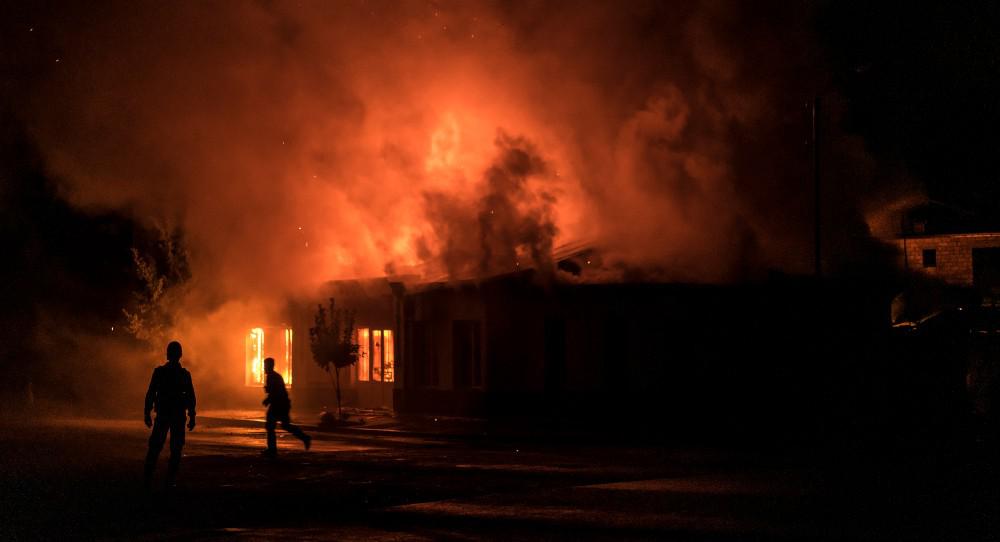
The war between Armenia and Azerbaijan over Nagorny Karabakh is a humanitarian catastrophe. A failure to respond properly undermines the European Union’s claims to be a strategic actor in its neighborhood.
The new war on the edge of Europe is both a humanitarian catastrophe and a great international failure.
Violence erupted between Armenians and Azerbaijanis in and around the disputed territory of Nagorny Karabakh on September 27, 2020, and is still ongoing. As their neighborhood is on fire, European countries are struggling to respond.
This is of course not a conflict where any one side has a monopoly on suffering and justice. But Europeans need to speak out urgently on a few basic issues.The fog of war and dearth of international reporters on the scene make it hard to discern properly what is happening. Perhaps 300 people are already dead in ten days of fighting.
But it is important to strongly highlight the terrible suffering being inflicted on the Armenian civilian population of Nagorny Karabakh, the disputed region that has been at the heart of the conflict since 1988. They have now endured more than a week of heavy bombardment.
The local human rights commissioner reports that half the civilian population—more than 70,000 people—has now fled Karabakh, but the road out to Armenia is a dangerous route. A Western journalist on the scene reported on October 7, “It’s almost impossible to report in #NagornoKarabakh because the bombing never stops.”
Amnesty International reports that Israeli-made cluster bombs, which are prohibited under international humanitarian law, have been fired into Karabakh. The Halo Trust, a British NGO, spent years clearing the region of these deadly devices left over from the conflict of the 1990s, which pose an especial danger to children.
The Armenian side has also been hitting Azerbaijani cities far from the front-line with artillery, with deadly effect. A television team from France 24 has reported all week of Armenian shells hitting the Azerbaijani urban centers of Ganje, Tarta, Barda, and Beylagan.
What should the Europeans be doing? The coronavirus pandemic, the U.S. election, and many other distractions obviously constrain diplomacy—indeed, these distractions may be one reason why Azerbaijan, which almost certainly started the current fighting, has decided to tilt the situation back in its favor by military means.
The European Parliament has debated and condemned the conflict. But as with Belarus, the EU institutions are shackled by their unanimity principle—although in this case, Cyprus is at the forefront of urging action.
Yet, a timid reaction is unacceptable—and not just on purely moral grounds. A failure to respond properly undermines European claims to be a strategic actor in its neighborhood.
It tears a great hole in the normative agenda of the EU’s Eastern Partnership policy and puts huge strain on the common neighbor of the two countries, Georgia, which has large Armenian and Azerbaijani minority populations.
EU member states have reacted more strongly. The most vocal is French President Emmanuel Macron, although even he seems to have missed the main point by focusing chiefly on the role of Turkey in fueling the conflict.
Europeans can start by expressing more vocal messages about the conflict itself and the underlying grievances of both parties.
They can declare that, although they recognize in principle the territorial integrity of Azerbaijan—which Nagorny Karabakh is an internationally recognized part of—the use of force against people living in a secessionist territory is no more acceptable here than it was when Yugoslavian president Slobodan Milosevic tried to do so in Kosovo, or when Russia’s former and current presidents, Boris Yeltsin and Vladimir Putin, respectively, tried to do so in Chechnya.
This conflict, which predates the collapse of the Soviet Union, is the classic case in which the self-determination of the Karabakh Armenians to control their own future is a vital opposing principle to that of territorial integrity. By sending rockets and shells against the Karabakh Armenians, Azerbaijani President Ilham Aliyev cynically undermines his own claim that he respects these people as citizens of Azerbaijan.
Europeans must also state much more loudly their support for Azerbaijan in its main grievance: the fact that, for more than two decades, Armenian forces have controlled not just the disputed territory of Karabakh itself but, wholly or partly, seven regions which were normal administrative districts of Azerbaijan but had the misfortune also to become a kind of strategic buffer zone.
These regions—some small parts of which have been recaptured in the last few days—were home to more than half a million people and constitute more than 8 percent of the de jure territory of Azerbaijan.
Having captured these regions in 1992–1993 with the declared intention of returning them as part of a peace deal, the Armenian side has since signaled ever more strongly than it intends to keep them in perpetuity. They are called “liberated” lands and given Armenian names, and around 17,000 Armenian settlers have made homes there.
This situation is unacceptable—and effectively makes Armenia cosponsor of the new violence. Without the return of these lands to the hundreds of thousands of Azerbaijanis who used to live there, a peace settlement is impossible.
How to reconcile both these legitimate grievances?
A great failing of the OSCE Minsk Group, the international body charged with negotiating a peaceful resolution of the conflict, is that it remained essentially a closed-door mediation framework which never had the capacity to voice a narrative of peace.
Russian diplomacy of the nineteenth-century variety—secretive talks between a few senior men (never women) in smoke-filled rooms, little engagement with experts or civil society groups—set the tone.
The challenge that faces the European nations of the OSCE and the EU is—once the combatants get exhausted or winter makes fighting difficult—to try to relaunch a different kind of peace process that addresses the needs of people.
In 1992, the newly formed Minsk Group called for a Minsk conference to solve the Karabakh conflict. The conference was never held, but the need for it now is greater than ever. That would be a cross-European forum where each side could express its grievances and all the concerned actors would be at the table.
The grim alternative looks to be an old-style, nineteenth-century great-power peace imposed by Russia and Turkey on Armenia and Azerbaijan from above with scant regard to humanitarian principles and their needs.

Senior Fellow, Carnegie Europe
Thomas de Waal is a senior fellow at Carnegie Europe, specializing in Eastern Europe and the Caucasus.
Recent Work
Thomas de Waal
Thomas de Waal
Carnegie does not take institutional positions on public policy issues; the views represented herein are those of the author(s) and do not necessarily reflect the views of Carnegie, its staff, or its trustees.

While the EU and European governments are embracing the much-lauded middle-power moment, this entails three difficult conundrums.

Richard Youngs

Much has been said of the changes Brussels is trying to make to the EU enlargement process. Here’s why gradual integration might—or might not—be the answer.

Dimitar Bechev

The European Commissioner for Trade is headed to China. But after President Xi’s bridge-building visit to Washington, can a more isolated EU overcome Beijing’s stranglehold on critical raw materials? Who will blink first?

Rym Momtaz, ed.

The domestic impacts of how long it is taking to end the war in Ukraine have pushed the French electorate to the political extremes and compromised the country’s diplomatic capacity.
Rym Momtaz

Before the next wave of EU enlargement takes place, the union needs to grapple with thorny questions of how power is distributed among its members.


Emil Sondaj Hansen, Ditte Brasso Sørensen