

Commentary
Judy Dempsey
{
  "authors": [
    "Judy Dempsey"
  ],
  "type": "commentary",
  "blog": "Strategic Europe",
  "centerAffiliationAll": "",
  "centers": [
    "Carnegie Endowment for International Peace",
    "Carnegie Europe"
  ],
  "collections": [],
  "englishNewsletterAll": "",
  "nonEnglishNewsletterAll": "",
  "primaryCenter": "Carnegie Europe",
  "programAffiliation": "",
  "programs": [],
  "projects": [],
  "regions": [
    "Europe",
    "Western Europe",
    "Germany"
  ],
  "topics": [
    "EU",
    "Technology"
  ]
}
Source: Getty
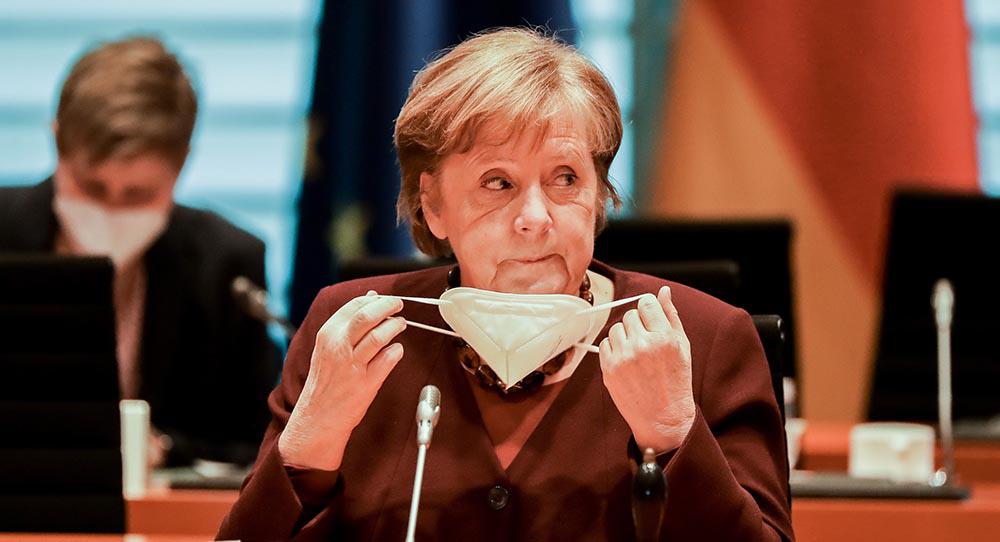
Germany is struggling to contain a pandemic that has laid bare intrinsic weaknesses of Europe’s largest economy and its once indomitable leader. The next German chancellor won’t have much time to repair the damage.
Angela Merkel could do no wrong. As other leaders on both sides of the Atlantic fumbled a year ago in their responses to the coronavirus, the German chancellor epitomized leadership and steady nerves. Her occasional television addresses displayed an empathy not known for a leader who normally shuns emotion and publicity. Opinion polls made Merkel almost invincible and indispensable. Until recently.
A second coronavirus wave—and now a third one spurred by a mutation that spread from the United Kingdom—and a slow rollout of vaccines has left Merkel’s conservative bloc struggling to contain the damage. The level of infection in Germany remains stubbornly high. The availability of vaccinations remains low.
This damage is eroding support for Merkel and her Christian Democratic Union party, which has yet to decide who will stand as its candidate to succeed her now that Merkel is seeing out her fourth and final term.
Such uncertainty is creating an unwelcome leadership vacuum in Europe’s largest economy. At a time when the administration of U.S. President Joe Biden has given Americans a much-needed morale boost by passing a $1.9 trillion coronavirus relief bill, European parliaments have still to pass the EU’s €1.8 trillion ($2.1 trillion) package aimed at rebuilding a post-pandemic Europe.
The absence of leadership in Berlin and other European capitals bodes ill for any speedy recovery once the pandemic is over. Perhaps it’s time for Merkel to step down and hand over the reins to her successor.
But it’s not as easy as that. The conservative bloc, which consists of the Christian Democrats and the Bavarian Christian Social Union (CSU) party, has yet to choose a joint candidate to contest September’s federal election. In January, the Christian Democrats elected Armin Laschet as their new leader—but not as their chancellor candidate. His handling of the coronavirus plus some scandals involving his son have diminished his popularity. Opinion polls indicate he hasn’t a chance of becoming the next chancellor. The other main contender—and a highly popular one at that—is Markus Söder, the CSU leader. He has been unflappable during the pandemic.
The conservative bloc has agreed to choose its chancellor candidate in May. But why not now? Let voters get a real impression of the candidate’s mettle in handling this hugely complex crisis by having Merkel stand aside.
As it is, judging from the outcomes of two regional elections held on March 14 in Baden-Württemberg and Rhineland-Palatinate, the writing could be on the wall for the conservative bloc. The Greens were once again swept into power in the former, the center-left Social Democrats in the latter. The Christian Democrats lost heavily in both. Although it’s early days in this election year, the Greens might end up as the biggest party.
The election defeat for the Christian Democrats was not just because of a mask procurement scandal involving the party’s parliamentarians. Patience is also wearing thin over the endless lockdowns, the lack of perspective, and the fact that so many children have been kept away from school for months.
Above all, the coronavirus has dented Germany’s image as an efficient, well-run country capable of dealing with a crisis of this scope. Merkel has to take responsibility for some of these shortfalls, which have shown how Germany is completely unprepared to deal with immense technological challenges.
The first is digitization. Patchy internet access and the lack of coordination among health authorities throughout the country are shameful for such a wealthy country endowed with talent and excellent research centers. There is no uniform online teaching platform for schools. Connections repeatedly break up.
Education is not a federal responsibility but a prerogative of Germany’s seventeen regions. But these authorities had all summer to come up with proven systems. Some regional governments have banned certain platforms such as Microsoft Teams because of Germany’s very strict data protection laws.
And the health authorities had all summer to modernize their Neanderthal systems. They didn’t. This is despite the fact that Merkel herself in September 2019 established a special committee aimed at pushing the country into the digital age. So much for the efficacy of that committee.
Exacerbating this undigitized economy is the heavy hand of Germany’s bureaucracy. In some ways, digitization presents a direct challenge to bureaucracy. So when Merkel and her ministers speak about making unbureaucratic decisions, especially when it comes to speeding up the vaccination rate, it falls on deaf ears. Several doctors to whom I have spoken complain about how, if too many vaccines are delivered to the special vaccination centers, the medical staff cannot use them, unless they put their foot down. “Your name is not on the list” is the refrain.
Flexibility hasn’t won out in this crisis. Nor has preparedness. When German Health Minister Jens Spahn announced that doctors’ practices could finally vaccinate their patients later in March (only designated medical centers are allowed to at the moment), there was jubilation among the profession. As it turned out, there weren’t enough shots available. The government’s decision to stop using the AstraZeneca vaccine on health grounds doesn’t help matters.
Such is the state of play in Germany. Like in other EU countries, the coronavirus should be the catalyst to tackle the technological and resilience weaknesses of such a rich part of the world and prepare for the next pandemic. Germany and its partners have been warned.

Nonresident Senior Fellow, Carnegie Europe
Judy Dempsey is a nonresident senior fellow at Carnegie Europe
Recent Work
Judy Dempsey
Judy Dempsey
Carnegie does not take institutional positions on public policy issues; the views represented herein are those of the author(s) and do not necessarily reflect the views of Carnegie, its staff, or its trustees.

With its public finances in shambles, the far right polling at 35 percent ahead of the 2027 presidential election, and a growing protest movement, is France’s crisis a threat to the EU’s geopolitical awakening?

Rym Momtaz, ed.

Ahead of a tough winter for Ukraine, Donald Trump’s swing back toward Russia bodes ill. But instead of panicking, Kyiv’s European allies are focusing on action.
Rym Momtaz

While the EU and European governments are embracing the much-lauded middle-power moment, this entails three difficult conundrums.

Richard Youngs

Much has been said of the changes Brussels is trying to make to the EU enlargement process. Here’s why gradual integration might—or might not—be the answer.

Dimitar Bechev

The European Commissioner for Trade is headed to China. But after President Xi’s bridge-building visit to Washington, can a more isolated EU overcome Beijing’s stranglehold on critical raw materials? Who will blink first?
Rym Momtaz, ed.