

Commentary
Judy Dempsey
{
  "authors": [
    "Judy Dempsey"
  ],
  "type": "commentary",
  "blog": "Strategic Europe",
  "centerAffiliationAll": "",
  "centers": [
    "Carnegie Endowment for International Peace",
    "Carnegie Europe"
  ],
  "collections": [
    "Transatlantic Cooperation"
  ],
  "englishNewsletterAll": "",
  "nonEnglishNewsletterAll": "",
  "primaryCenter": "Carnegie Europe",
  "programAffiliation": "",
  "programs": [],
  "projects": [],
  "regions": [
    "Asia",
    "Europe",
    "North America",
    "South Asia",
    "Afghanistan",
    "Western Europe"
  ],
  "topics": [
    "Foreign Policy",
    "Security",
    "EU"
  ]
}
Source: Getty
The fall of Afghanistan to the Taliban lays bare Europe’s lack of strategic foresight and dangerous dependence on the United States. The EU must address its shortcomings or risk losing the ability to defend its values and interests.
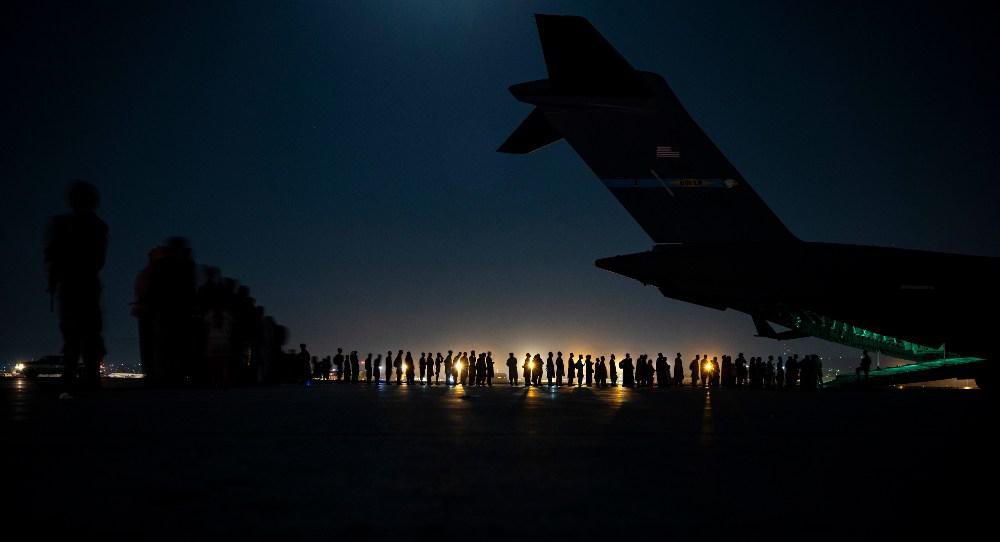
As soldiers and diplomats from many countries try and evacuate their citizens and Afghan employees from the chaos and danger of Kabul airport, the blame game is in full swing.
The German government, in particular the foreign ministry, has been lambasted for its slow response, its lack of preparedness, and its inability to respond two months ago to requests by its own diplomats based in Afghanistan and its defense ministry to put evacuation plans in place. That evacuation drive is now underway.
Other European capitals, notably London, have unreservedly blamed the United States for this human and political debacle.
It’s as if President Joe Biden was solely responsible for the fall of Afghanistan to the Taliban. It’s as if America’s NATO and other European allies had forgotten how it was former president Donald Trump who negotiated a so-called peace and withdrawal deal with the Taliban. It’s as if they disregarded how, in practice, that deal gave this movement carte blanche to sweep across the country—an ambition it had been waiting to realize since 2001, when American troops entered Afghanistan.
Once the evacuation efforts are over, Afghanistan, like Myanmar, Belarus, and eastern Ukraine before it, will disappear from the headlines, except for the refugee aspect. When it comes to Afghanistan, there’ll be continuing wrangling inside the EU over how many refugees member states should accept, with everyone forgetting the fact that millions of Afghans are already in camps in neighboring Iran and Pakistan.
But it is the broader, geostrategic context of Afghanistan that will spell either ruin or opportunity for the Europeans.
There’s enough ruin already.
First, the Europeans, equipped over decades with the soft power tools of development aid and the hard power equipment of NATO, turned a blind eye to the relentless corruption of the government in Kabul.
It’s not as if they didn’t have enough intelligence to know how the billions in aid and inadequate training of the police and military were being squandered, often to the detriment of ordinary Afghans.
Over the years I have read the undistilled analysis by the U.S. Special Inspector General for Afghanistan Reconstruction (SIGAR). These reports have given a blow-by-blow account of the waste, the corruption, the unwillingness to tackle the weak governance, the theft of military hardware, and the sheer scale of the inefficiency of the reconstruction effort. European governments and their intelligence agencies had no excuse not to know.
Second, the Europeans cooperated haphazardly in the field of development aid and military operations. European aid workers told me privately how individual EU countries seemed obsessed with putting up their national flag over a completed project.
Certainly, the effort to build schools and get girls into the classroom cannot be underestimated. These were such positive aspects of the past two decades. The future of this generation of young women is now in jeopardy.
Third, and ask any NATO official or police officer about these deficits, the NATO mission in Afghanistan was flawed in several respects.
It did not give the essential spur to interoperability that would enable troops from different countries to work seamlessly together. The different military equipment systems, from helicopters and tanks to (the lack of) logistics and communication, made a mockery of pooling and sharing.
And as for the police training, the record of Germany, which was one of the first countries to undertake that mission, replaced later by an EU mission, was seriously flawed.
One of the main reasons for these shortcomings is that the national training systems are not integrated. There is no single training culture. The member states have their own methods, traditions, and instructions.
In short, the two decades in Afghanistan did not inculcate a European strategic culture at EU or NATO level.
Resorting to the blame game is no substitute for questioning Europe’s lack of strategic foresight and its indisputable dependence on the United States.
Inevitably, there are calls for a “European strategic autonomy.” Such a response is as short-sighted as it is unrealistic. Europe is going to continue to depend on the United States despite what happened in Afghanistan.
Yet, that dependence must move away from subservience to scrutinizing in a robust manner NATO’s goals and ambitions. For too long, successive NATO secretary generals, who owe their position to Washington, have unconditionally accepted this lopsided relationship. No wonder. The United States, besides being the biggest contributor to NATO, is Europe’s security guarantor.
It will remain one-sided until the Europeans start thinking strategically. This means taking an unjaundiced look at its capabilities, at its intelligence structures, at its different cultures that inhibit cohesion and solidarity, and the aims of development aid.
None of the above is easily attainable.
But if these fundamental shortcomings are not addressed, and soon, then not only will Europe’s efforts to promote its values and interests outside the bloc become futile. Europeans will end up turning their backs on those Afghans who were beginning to enjoy the universal values of freedom, dignity, and human rights. And Europe, even at home, will be unable to defend itself.

Nonresident Senior Fellow, Carnegie Europe
Judy Dempsey is a nonresident senior fellow at Carnegie Europe
Recent Work
Judy Dempsey
Judy Dempsey
Carnegie does not take institutional positions on public policy issues; the views represented herein are those of the author(s) and do not necessarily reflect the views of Carnegie, its staff, or its trustees.

While the EU and European governments are embracing the much-lauded middle-power moment, this entails three difficult conundrums.

Richard Youngs

Much has been said of the changes Brussels is trying to make to the EU enlargement process. Here’s why gradual integration might—or might not—be the answer.

Dimitar Bechev

The European Commissioner for Trade is headed to China. But after President Xi’s bridge-building visit to Washington, can a more isolated EU overcome Beijing’s stranglehold on critical raw materials? Who will blink first?

Rym Momtaz, ed.

The domestic impacts of how long it is taking to end the war in Ukraine have pushed the French electorate to the political extremes and compromised the country’s diplomatic capacity.
Rym Momtaz

Before the next wave of EU enlargement takes place, the union needs to grapple with thorny questions of how power is distributed among its members.


Emil Sondaj Hansen, Ditte Brasso Sørensen