

Commentary
Gwendolyn Sasse
{
  "authors": [
    "Gwendolyn Sasse"
  ],
  "type": "commentary",
  "blog": "Strategic Europe",
  "centerAffiliationAll": "",
  "centers": [
    "Carnegie Endowment for International Peace",
    "Carnegie Europe"
  ],
  "collections": [
    "Europe’s Eastern Neighborhood"
  ],
  "englishNewsletterAll": "",
  "nonEnglishNewsletterAll": "",
  "primaryCenter": "Carnegie Europe",
  "programAffiliation": "",
  "programs": [],
  "projects": [],
  "regions": [
    "Russia",
    "Eastern Europe",
    "Ukraine"
  ],
  "topics": [
    "Security",
    "Democracy",
    "EU"
  ]
}
Source: Getty
President Zelensky seems willing to accept a neutral status for Ukraine in return for firm security guarantees. But without the required political will on the Russian side, a mutually acceptable deal may be out of reach.
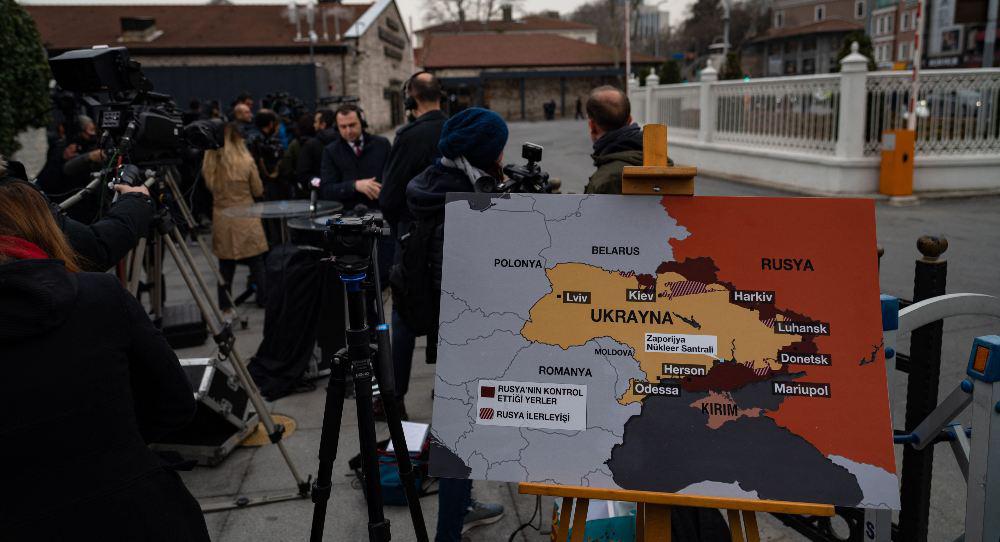
After nearly three weeks of online talks, in-person negotiations between Ukraine and Russia resumed on March 29. They took place in Istanbul, thereby making Turkish President Recep Tayyip Erdoğan the main international mediator, at least for the time being. Unsurprisingly, Erdoğan proclaimed progress at the end of the talks in order to maintain a momentum.
Both the Ukrainian and Russian delegations in Istanbul also referred to progress made and an eventual peace agreement being possible. But this is as far as it went.
The Russian delegation tried to present the idea of a direct meeting between Ukrainian President Volodymyr Zelensky and Russian President Vladimir Putin as a political compromise and the plan to reduce military activity around Kyiv as a military compromise.
The former is clearly no concession, but simply a statement of fact, as the presidents will be the final arbiters of the conditions attached to any peace plan. The latter appears to have been, by and large, empty rhetoric, as there was no immediate scaling back of military action and what followed looks more like a regrouping of forces. This is a necessity rather than a compromise on the part of the Russian armed forces.
U.S. President Joe Biden has been quick to point to Russia’s unwillingness to negotiate. Ukraine’s delegation as well as its president and foreign minister have tried to sound more optimistic. The critical element in the negotiations to date has been the concept of “neutrality.” Both sides interpret this differently. In addition to Ukraine giving up its aspirations to join NATO, Russia links it to the demand of demilitarization. This is not acceptable to Ukraine.
Zelensky also insists on strong security guarantees in return for giving up on NATO membership. The Ukrainian suggestion is to include a large number of guarantor states—the permanent members of the UN Security Council plus Canada, Germany, Israel, Italy, Poland, and Turkey—and clearly spell out safeguards to protect Ukraine against future Russian aggression.
The Ukrainian delegation made a reference to this guarantee having to be as firm as Article 5 of the NATO Treaty. The guarantor states would have to support Ukraine, including with military assistance or even a no-fly zone.
As NATO is already careful not to cross a line and become directly involved in the war, Ukraine’s proposal cannot be implemented in full. But its main purpose is to focus attention on tangible security guarantees. A further detail in the Ukrainian proposal is the suggestion that the guarantor states should not only not obstruct but actively support Ukraine’s further integration with the EU.
The fact that Putin also sees the EU and EU membership for Ukraine as a danger to his political and economic system has been less apparent over the years. Therefore, it is noteworthy that the Russian side has pointed to Austria and Sweden as possible models for Ukraine.
While the Ukrainian reaction was negative, pushing for a different and more institutionalized “Ukrainian model,” it is noteworthy that Austria and Sweden—and Finland—joined the EU in 1995 and gradually widened the meaning of neutrality. Sweden eventually dropped the explicit reference to military neutrality, and all three countries cooperate with the NATO.
These trajectories are familiar to Russia. Thus, a reference to any of these countries acknowledges—intentionally or unintentionally—that post-war Ukraine could take a similar path. The EU might indeed play a role in the institutionalization of Ukraine’s security, provided the bloc can reach a consensus on the way forward.
Putin’s other key demands—the recognition of Crimea as Russian territory and of the pseudo-independence of the so-called people’s republics in Donbas—leave much less room for compromise.
The Ukrainian negotiators have suggested that a period of fifteen years could be stipulated for the status of the peninsula to be settled bilaterally. For Putin and Russian elites and society, this issue is closed, so it seems more likely that it will be left out of a peace agreement altogether.
With regard to the Russian-occupied territories in the Donbas, the Ukrainian side proposed returning to status negotiations. On paper, a formula might be found that leaves the final status of the territories open. The parts of southeastern Ukraine the Russian troops have gained partial or full control over will also have to feature in the negotiations as they continue.
Zelensky faces an additional hurdle: he has committed himself to a referendum and parliamentary vote on the final version of the agreement. The president seems to be preparing his country for the eventuality of agreeing on a neutral status, but the issue of territorial integrity is so closely tied to the resistance by the Ukrainian army and the population at large that is hard to imagine that Crimea or parts of the Donbas could figure in an agreement put to a popular vote.
It is obvious that the security guarantees tied to military neutrality will take time and political will to negotiate. This political will is currently not visible on the Russian side—but it might appear if the war drags on.
Gwendolyn Sasse is a nonresident senior fellow at Carnegie Europe and director of the Centre for East European and International Studies (ZOiS) in Berlin.
Nonresident Senior Fellow, Carnegie Europe
Gwendolyn Sasse is a nonresident senior fellow at Carnegie Europe. Her research focuses on Eastern Europe, with a particular focus on Ukrainian politics and society, EU enlargement, and comparative democratization.
Recent Work
Gwendolyn Sasse
Gwendolyn Sasse

The aftermath of the Ceuta crisis shows Europe has drawn the wrong lessons. Rather than doubling down on failed migration policies, the EU needs to address the underlying roots of such episodes.

Richard Youngs

An overwhelming victory by a far-right-wing party in a small state in eastern Germany will have major repercussions for Chancellor Friedrich Merz’s coalition.

Judy Dempsey

Canadian Prime Minister Mark Carney has twice inspired praise for standing up to U.S. President Donald Trump: at the 2026 World Economic Forum in Davos and on Canada-U.S. trade negotiations. Is Carney showing a third way better than the EU has in dealing with the Trump administration?

Rym Momtaz, ed.

The EU’s responses to two recent incidents expose the gulf between European perceptions and capabilities. Unless the union can bridge that gap, it will never become a real geostrategic power.
Rym Momtaz

In supporting Europe’s far-right, MAGA and Russia both want the same thing: a weaker EU. Europe must defend itself without abandoning the openness these forces exploit.

Armida van Rij