

Commentary
Are Germany’s economic, industrial, and political struggles becoming a liability for the EU’s ability to rise to the geopolitical moment?
Rym Momtaz, ed.
{
  "authors": [
    "Marc Pierini",
    "Francesco Siccardi"
  ],
  "type": "commentary",
  "blog": "Strategic Europe",
  "centerAffiliationAll": "",
  "centers": [
    "Carnegie Endowment for International Peace",
    "Carnegie Europe"
  ],
  "collections": [],
  "englishNewsletterAll": "",
  "nonEnglishNewsletterAll": "",
  "primaryCenter": "Carnegie Europe",
  "programAffiliation": "",
  "programs": [],
  "projects": [],
  "regions": [
    "Europe",
    "Türkiye",
    "Middle East"
  ],
  "topics": [
    "Foreign Policy",
    "Security",
    "Democracy",
    "Political Reform",
    "EU"
  ]
}
Source: Getty
A return to a parliamentary democracy system—the opposition’s most important electoral promise—is highly unlikely if Erdogan remains in power. This would be bad news for Turkey’s Western allies.
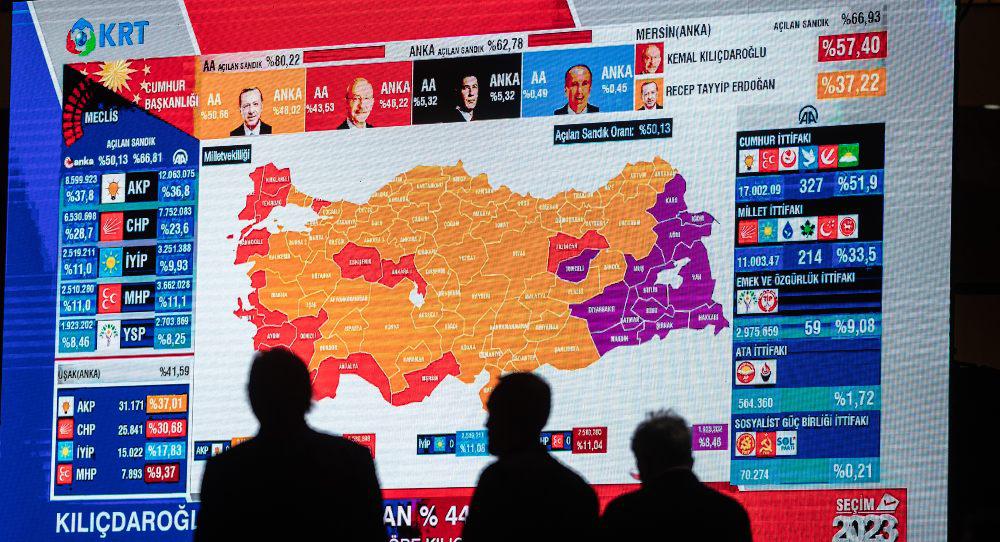
After a dynamic and unfair campaign, the interim results of Turkey’s dual election send the two main presidential contenders to a second round and give a safe majority to the incumbent parliamentary alliance.
This means that whoever is elected on May 28 will run the country under the 2017 constitution, which installed a super-presidential regime.
If Kemal Kılıçdaroğlu, the opposition leader running against Recep Tayyip Erdoğan, were to be elected, this would constrain his alliance’s plan to return to parliamentary democracy.
If Erdoğan were to be reelected, this would give him greater leeway to reinforce his authoritarian, nationalist, and conservative postures.
Turkey’s vote has been free but certainly not fair. Several opposition figures—like Selahattin Demirtaş, the leader of the pro-Kurdish Peoples’ Democratic Party (HDP)—are in jail, or, as is the case for Istanbul’s mayor Ekrem Imamoğlu, threatened with a political ban. Imamoğlu has appealed a recent conviction by an Istanbul court.
The media in the country is heavily controlled by the government, effectively preventing the emergence of a transparent, unbiased information ecosystem. And while it is not unusual for journalists to be arrested on the basis of “spreading disinformation,” a recent disinformation law has tightened the government’s grip on social media and news websites.
Symbolically, the day of the presidential runoff will coincide with the tenth anniversary of the Gezi Park protests—a large national movement whose repression by the government marked one of the first acts of Turkey’s descent into a semi-authoritarian model.
In this context, the vote has confirmed some well-known electoral patterns and presented some unexpected outcomes.
As anticipated, the opposition won in most major urban centers and in the southeast, where the Kurdish majority mobilized in support of Kılıçdaroğlu. The rest of the country, from inner Anatolia to the Black Sea coast, voted in favor of the ruling alliance.
Contrary to what many observers expected, the consequences of the February 6 earthquake did not mark the demise of the Justice and Development Party (AKP) despite the government’s poor management of the emergency. The effects of the economic crisis and rampant inflation also seem to have pushed the Turkish public to reconfirm their trust in the government they know, rather than choosing the one they do not.
Overall, the poor performance of the opposition coalition against the forecasts of most opinion polls and the over-performance of nationalist parties across the board were two of the most remarkable outcomes of the election.
In electoral terms, the Table of Six alliance proved to be less than the sum of its parts with weak performances from the coalition’s junior members. Sinan Oğan, who led his right-wing Ancestral Alliance to an unexpected 5.2 percent, declared on May 15 that he would reveal his voting recommendation for the second round within a couple of days.
But in terms of parliamentary support, the key takeaway is the confirmation of the incumbent majority. This points to a continuation of the governance trends observed in the past five years. It will also prevent any return to a parliamentary democracy system, which was the opposition’s most important electoral promise.
For whoever wins the second round, the priority will be fixing the economy. Inflation is still a major concern due to Erdoğan’s policy on low interest rates. In addition, balance of payment deficits are structural, and the quick fixes used in recent months—currency swaps, advanced payments to Turkey for the Russian nuclear power plant, delayed payments on Russian gas deliveries—are not sustainable in the medium and long term.
Unless a drastic policy change is decided, inflation will remain high and the lira will tumble further. In such a context, international bankers will remain prudent and foreign direct investment from Western countries will remain shy. This is bad news for the average citizen in Turkey and for European businesses as well.
On the international front, the major question is whether Turkey will stick to the present “balanced policy” between NATO and Russia, which has in practice helped Moscow drive a wedge into NATO’s defense architecture.
This policy has been at the center of President Erdoğan’s international posture in recent years and will remain under scrutiny by Western countries in the run-up to NATO’s summit in Vilnius in mid-July. The most immediate issue is Turkey’s veto on the North Atlantic Alliance’s enlargement to Sweden. But other problems loom large, namely Turkey’s participation in reassurance operations in Eastern Europe, its air force modernization, and its missile defense equipment.
More generally, Western countries will watch how the rise of the conservative forces in this election will influence Turkey’s foreign policy orientation. A return to the disruptive, anti-Western rhetoric of 2020 could be in the cards. Based on the shift in political forces, there might well be a temptation to keep assigning the blame for current problems to Europe and the United States, as we have heard during the incumbent president’s campaign.
Similarly, domestic politics will be watched closely, as the election results might lead to a further deterioration of Turkey’s rule-of-law architecture and therefore a wider gap with Western countries, who will remain its most vital economic interlocutors.
In short, the outcome of the May 28 runoff will be of major importance for the people of Turkey and for the country’s Western partners.

Senior Fellow, Carnegie Europe
Marc Pierini is a senior fellow at Carnegie Europe, where his research focuses on developments in the Middle East and Turkey from a European perspective.
Deputy Director, Carnegie Europe
Francesco Siccardi is deputy director at Carnegie Europe.
Carnegie does not take institutional positions on public policy issues; the views represented herein are those of the author(s) and do not necessarily reflect the views of Carnegie, its staff, or its trustees.

Are Germany’s economic, industrial, and political struggles becoming a liability for the EU’s ability to rise to the geopolitical moment?

Rym Momtaz, ed.

European Commission President Ursula von der Leyen is about to give her annual address on the state of the EU. Here’s what she won’t—but should—say.
Rym Momtaz

The aftermath of the Ceuta crisis shows Europe has drawn the wrong lessons. Rather than doubling down on failed migration policies, the EU needs to address the underlying roots of such episodes.

Richard Youngs

An overwhelming victory by a far-right-wing party in a small state in eastern Germany will have major repercussions for Chancellor Friedrich Merz’s coalition.

Judy Dempsey

Canadian Prime Minister Mark Carney has twice inspired praise for standing up to U.S. President Donald Trump: at the 2026 World Economic Forum in Davos and on Canada-U.S. trade negotiations. Is Carney showing a third way better than the EU has in dealing with the Trump administration?
Rym Momtaz, ed.