

Commentary
Pierre Vimont
{
  "authors": [
    "Pierre Vimont"
  ],
  "type": "commentary",
  "blog": "Strategic Europe",
  "centerAffiliationAll": "",
  "centers": [
    "Carnegie Endowment for International Peace",
    "Carnegie Europe"
  ],
  "collections": [
    "Europe’s Eastern Neighborhood",
    "EU Integration and Enlargement"
  ],
  "englishNewsletterAll": "",
  "nonEnglishNewsletterAll": "",
  "primaryCenter": "Carnegie Europe",
  "programAffiliation": "",
  "programs": [],
  "projects": [],
  "regions": [
    "Europe",
    "Western Europe",
    "France",
    "Eastern Europe"
  ],
  "topics": [
    "Foreign Policy",
    "EU",
    "Security"
  ]
}
Source: Getty
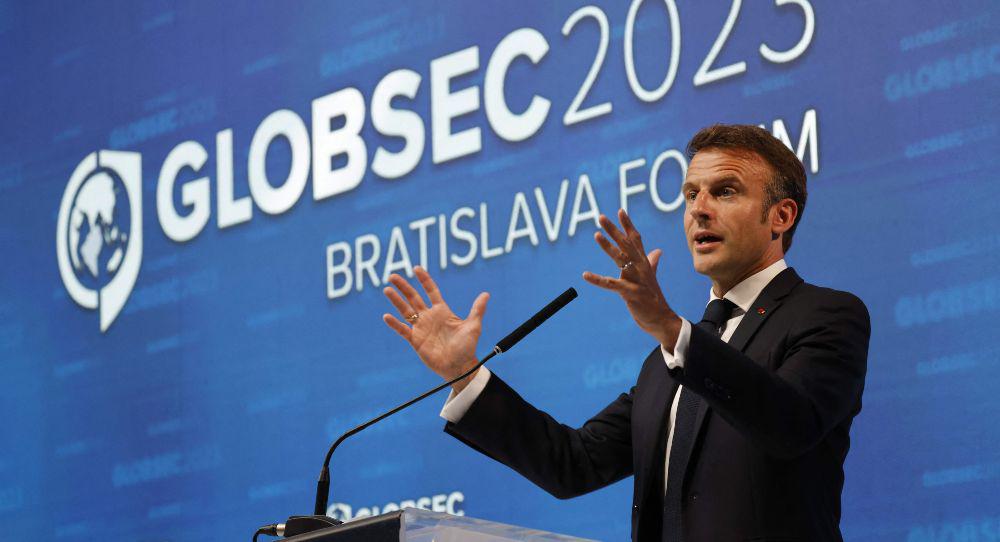
In Bratislava, President Macron presented a vision for a militarily capable EU that enlarges eastward. But making this a reality means revising the bloc’s governance.
Last week, when embarking on his trip to Bratislava to attend the GLOBSEC Forum and then to Moldova for the second summit of the European Political Community, Emmanuel Macron had a clear goal in mind: reassuring his East and Central European partners about France’s commitment to supporting Ukraine in the war against Russia.
From that point of view, the French president’s speech in Bratislava was probably his most clear-cut engagement for a Ukrainian military success in a long time. He emphasized the importance of supporting Ukraine’s leadership in its upcoming military counteroffensive, adding that EU partners will have to take stock of the Ukrainian progression by mid-summer and enhance, if need be, their assistance.
Striking a more geopolitical note, Macron stressed the unacceptable nature of any immediate ceasefire which would be tantamount to recognizing de facto the annexation of the Ukrainian territories occupied by Russia. From that observation he drew his personal take of a possible endgame to the war, defining a fair and sustainable peace as one that requires the full consent of the aggressed Ukraine and the respect by all sides of the principles embodied in the rules of international law. He repeated that only a successful counteroffensive could deliver the proper conditions for a genuine peace settlement.
This statement got a warm reception from the GLOBSEC audience eager for clarification from the French leader. Indeed, Macron’s straightforward speech, in which he also called for strong bilateral and multilateral security guarantees for Ukraine to be agreed at the NATO Vilnius summit, assumes a more assertive French political line on the Russo-Ukrainian conflict.
This firm stance is undoubtedly in sharp contrast to the more cautious position adopted by France at the NATO Bucharest summit in 2008. Additionally, it consolidates the French president’s geopolitical assessment of the balance of power in Europe and the shared perception by all European partners of the Russian security threat.
The French president did not stop there. He went on to consolidate his now well-known doctrine in favor of achieving a genuine European strategic autonomy that encompasses both the industrial and technological as well as the defense fields.
Dispelling some of the misunderstandings that have in the past handicapped the French vision on European security, Macron insisted on the need for enhanced military capacities as a positive contribution to a credible European pillar inside NATO. This has many practical implications: consolidating a genuine technological and industrial defense base by innovating, manufacturing, and buying in Europe; setting up European operational capacities for military interventions; and finally, shaping a common long-term vision of European strategic interests in light of today’s security threats.
Simply put, Macron sent a gentle reminder by rebooting the agenda that EU member states endorsed last year when adopting the Strategic Compass.
A third dimension emerged from Macron’s public intervention. With his vision on the European Union’s future, he brought substantial new thinking on both the enlargement process and the geopolitical mindset required from the EU in foreign policy.
On enlargement and in relation to the candidate status of Ukraine and Moldova, the French president offered a much bolder approach than he had until now. As he clearly stated, this was no longer a matter of if or when but rather a question of how.
The perspective of a union enlarged to more than thirty members implies a change in the process itself, with a staged approach allowing the candidate countries to benefit from some of the EU common policies without having yet reached the status of a full-fledged member. It also calls for a profound revision of the bloc’s governance with a more flexible organization, where the balance between full integration and more direct relations among member states would need to be revisited and new ad-hoc formats identified.
Presented in general terms, these propositions underline the necessity, if the next accessions are to be successful, of genuine institutional reform. And they imply that such a revision would have to look beyond the simple extension of qualified majority voting to the EU’s Common Foreign and Security Policy—a measure which, until now, was considered the key condition for a more efficient union.
On the external front, Emmanuel Macron emphasized the need for Europe to assume a more assertive role in future European security negotiations, including on arms control. He made it clear that it is for European nations to define their own common strategic interests. Lastly, he asserted that once the conflict in Ukraine is settled, Europeans would need to define the parameters of any peaceful coexistence with Russia without complacency but with the necessary coherence that has been missing in the past.
Ultimately, President Macron was not merely reassuring on French policy toward the war in Ukraine. He was also demanding in his strategic foresight over the future of Europe. So far, on this aspect of Macron’s presentation, European partners have kept quiet. But the conversation starts now.

Senior Fellow, Carnegie Europe
Pierre Vimont is a senior fellow at Carnegie Europe. His research focuses on the European Neighborhood Policy, transatlantic relations, and French foreign policy.
Recent Work
Pierre Vimont
Pierre Vimont
Carnegie does not take institutional positions on public policy issues; the views represented herein are those of the author(s) and do not necessarily reflect the views of Carnegie, its staff, or its trustees.

Before the next wave of EU enlargement takes place, the union needs to grapple with thorny questions of how power is distributed among its members.


Emil Sondaj Hansen, Ditte Brasso Sørensen

A summer of escalation in the Black Sea has hurt Ukraine economically and is exacerbating world food security. A truce is needed—as is a broader reframing of Europe’s Ukraine strategy.

Thomas de Waal

Are Germany’s economic, industrial, and political struggles becoming a liability for the EU’s ability to rise to the geopolitical moment?

Rym Momtaz, ed.

European Commission President Ursula von der Leyen is about to give her annual address on the state of the EU. Here’s what she won’t—but should—say.
Rym Momtaz

The aftermath of the Ceuta crisis shows Europe has drawn the wrong lessons. Rather than doubling down on failed migration policies, the EU needs to address the underlying roots of such episodes.

Richard Youngs