

Commentary
Dimitar Bechev
{
  "authors": [
    "Dimitar Bechev"
  ],
  "type": "commentary",
  "blog": "Strategic Europe",
  "centerAffiliationAll": "",
  "centers": [
    "Carnegie Endowment for International Peace",
    "Carnegie Europe"
  ],
  "collections": [
    "EU Integration and Enlargement"
  ],
  "englishNewsletterAll": "",
  "nonEnglishNewsletterAll": "",
  "primaryCenter": "Carnegie Europe",
  "programAffiliation": "",
  "programs": [],
  "projects": [],
  "regions": [
    "Europe",
    "Western Europe",
    "Western Balkans"
  ],
  "topics": [
    "Foreign Policy",
    "EU",
    "Security"
  ]
}
Source: Getty
The more incidents of violence occur, the less likely Belgrade and Pristina are to compromise. Brussels should increase pressure on both parties to conclude an agreement.
Until four days ago, Serbia’s President Aleksandar Vučić was in a comfortable position. In the eyes of the EU and U.S. negotiators involved in efforts to settle the Kosovo issue, he was the proverbial adult in the room.
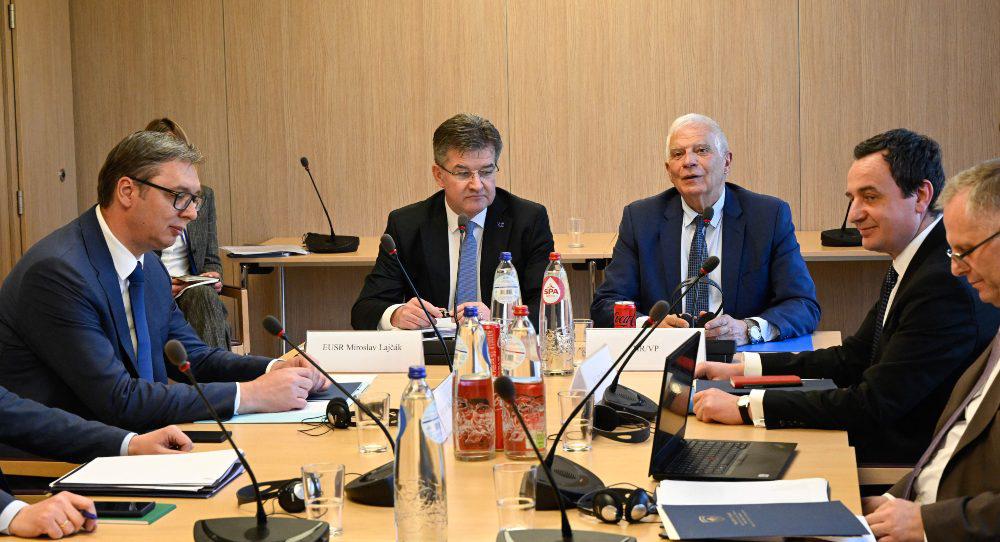
The last round of talks on September 14 saw the Serbian leader accept a blueprint for a deal on Serb autonomy proposed by the EU High Representative for Foreign Affairs and Security Policy Josep Borrell and his Balkan envoy Miroslav Lajčak. It was Kosovo’s Prime Minister Albin Kurti who turned it down. By that point, Brussels had already become so frustrated with Kurti’s stubborn ways that they considered imposing sanctions on the Kosovars.
Kurti’s decision to dispatch riot police and special forces in the Serb-populated northern municipalities in order to install mayors voted in by less than 2 percent of the locals did not win the prime minister any fans in Western capitals, either. The United States, Kosovo’s top international ally, was not thrilled. By contrast, there was muted praise for Vučić, who also took credit for the reported delivery of ammunitions to Ukraine—via third countries—as well as for coming closer to firing the pro-Moscow chief of the Security and Information Agency (BIA), Aleksandar Vulin.
But then it all changed.
In the early hours of September 24, a group of thirty Serb militants blocked a road near Banjska, a village in the vicinity of Zvečan in northern Kosovo. A firefight with Kosovo police left one officer dead and several injured. The standoff escalated as the Kosovars sent over extra forces. Three of the heavily armed Serbian gunmen were shot. Police detained six more Serbs and seized a large weapons cache from the nearby Banjska Monastery. The rest of the group appears to have withdrawn into Serbia, possibly after negotiations with the authorities.
This incident, the most serious example of violence in Kosovo for years, turned the tables on Vučić. As the standoff unfolded, Kurti called out Serbia as the chief culprit for the deadly firefight. “Organised crime with political, financial and logistical support from officials in Belgrade is attacking our country,” he wrote on social media. Interior Minister Xhelal Sveçla added that the kit recouped at the monastery would suffice to equip a force of several hundred. All Vučić could say in response was that Kurti bore responsibility for the bloodshed; he caused the Kosovo Serb “revolt” with his heavy-handed policies.
Worse still, the influential Serbian Orthodox Church was not thrilled about one of its monasteries being caught in between and the abbot, Father Danilo, being all but held hostage. In a press statement, the Metropolitan of Raška and Prizren Teodosije (Theodossius) dryly stated that there had been no weapons found in Banjska. The statement called for tensions to be dialed down—distancing itself from Serbian authorities.
But then Vučić doubled down. Adding more fuel to the fire, the Serbian government declared Thursday, September 27 a day of national mourning. Is Belgrade actually acknowledging it stood behind the paramilitaries whom Pristina describes as “terrorists”? The bottom line is that from a promoter of regional stability, Vučić is at risk of being seen as a spoiler if not a warmonger.
Of course, there is another theory making the rounds in Belgrade. It is that Kosovo Serb leaders are keen to emancipate themselves from Vučić’s tight embrace. The shoot-out is therefore a matter of the tail wagging the dog, with Serbia sucked into an escalation not of its choosing.
The Kosovo authorities look into the role of Milan Radojičić, the deputy chair of the dominant Serb party in the north, Srpska lista (Serbian list). He was there during the standoff—Kosovars released video footage which proved that, while Kurti called for a tough line on Srpska lista. But then Radojičić miraculously disappeared from the monastery, along with most of the thirty gunmen. There is speculation that the withdrawal was negotiated, with the U.S. embassies mediating between the Kosovo forces of order and the heavily armed Serbian contingent.
As per Vučić’s interview to the national broadcaster RTS on September 27, Radojičić is somewhere in central Serbia. The Serb leader is sticking to his guns: It was all the Kosovars’ fault—they started it first.
But should the story of Radojičić freelancing be corroborated, it would appear that Vučić has lost control over his erstwhile proxies who are now wrecking the whole edifice he has built. The militant nationalism Vučić has been cultivating has now given birth to forces he can no longer rein in. The strongman may be yielding to local players who previously sought his patronage.
If the likes of Radojčić order the mood music within northern Kosovo’s Serbian community, that is a problem for Vučić—but it is also a problem for the EU, which is trying to push a negotiated settlement in Kosovo.
If Belgrade is not coordinating with the local Serbs, Brussels is in trouble. Local semi-criminal figures have no incentive to accept any EU settlement plan. They profit from the status quo and will likely fight tooth and nail to keep it the way it is. Vučić is under the threat of becoming irrelevant. That could expire the Brussels dialogue.
In light of Russia’s war in Ukraine, the EU has been working to resolve Kosovo’s status once and for all. It nearly got there with the Ohrid agreement in March 2023, which ultimately neither Kurti nor Vučić signed.
Now there is another mini-crisis that consumes the EU’s attention. So long as these recurrent crises dominate the headlines, Borrell and others in Brussels will be playing whack-a-mole—meaning containing violence here and there, preventing the outbreak of an even bigger conflict and keeping Serbs and Albanians apart.
The big prize—Kosovo recognized by Serbia in exchange of some form of Serb autonomy—remains, as ever, out of reach. The more such incidents occur, the less likely it is that Serbia and Kosovo will be willing or able to compromise. The EU will not be able to fix the problem—perhaps only manage it and keep a lid on it. That negative scenario is very likely to play out in Kosovo. That is why Brussels has to gather all its strength and put pressure on Serbia and Kosovo, so they shake hands, and finalize and implement the agreement.
The EU must keep its eyes on the prize.

Senior Fellow, Carnegie Europe
Dimitar Bechev is a senior fellow at Carnegie Europe, where he focuses on EU enlargement, the Western Balkans, and Eastern Europe.
Recent Work
Dimitar Bechev
Carnegie does not take institutional positions on public policy issues; the views represented herein are those of the author(s) and do not necessarily reflect the views of Carnegie, its staff, or its trustees.

The EU can impose sanctions but struggles to enforce them without the United States. With Washington increasingly disinterested in backing European interests, the bloc must now fend for itself.


Nicu Popescu, Tiago Antunes

Russia is testing the waters of NATO’s mutual defense clause. What do strikes in Romanian territorial waters mean for the alliance’s posture toward Moscow?
Dimitar Bechev

With its public finances in shambles, the far right polling at 35 percent ahead of the 2027 presidential election, and a growing protest movement, is France’s crisis a threat to the EU’s geopolitical awakening?

Rym Momtaz, ed.

Ahead of a tough winter for Ukraine, Donald Trump’s swing back toward Russia bodes ill. But instead of panicking, Kyiv’s European allies are focusing on action.
Rym Momtaz

While the EU and European governments are embracing the much-lauded middle-power moment, this entails three difficult conundrums.

Richard Youngs