

Commentary
Judy Dempsey
{
  "authors": [
    "Judy Dempsey"
  ],
  "type": "commentary",
  "blog": "Strategic Europe",
  "centerAffiliationAll": "",
  "centers": [
    "Carnegie Endowment for International Peace",
    "Carnegie Europe"
  ],
  "collections": [],
  "englishNewsletterAll": "",
  "nonEnglishNewsletterAll": "",
  "primaryCenter": "Carnegie Europe",
  "programAffiliation": "",
  "programs": [],
  "projects": [],
  "regions": [
    "Europe",
    "Eastern Europe",
    "Western Europe"
  ],
  "topics": [
    "EU",
    "Democracy",
    "Political Reform"
  ]
}
Source: Getty
With over 99 percent of the votes counted, Poland is poised to have a new centrist government. Warsaw’s new leadership has a great chance to restore the rule of law, end the country’s bitter polarization, and revive its influence in Europe.
After eight years in power, Poland’s conservative Law and Justice (PiS) party has been defeated by the centrist Civic Coalition (KO) in Sunday’s parliamentary election.
Even though PiS won the most votes (35.4 percent), it lost its parliamentary majority. KO, which ranked second at the polls, will be able to form a government with two other opposition parties, the centrist Third Way and The Left. The turnout was a whopping 74 percent, the highest since 1989, when the communist regime was ousted.
The results are good news for Poland, good news for the European Union, and bad news for populist parties—especially for Viktor Orbán’s Fidesz government in Hungary. Orbán has lost a useful Eurosceptic ally.
It is good news for Poland, the EU’s fifth largest member, because this election was about the future of its democracy.
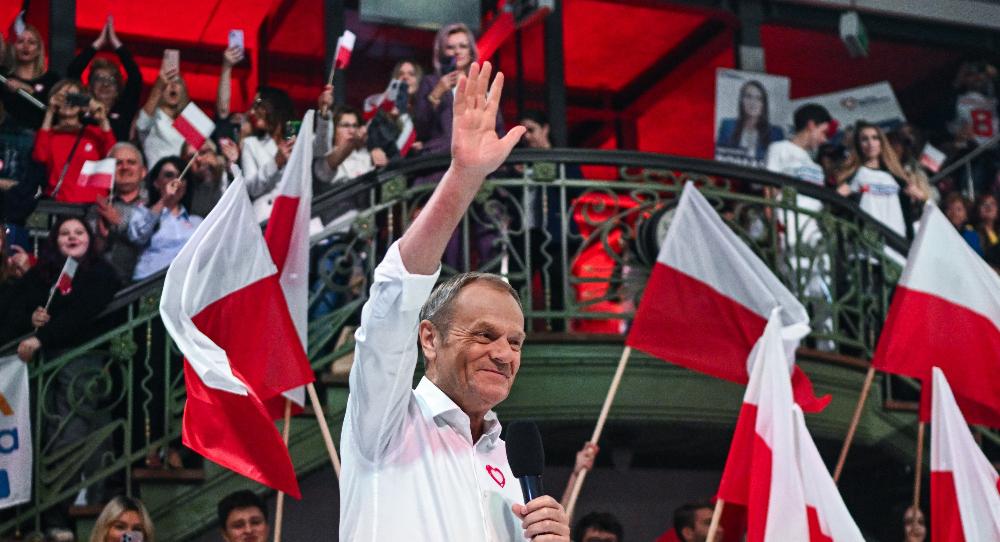
“Poland won. Democracy has won,” said a jubilant Donald Tusk, the leader of KO and Poland’s former prime minister.
Since it came to power in 2015, PiS has systematically undermined the rule of law and the independence of the judiciary. It dismissed judges. It ran roughshod over the Constitutional Court. It interfered in the appointment of public prosecutors.
That wasn’t all. The longer it was in power, the more PiS got involved in the management of state enterprises. Corruption spread. Large parts of the media were influenced if not under the control of the ruling party.
As for women’s rights, especially the right to abortion, they became severely restricted as the government and the Catholic Church moved Poland in the direction of a highly conservative country.
But it was the way in which PiS tried to shackle the judiciary that put it on a collision course with the EU. For several years, independent lawyers, civil society activists, and a disorganized opposition warned the EU about the incremental erosion of democracy in Poland.
Brussels dragged its feet over taking action. This only emboldened parties like PiS and Fidesz to continue promoting a political agenda that denigrated the rule of law. In their views, it was about stopping the EU from interfering in their national sovereignty. In reality, it was about reducing accountability so as to increase their powers.
Finally, as a means to put pressure on both countries, the EU withheld Poland’s €35-billion share of the union’s Covid recovery fund until Warsaw moved toward restoring an independent judiciary. As new judicial legislation is held up for review by the Polish Constitutional Court, a change of government could help unlocking those much-needed funds.
Even though PiS has acknowledged the electoral defeat, don’t expect any smooth transition to KO and its allies, or a swift return to the rule of law.
President Andrzej Duda, who is supposed to be independent but has been in office with the support of PiS and has two more years to serve, has the authority to invite the party who won the most votes to form the next government.
The number of seats in the Sejm, the lower house of the Polish parliament, doesn’t give PiS and its ally, Confederation, enough to establish anything that resembles a stable coalition, let alone a majority.
Duda can then turn to KO. Tusk has his work cut out. For one thing, Duda could obstruct KO’s plans to overturn PiS’s judicial decisions. Furthermore, Tusk’s political allies consist of young people who want to see new faces in power and an invigorated Poland that is inclusive and can retain its influence and status in the EU.
The latter shouldn’t be insurmountable. Indeed, a KO-led government should give its ideas about EU’s future direction, particularly on foreign policy, defense, and security.
Despite PiS’s consistent political and until recently military support for Ukraine and its hospitability towards nearly one million Ukrainian refugees, its Eurosceptic stance and its assault on the rule of law deprived Warsaw of a more influential role in Brussels at a time of unprecedented challenges facing the EU.
And just as important for the EU, a KO-led coalition could give centrist, conservative, and liberal parties a fillip. The results of Poland’s election show that nationalist, Euroskeptic governments such as those of Hungary and Slovakia need not be a permanent and divisive feature of European politics.
Whether or not Duda drags his feet on putting a new government in place, a new opposition government will have two immense domestic tasks to deal with.
One is to restore public trust in the institutions that were so undermined by PiS. The other is about ending the bitter, dangerous polarization that has characterized Poland for several years. During that time, the space for the middle ground, for the center, was so narrow and so marginalized that it almost disappeared. KO and the young people who voted for change have the great chance to end this vilification—and give Poland back its place in the EU.

Nonresident Senior Fellow, Carnegie Europe
Judy Dempsey is a nonresident senior fellow at Carnegie Europe
Recent Work
Judy Dempsey
Judy Dempsey
Carnegie does not take institutional positions on public policy issues; the views represented herein are those of the author(s) and do not necessarily reflect the views of Carnegie, its staff, or its trustees.

The EU can impose sanctions but struggles to enforce them without the United States. With Washington increasingly disinterested in backing European interests, the bloc must now fend for itself.


Nicu Popescu, Tiago Antunes

Russia is testing the waters of NATO’s mutual defense clause. What do strikes in Romanian territorial waters mean for the alliance’s posture toward Moscow?

Dimitar Bechev

With its public finances in shambles, the far right polling at 35 percent ahead of the 2027 presidential election, and a growing protest movement, is France’s crisis a threat to the EU’s geopolitical awakening?

Rym Momtaz, ed.

Ahead of a tough winter for Ukraine, Donald Trump’s swing back toward Russia bodes ill. But instead of panicking, Kyiv’s European allies are focusing on action.
Rym Momtaz

While the EU and European governments are embracing the much-lauded middle-power moment, this entails three difficult conundrums.

Richard Youngs