

Commentary
As we close out another season of Strategic Europe, it is worth taking stock of the deep shifts underway.
Rym Momtaz
{
  "authors": [
    "Wojciech Konończuk"
  ],
  "type": "commentary",
  "blog": "Strategic Europe",
  "centerAffiliationAll": "",
  "centers": [
    "Carnegie Endowment for International Peace",
    "Carnegie Europe"
  ],
  "collections": [
    "Europe’s Eastern Neighborhood",
    "EU Integration and Enlargement"
  ],
  "englishNewsletterAll": "",
  "nonEnglishNewsletterAll": "",
  "primaryCenter": "Carnegie Europe",
  "programAffiliation": "",
  "programs": [],
  "projects": [],
  "regions": [
    "Europe",
    "Eastern Europe",
    "Russia"
  ],
  "topics": [
    "Security",
    "EU",
    "Foreign Policy"
  ]
}
Source: Getty
Despite recent tensions, Poland and Ukraine are destined to cooperate. Common security interests and the proximity of the two societies provide the basis for overcoming the current clash.
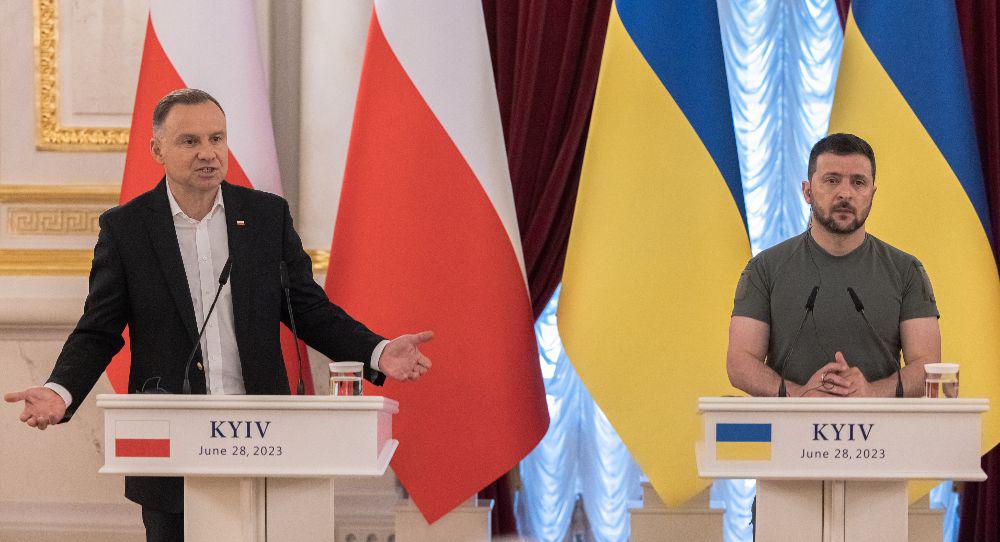
The last year and a half has been a honeymoon period in Polish-Ukrainian relations. During the most tragic times in Ukraine’s recent history, the Polish government and people did their best to welcome millions of Ukrainian refugees and provide military, humanitarian, and other much-needed assistance to the nation that was fighting an existential war. Presidents Andrzej Duda and Volodymyr Zelensky used their regular meetings to express this friendship.
For the vast majority in Poland, Russian aggression against Ukraine is also “our war.” According to the Kiel Institute for World Economy (IfW) estimate, total Polish aid, including refugee costs, amounts to a whopping €19.7 billion ($20.7 billion), including €3 billion ($3.1 billion) for military supplies.
The Polish government does not disclose the details. However, it is a public secret that the actual amount of military aid is much higher. In total, the Polish state’s support amounts to at least 3.2 percent of Poland’s GDP.
Russia’s full-scale war brought Poles and Ukrainians closer than ever. Polish empathy and sympathy for the refugees was noticed and appreciated. Unsurprisingly, 94 percent of Ukrainians consider Poland a friendly country and most Poles like Ukrainians—the highest figure since 1991. About 2.3 million Ukrainians live in Poland, and surveys show that they feel comfortable in their new place.
If this is so, why have there recently been tensions between the two nations?
In much of the international media, the Polish government and the parliamentary election campaign in Poland are blamed for this. Although this factor is not negligible, further explanations are needed.
Even before the Russian invasion, Polish-Ukrainian relations were full of love-hate paradoxes that regularly led to emotional clashes, in particular regarding the interpretation of bilateral relations during the Second World War in Western Ukraine. In 1943–44, the Ukrainian Insurgent Army carried out large-scale ethnic cleansing against Polish civilians, but Kyiv refuses to call it by its real name. Let us try to decipher the recent tensions.
This time the key word is grain. To understand the crisis, we need to go back to June 2022, when the EU took an unprecedented decision to open its internal market to Ukrainian exports and temporarily lift all tariffs. Such an extraordinary privilege has never been granted to a non-EU country.
After only a few months, neighboring countries began to complain about cheaper and more competitive Ukrainian agricultural production. In May, the European Commission banned imports of Ukrainian corn, rapeseed, wheat, and sunflowers to Poland, Slovakia, Hungary, Romania, and Bulgaria for almost five months. Since the beginning of the war, these five countries purchased almost 40 percent of these EU imports of Ukrainian products.
In mid-July, Russia again blocked the Black Sea corridor for Ukrainian agricultural products, forcing Kyiv to put pressure on the Commission and its EU neighbors. On September 15, Brussels lifted the grain ban, but protests by local farmers prompted all five governments of Central and Eastern European countries to unilaterally extend the de facto ban.
Romania and Bulgaria, however, negotiated a bilateral mechanism with Kyiv that allows Ukrainian grain to enter their markets after 30-60 days on the basis of special licenses. However, the reaction of the five countries confirms that the destabilizing problem of Ukrainian grain is objective.
In the case of Poland, the impending election does not help. Both the government and the whole opposition were in favor of maintaining the ban. Unfortunately, the Ukrainian government has little understanding of this, as evidenced by Zelensky’s speech at the UN, in which he accused some EU countries of “feigning solidarity by indirectly supporting Russia.”
These unfair and undeserved words provoked an angry reaction in Poland—both in the government and in society. For Poles—from left to center to right-wing voters as well as Polish volunteers helping at the frontline—the Ukrainian president’s words were an insult. The Polish opposition, too, criticized Zelensky for his “foolish, unnecessary words. Unfair to [Poles].”
The main lesson of the crisis is that too much political emotion inflicts damage. Some conciliatory words have already been spoken on both sides, but the atmosphere is clouded. Mainly because Polish Prime Minister Mateusz Morawiecki’s words “we are no longer supplying weapons to Ukraine because we are now equipping Poland with more modern weapons,” have been misinterpreted by some media. He never said that Poland will not deliver new weapons, but on the contrary stressed that “we will not endanger Ukraine’s security.”
Since the Russian invasion, Poland supplied Ukraine with the following, among other things: 340 tanks (T72, PT -91, Leopard 2A4), 70 modern Krab armored howitzers, 100 modern Rosomak armored personnel carriers, 14 MiG29 aircraft and 12 Mi-24 helicopters, as well as large quantities of ammunition, fuel, and 20,000 of the 40,000+ Starlink systems operating now in Ukraine.
Not much heavy equipment can be given away from the Polish Armed Forces’ inventory, and the current focus is on increasing the country’s own depots. Yes, Poland and other countries in NATO’s Eastern flank support Ukraine at the expense of their own security.
Security remains the most solid foundation for Polish-Ukrainian relations; therefore, any strategic change in bilateral relations is impossible. Especially because there is a war to win. Polish society is among the most Ukraine-friendly in the EU: 72 percent of Poles like Ukrainians, compared to 49 percent of Germans and 55 percent of Romanians.
Poland also remains Ukraine’s most loyal ally and has said it will support Kyiv as long as it takes. This is a serious statement that speaks to the bond between the countries. Rather than posturing, Ukraine and Poland should learn how to master the art of tension management that occasionally occurs between neighbors.
Wojciech Konończuk is director of the Centre for Eastern Studies (OSW).

Wojciech Konończuk
Carnegie does not take institutional positions on public policy issues; the views represented herein are those of the author(s) and do not necessarily reflect the views of Carnegie, its staff, or its trustees.

As we close out another season of Strategic Europe, it is worth taking stock of the deep shifts underway.

Rym Momtaz
The EU had to compromise to adopt a twenty-first sanctions package against Russia, exposing growing cracks in the union’s resolve. Is this latest, weaker round worth it to keep pressure on Moscow?
Rym Momtaz, ed.

Trump is distracted and Ukraine wants Europe to step up. The continent’s leaders must find their voice and assert it in talks with Russia.

Alissa de Carbonnel

Mounting economic strain and battlefield losses will not necessarily make the Kremlin less dangerous. They could instead push Moscow toward a more aggressive hybrid campaign designed to test NATO’s Eastern flank, exploit allied hesitation, and fracture European resolve.

Maksym Beznosiuk

Over the past ten years, NATO has held almost as many summits as it did during the entirety of the Cold War. Are they still useful, or is it time to stop holding annual meetings?
Rym Momtaz, ed.