

Commentary
While the EU and European governments are embracing the much-lauded middle-power moment, this entails three difficult conundrums.
Richard Youngs
{
  "authors": [
    "Christian Achrainer",
    "Michelle Pace"
  ],
  "type": "commentary",
  "blog": "Strategic Europe",
  "centerAffiliationAll": "",
  "centers": [
    "Carnegie Endowment for International Peace",
    "Carnegie Europe"
  ],
  "collections": [
    "Europe’s Southern Neighborhood"
  ],
  "englishNewsletterAll": "",
  "nonEnglishNewsletterAll": "",
  "primaryCenter": "Carnegie Europe",
  "programAffiliation": "",
  "programs": [],
  "projects": [],
  "regions": [
    "Middle East",
    "Europe",
    "North Africa",
    "Egypt",
    "Western Europe",
    "Southern, Eastern, and Western Africa"
  ],
  "topics": [
    "Foreign Policy",
    "Migration",
    "Democracy",
    "Political Reform",
    "EU",
    "Security"
  ]
}
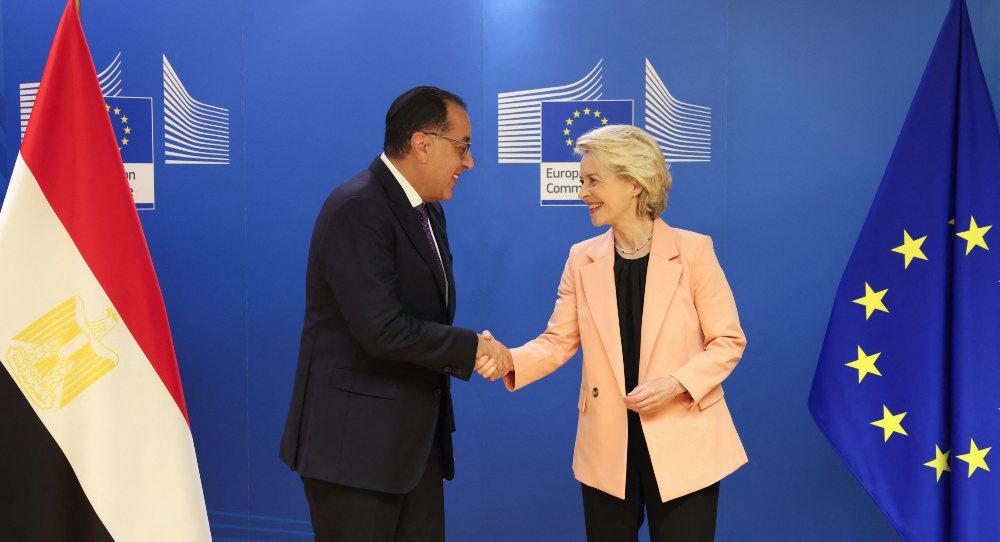
Source: Getty
Brussels is overlooking Egypt’s lack of democratic reforms to secure Cairo’s cooperation in other fields. This short-sighted approach is emboldening the regime and hurting Egyptian civil society.
This blog is part of SHAPEDEM-EU, an EU-funded project that aims to rethink and reshape EU democracy support policies in its eastern and southern neighborhoods.
On December 10-12, Egyptians will reelect Abdelfattah al-Sisi as their president. Nothing else can be expected, because his regime’s grip over Egypt’s political—and economic—sphere is tight, and the runup to the election was, as expected, unfree and unfair.
Al-Sisi was head of the Egyptian Armed Forces when the then president Mohamed Morsi, a leading member of the Muslim Brotherhood, was toppled in a military coup in 2013.
Al-Sisi was elected president one year later, and today, Egypt is even more authoritarian than under Hosni Mubarak, who was forced to step down during the 2011 revolution.
Thus, not much is left of the hope that Egypt could democratize. There is also not much left of the EU’s post-Arab uprisings pledge to end its largely unconditional cooperation with authoritarian rulers in the Arab world.
Once again, the EU and its member states turn a blind eye on the lack of political reforms in exchange for cooperation in questions of, inter alia, energy, migration, and security. Stability trumps support for reforms. As a result, the EU contradicts and ridicules its proclaimed aim to promote democratization.
This interplay of democracy support and other policy fields, as well as the apparent lack of organizational learning from past ineffective practices, are core research interests of the Horizon Europe project SHAPEDEM-EU.
In the field of security, for example, the EU Foreign Affairs Council could not agree on a binding full-fledged arms embargo after the military coup. Instead, some 55 percent of Egypt’s arms imports in the period 2015-2022 came from France, Germany, and Italy.
The EU and its members have also closely cooperated with Cairo in fighting terrorism, without taking a critical stance toward the regime’s usage of the “terrorism” label to imprison tens of thousands of peaceful oppositionists or its over-militarized approach which includes extrajudicial killings and torture.
Moreover, Brussels hopes that Cairo can play a constructive role in easing regional conflicts, for example in Libya. Right now, the Egyptian regime is once again showing the Western world that it is one of very few players that can mediate between Hamas and the Israeli government.
In the field of energy, Brussels has courted Cairo when trying to reduce gas imports from Russia. In June 2022, Egypt, Israel, and the EU signed a memorandum of understanding in which Israel would export gas to Egypt where it would be liquified and then shipped to the EU.
European Commission President Ursula von der Leyen in that context stated that “Egypt is […] a crucial partner in our efforts to move away from Russian fossil fuels and towards more reliable suppliers.” During the COP27 climate summit held in November 2022 in Sharm El-Sheikh, the EU and Egypt established a strategic partnership on renewable hydrogen.
There’s also the issue of migrants. Reducing the influx of migrants is a prime concern of European policymakers. Ahead of the European Council meeting in late October 2023, von der Leyen suggested increasing support for Cairo in this domain, hinting at a deal that could be somewhat comparable to the agreement the EU signed with Tunisia in July 2023.
Reportedly, it would mean some €9 billion ($9.7 billion) in investments, loans, and debt relief to support Egypt’s tumbling economy in exchange for efficient border control. In recent years, Brussels and Cairo have signed deals on migration management worth €111 million ($120 million), which include, among other commitments, the delivery of patrol boats and joint trainings.
The Egyptian leadership presents itself as an invaluable partner in the fields of energy, migration, and security. It is well aware that it can create fear among European policymakers and uses these issues for its own benefit.
Al-Sisi has continuously warned of a Syria or Libya scenario in Egypt should the military lose control, and of the massive number of migrants that may try to leave the by far most populous country in the EU’s southern neighborhood in case of instability. In exchange for preventing this scenario, he expects the EU to turn a blind eye on entrenched authoritarianism and gross human rights violations.
Cairo’s strategy is working: The EU and its member states have not only reestablished relations with Egypt after a short period of reflection following the military coup—they seek to significantly enhance cooperation.
Democracy support, therefore, is not a priority for the union. This is reminiscent of the pre-2011 period; once again, the EU is taking a short-sighted approach. Apparently, the bloc has not learnt from the past.
Yet, as SHAPEDEM-EU research shows, it is imperative that the EU embarks on a journey of unlearning before it can learn how to respond to the people’s call for democratization and hence sustainable stability more efficiently.
Of course, no one expects the EU to bring about democratic change from the outside. However, the few remaining local pro-democracy actors hope that the EU and its member states will at least not make their work even more difficult by propping up the regime.
Current EU practices send fatal messages: The Egyptian regime is reassured that it can continue its unprecedented repression, and local democratization actors conclude that they cannot trust the EU’s promises and rhetoric of values.
In sum, the EU supports authoritarianism rather than democratization in Egypt. Al-Sisi can go into his third term as the uncontested ruler who need not worry about conditionality or critique regarding human rights violations.
Christian Achrainer is a postdoctoral researcher at Roskilde University, Denmark.
Michelle Pace is professor in Global Studies at Roskilde University, Denmark.

Christian Achrainer
Roskilde University
Christian Achrainer is a postdoctoral researcher at Roskilde University, Denmark.
Michelle Pace
Roskilde University
Michelle Pace is professor in Global Studies at Roskilde University, Denmark.
Carnegie does not take institutional positions on public policy issues; the views represented herein are those of the author(s) and do not necessarily reflect the views of Carnegie, its staff, or its trustees.

While the EU and European governments are embracing the much-lauded middle-power moment, this entails three difficult conundrums.

Richard Youngs

Much has been said of the changes Brussels is trying to make to the EU enlargement process. Here’s why gradual integration might—or might not—be the answer.

Dimitar Bechev

The European Commissioner for Trade is headed to China. But after President Xi’s bridge-building visit to Washington, can a more isolated EU overcome Beijing’s stranglehold on critical raw materials? Who will blink first?

Rym Momtaz, ed.

The domestic impacts of how long it is taking to end the war in Ukraine have pushed the French electorate to the political extremes and compromised the country’s diplomatic capacity.
Rym Momtaz

Before the next wave of EU enlargement takes place, the union needs to grapple with thorny questions of how power is distributed among its members.


Emil Sondaj Hansen, Ditte Brasso Sørensen