

Commentary
Dimitar Bechev, Iliriana Gjoni
{
  "authors": [
    "Dimitar Bechev"
  ],
  "type": "commentary",
  "blog": "Strategic Europe",
  "centerAffiliationAll": "",
  "centers": [
    "Carnegie Endowment for International Peace",
    "Carnegie Europe"
  ],
  "collections": [
    "EU Integration and Enlargement"
  ],
  "englishNewsletterAll": "",
  "nonEnglishNewsletterAll": "",
  "primaryCenter": "Carnegie Europe",
  "programAffiliation": "",
  "programs": [],
  "projects": [],
  "regions": [
    "Europe",
    "Western Europe",
    "Western Balkans"
  ],
  "topics": [
    "Foreign Policy",
    "EU",
    "Democracy"
  ]
}
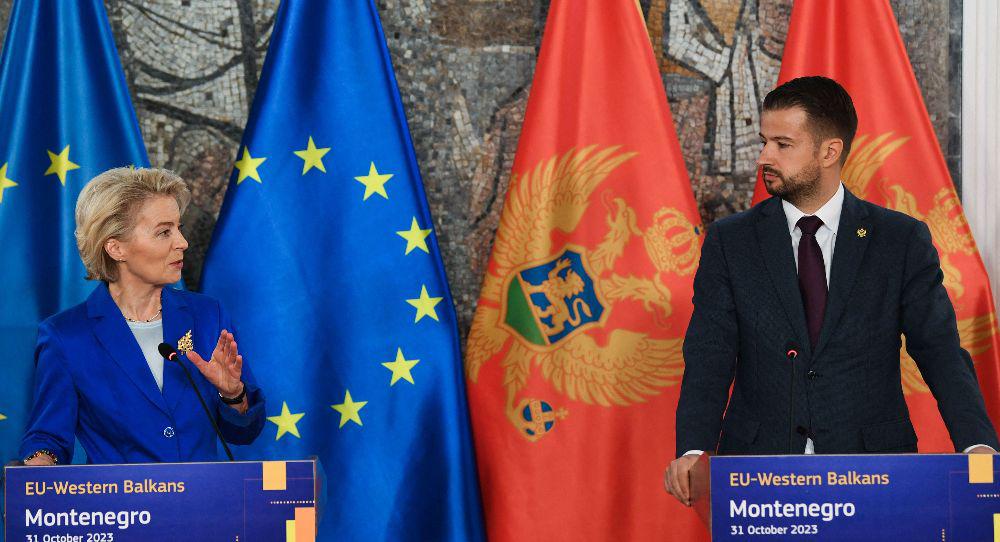
Source: Getty
The new government’s pledge to align with EU standards makes Montenegro the likely next addition to the bloc. But fractious domestic politics could yet derail the country’s European ambitions.
The EU is enlarging. If all goes well, there will be a new member state joining toward the end of this decade. And while all eyes are on Ukraine, which back in December received back a clearance to launch accession talks, the union’s next addition is likely to be a minuscule country on the other side of Eastern Europe: Montenegro.
Under a new coalition government in power since October 2023, the former Yugoslav republic hopes to follow the example of neighboring Croatia and make it into the EU. At least that is what top EU officials heard from Prime Minister Milojko Spajić at the Intergovernmental Conference (IGC) they hosted in Brussels on January 29.
Spajić was welcomed with open arms. “I have attended many IGCs and never seen such positive mood,” a civil servant who had been in the room told me. The EU is in need of a success story on enlargement and Montenegro comes closest to it. If the twenty-seven-member strong bloc is to show resolve in the face of Russian aggression, it better open its door—as NATO did in 2017 when it accepted Montenegro, which at the time appeared to be a battleground between the West and Moscow.
But the Montenegrins are not building their case on geopolitics only. They argue that they can demonstrate progress on conforming with the EU’s standards, which have been tightened for the Western Balkans compared to candidates in previous rounds of enlargement. Montenegro is ahead of the pack, having opened all its negotiation chapters and closed three of them.
Should the European Commission’s interim benchmark assessment report opine at the end of April that sufficient progress is scored on judiciary and other rule-of-law reforms, the Spajić cabinet could actually close five more chapters by the end of this year.
In the meantime, Podgorica has to convince skeptics that it is cracking down on corruption and organized crime—phenomena that many inside and outside the country see as deeply rooted.
Montenegro has a mixed reputation. On the one hand, successive pro-Western governments have aligned fully with the EU’s foreign policy, including sanctions on Russia, which have left a huge footprint in the Montenegrin economy. Further back, in 2006, it separated peacefully from Serbia. Relations with neighbors, including EU member Croatia, are generally positive.
On the other hand, the long reign of the Democratic Party of Socialists (DPS)—in power between 1991 and 2020—and its leader Milo Djukanović had come to symbolize state capture. The two ramshackle coalition governments that succeeded DPS after the pivotal elections in August 2020 promised to speed up the country’s EU integration but delivered little in practice. The phrase “Montenegro is a frontrunner” elicited snarky comments in Brussels and foreign ministries across the EU.
This time around it might be different. The centrist Europe Now Movement (PES) won two crucial elections last year: first, the presidential race, which saw its co-founder Jakov Milatović beat Djukanović, and then snap general polls in June. As a result, Dritan Abazović’s minority cabinet, reliant on DPS parliamentary backing, has been replaced by a government commanding sufficient support. As a result, key judicial appointments and legislation went through legislation, to Brussels’ delight. Most importantly, the new administration succeeded in holding an overdue population census without any obstructions. For the time, being, the vexing fight over Montenegrin identity between self-identified Serbs and ethnic Montenegrins has been defused. Prime Minister Spajić would rather talk jobs and growth than ethnic belonging. All in all, the political momentum is going in a direction Brussels likes.
Yet plenty could still go wrong. For starters, Montenegrin politics remains as fractious as ever, with Spajić and Milatović recently partying ways.
People are furthermore uneasy about PES’s perceived Faustian bargain with For the Future of Montenegro (ZBCG), a coalition of Serb nationalist parties formerly aligned with Russia and fighting NATO membership. Andrija Mandić, one of the ZBCG’s leaders, is now parliamentary speaker. In fairness, the coalition deal commits Mandić to Montenegro’s pro-Western course—including NATO, the recognition of Kosovo, sanctions against Russia and, most importantly, accession to the EU.
The ZBCG has been voting on laws required by Brussels. But detractors ask whether Mandić is not a wolf in sheepskin. Rubbing shoulders with Republika Srpska’s Milorad Dodik and putting on display Serbia’s flag (“it’s actually Montenegro’s old banner,” Mandić argues) raises eyebrows. So does the support Serbia’s leader Aleksandar Vučić provides to the Serb bloc. And, under the partnership deal, the ZBCG has to eventually nominate three ministers to the government, a development which will be watched carefully by both locals and the West.
Fears of a creeping re-Serbianization are, of course, exploited by DPS, which has, for over a decade, worn the mantle of a defender of Montenegrin sovereignty and identity. The former ruling party would not mind being included in Spajić’s government, in the name of keeping Serbia out and cementing Montenegro’s Western orientation. But that may result in a blockage of rule-of-law reforms.
There are risks on the EU side, too. Not all member states may look kindly to the argument that enlargement should be a priority. Some, experts fear, could pour cold water on Montenegro’s ambitions to start closing chapters this year with a view to wrapping up accession talks in 2028. Failure to score progress on the EU track could sow discord in domestic politics.
Montenegro could relapse into its default state: basking in the glory of being “a frontrunner” without changing much internally. This would clearly be a win for those in the Western Balkans who maintain that the EU has lost its credibility and that therefore flirting with Russia, China, and others is fully warranted.
A window of opportunity has opened for Montenegro. There’s no time to squander it.

Senior Fellow, Carnegie Europe
Dimitar Bechev is a senior fellow at Carnegie Europe, where he focuses on EU enlargement, the Western Balkans, and Eastern Europe.
Recent Work

Dimitar Bechev, Iliriana Gjoni
Dimitar Bechev
Carnegie does not take institutional positions on public policy issues; the views represented herein are those of the author(s) and do not necessarily reflect the views of Carnegie, its staff, or its trustees.
The full list of humiliations Europe has endured since Donald Trump returned to the White House makes for grim reading. But Washington’s adversarial approach to its allies undermines its own power base.

Rym Momtaz
The closure of the Strait of Hormuz has triggered a global energy crisis, but Europe is stuck in reaction mode. Without more strategic foresight, the EU will remain dependent on fossil fuels and will never be truly secure.


Milo McBride, Pauline Gerard
After spending much of 2025 trying to placate Donald Trump, some European leaders are starting to change posture. But is even a hostile Washington still so important to Europe that the U.S. president’s outbursts are worth putting up with?
Rym Momtaz, ed.
European leaders have now not only lost faith in Donald Trump’s U.S. presidency, but also in America’s hegemony as a whole. But short-term challenges make an immediate divorce unwise.
Rym Momtaz
Europe has an interest in supporting Armenian leader Nikol Pashinyan as he tries to make peace with neighbors and loosen ties with Russia. But it is depersonalized support in the long term, not quickfire flash, that will win the day.

Thomas de Waal