

Commentary
The EU can impose sanctions but struggles to enforce them without the United States. With Washington increasingly disinterested in backing European interests, the bloc must now fend for itself.
Nicu Popescu, Tiago Antunes
{
  "authors": [
    "Nona Mikhelidze"
  ],
  "type": "commentary",
  "blog": "Strategic Europe",
  "centerAffiliationAll": "",
  "centers": [
    "Carnegie Endowment for International Peace",
    "Carnegie Europe"
  ],
  "collections": [
    "EU Integration and Enlargement",
    "Aso Tavitian Initiative"
  ],
  "englishNewsletterAll": "",
  "nonEnglishNewsletterAll": "",
  "primaryCenter": "Carnegie Europe",
  "programAffiliation": "",
  "programs": [],
  "projects": [],
  "regions": [
    "Georgia",
    "Europe",
    "Caucasus"
  ],
  "topics": [
    "Democracy",
    "EU",
    "Foreign Policy"
  ]
}
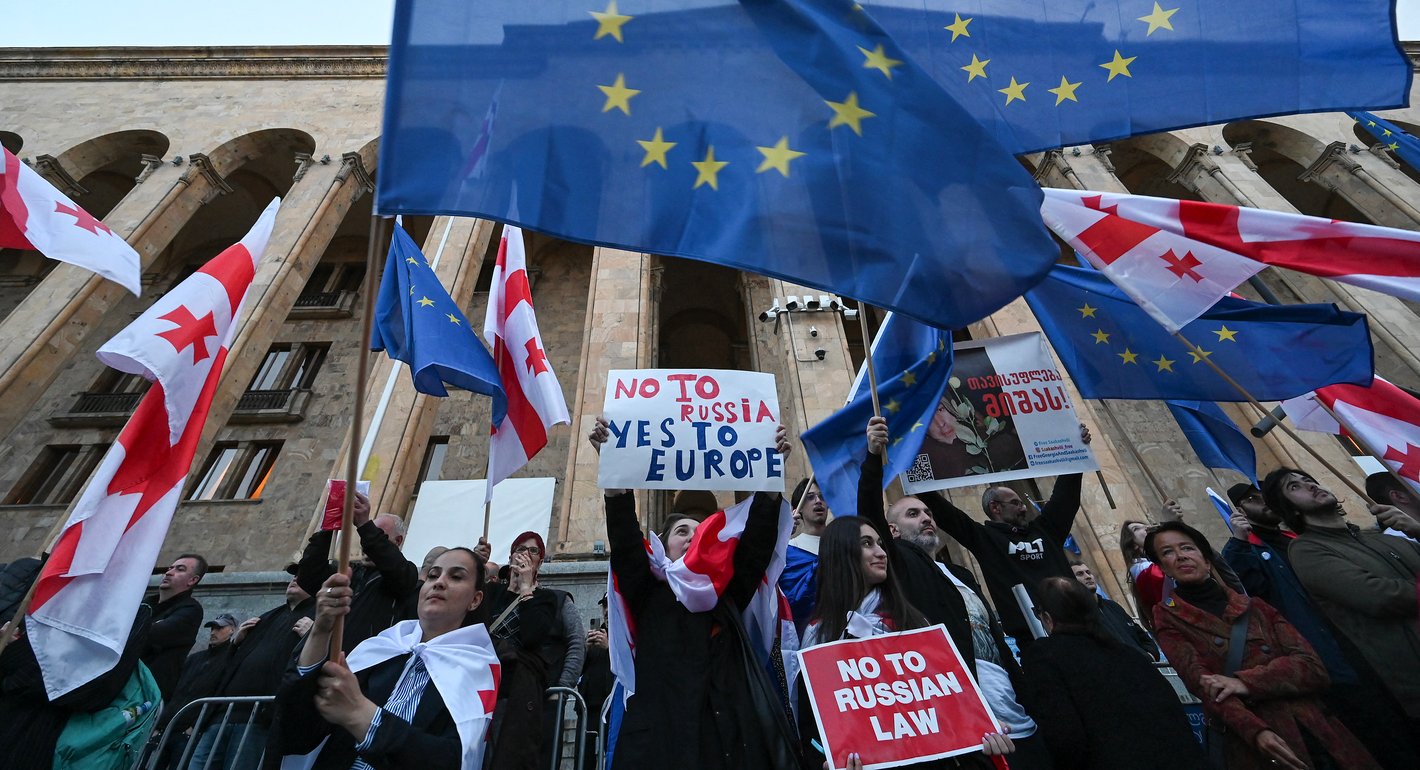
Source: Getty
The EU’s failure to leverage strict conditionality emboldened Georgia’s government to pursue regressive policies. Ongoing protests should prompt Brussels to empower Georgian grassroots as catalysts for democratic change.
This article is part of SHAPEDEM-EU, an EU-funded project that aims to rethink and reshape EU democracy support policies in its eastern and southern neighborhoods.
The ongoing surge of protests in Georgia, sparked by the proposed reintroduction of the Russian-style “foreign agents” law by the ruling Georgian Dream party, heralds a pivotal moment in the nation’s post-Soviet journey.
As the country commemorates thirty-three years of independence, a youth uprising has emerged, challenging not only governmental policies but also the established norms of civil society engagement and EU democracy promotion endeavors.
Unlike previous demonstrations, the current protests are distinguished by the prominent participation of the Zoomers generation, or Gen Z. Operating beyond traditional political and NGO affiliations, these activists bring fresh energy and self-organizational skills to the forefront, marking a departure from conventional democratic actors in Georgia.
The emergence of a truly grassroots movement, characterized by its innovative slogans and independent ethos, not only contests the government’s conservative, anti-European stance but also calls into question the efficacy of traditional civil society organizations, often exclusively championed by the EU as the primary agents of democratization in the country.
The Georgian Dream’s decision to reintroduce the foreign agents bill, which would require non-governmental groups and media to register as “organisations serving the interest of a foreign power” if more than 20 percent of their funding comes from foreign donors, reflects not only a shift in foreign policy orientation but also a regression in democratic development. However, the root of the current crisis extends beyond governmental decisions to a critical misstep by the EU, some of the Georgian opposition parties, and civil society organizations. Their prioritization of geopolitics over democracy has not only jeopardized Georgia’s path toward EU integration but has also hindered progress on crucial democratic reforms.
Back in December 2023, despite falling short of the EU’s conditions for candidate status, Georgia was granted the designation, which bolstered the ruling party and marginalized efforts for meaningful democratic reform. Moreover, the parliamentary opposition, motivated by a “candidate status at any cost” mindset, collaborated with the government to maintain the appearance of compliance with EU conditions. Meanwhile, a considerable part of Georgia’s civil society organizations, instead of acting as watchdogs, failed to engage in honest discourse on candidate status. Some sidelined dissenting voices and skewed the narrative, prioritizing public support for European integration over the imperative of genuine democratic progress.
Granting EU candidate status to Georgia has backfired. Rather than stimulating reforms, the EU’s failure to enforce conditionality effectively emboldened the Georgian government to pursue regressive policies reminiscent of those of Russia. Viewing candidate status as validation, the ruling party intensified authoritarian measures, reintroducing the foreign agents law, and proposing anti-LGBTQ+ legislation.
As Georgian society, particularly its youth, grapples with the consequences and charts a new path, the streets of Georgia’s main cities echo with the resounding chant “no to Russia, yes to Europe,” voiced by the Zoomers generation. Yet, this slogan transcends foreign policy; for Georgian youth, embracing Europe signifies adopting a way of life encapsulated in various other rallying cries: “equality,” “unity” (in overcoming the polarization plaguing Georgia), “respect for fundamental human freedoms,” “universal and quality education for all,” “gender equality,” and more. Through these chants, the Georgian youth sends a clear message to the political establishment, local civil society organizations, and the EU: the country is shedding its post-Soviet identity and embarking on a new phase of development, the contours of which remain difficult to fully envision.
Amid dwindling prospects for change within the ruling party, the Georgian youth signals to the EU that it is time to reassess the drivers of transformation in their country and to overhaul the union’s strategy for engaging with civil society organizations. This entails a decisive shift away from top-down democracy promotion and the sole reliance on elitist, outdated post-Soviet entities, both in age and mindset. It emphasizes the critical need to reassess EU democracy promotion strategies and to empower grassroots movements as the true catalysts for change in Georgian society.
Looking ahead, as the October 2024 parliamentary election approaches, Georgians, particularly the youth, must consider a crucial factor beyond the government’s autocratic tendencies: the timing of the reintroduction of the foreign agents law. Before this decision, the Georgian Dream party seemed poised for victory. Pursuing such an initiative now wasn’t politically strategic, particularly after the European Commission granted candidate status to Georgia in December 2023. The EU’s move bolstered the Georgian Dream’s image, countering accusations of pro-Russia leanings. The government’s persistence with the law despite these circumstances suggests significant pressure from the Kremlin, which raises concerns about Moscow’s potential leverage over Georgia’s de facto leader, Bidzina Ivanishvili, and his administration.
This very reality transforms the forthcoming parliamentary election into a referendum on Georgia’s future course, whereby voting against the ruling party would signify a strong endorsement of European values and a reaffirmation of Georgian aspirations for enhanced integration with the EU.
Meanwhile, a pivotal decision looms for the European Commission regarding the opening of accession negotiations with Georgia. Should the Georgian Dream emerge victorious, prospects for implementing reforms will dim. The EU is thus at a critical juncture, torn between geopolitics and democratic principles.
Yet, Brussels cannot afford to waver; it must not repeat past compromises. To yield now risks undermining the very values it champions. The EU’s credibility hangs in the balance, alongside its role as a normative force.
The union must stand firm, recognizing that its strategic response pivots on upholding democracy. Security and stability demand an unwavering commitment to reinforcing democratic principles through rigorous conditionality. Anything less jeopardizes not just Georgia’s future but the EU’s foundational identity as a bastion of values in a turbulent world.
Nona Mikhelidze is a senior fellow at the Istituto Affari Internazionali (IAI).

Nona Mikhelidze
Senior Fellow, Istituto Affari Internazionali (IAI)

The EU can impose sanctions but struggles to enforce them without the United States. With Washington increasingly disinterested in backing European interests, the bloc must now fend for itself.


Nicu Popescu, Tiago Antunes

Russia is testing the waters of NATO’s mutual defense clause. What do strikes in Romanian territorial waters mean for the alliance’s posture toward Moscow?

Dimitar Bechev

With its public finances in shambles, the far right polling at 35 percent ahead of the 2027 presidential election, and a growing protest movement, is France’s crisis a threat to the EU’s geopolitical awakening?

Rym Momtaz, ed.

Ahead of a tough winter for Ukraine, Donald Trump’s swing back toward Russia bodes ill. But instead of panicking, Kyiv’s European allies are focusing on action.
Rym Momtaz

While the EU and European governments are embracing the much-lauded middle-power moment, this entails three difficult conundrums.

Richard Youngs