

Commentary
Gwendolyn Sasse
{
  "authors": [
    "Gwendolyn Sasse"
  ],
  "type": "commentary",
  "blog": "Strategic Europe",
  "centerAffiliationAll": "",
  "centers": [
    "Carnegie Endowment for International Peace",
    "Carnegie Europe"
  ],
  "englishNewsletterAll": "",
  "nonEnglishNewsletterAll": "",
  "primaryCenter": "Carnegie Europe",
  "programAffiliation": "",
  "programs": [],
  "projects": [],
  "regions": [
    "Ukraine",
    "Europe",
    "Eastern Europe"
  ],
  "topics": [
    "Security",
    "EU Enlargement",
    "Political Reform"
  ]
}
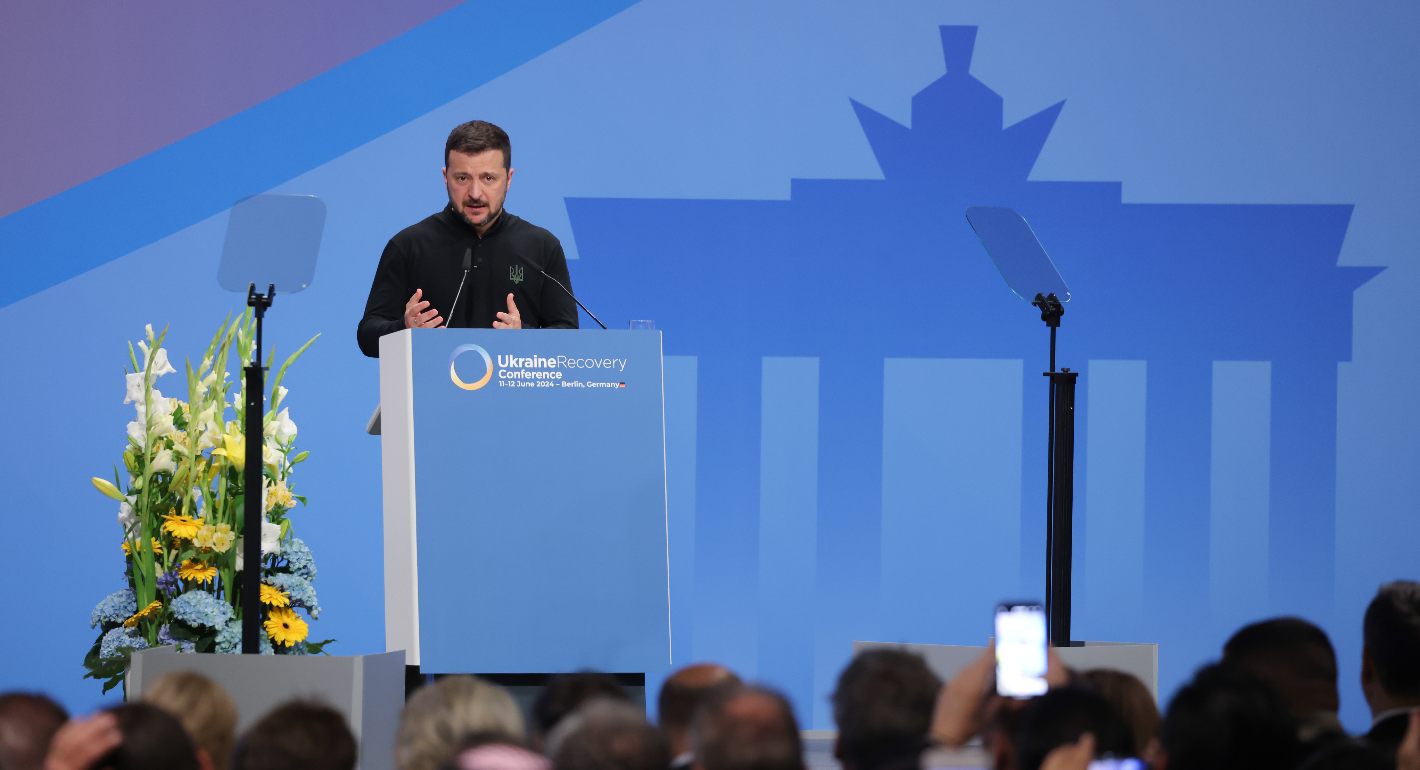
Source: Getty
This week’s political conferences will highlight Ukraine’s threefold challenge of wartime resilience, recovery, and EU accession. Kyiv’s partners must adjust to thinking in all three dimensions simultaneously.
The different dimensions of Russia’s war against Ukraine will be at the forefront this week in a series of events around the Ukraine Recovery Conference in Berlin, taking place on June 11-12, and the Summit on Peace in Ukraine, happening on June 15-16 in Switzerland.
Today, Ukrainian President Volodymyr Zelensky will also speak in the German parliament. It is the second time he will address German parliamentarians. His last—online—address in March 2022 was both a desperate plea and open criticism of Germany’s hesitant military support. This time, the tone is likely to be different, as Zelensky will express gratitude for substantial military and financial aid. Yet the main message will remain the same: more support is needed, and Germany and others are, to a large extent, deciding what the next phase of this war will look like.
The Ukrainian president’s presence in parliament reminds politicians and the public of the realities of a war which, for many Germans and other Western Europeans, still seems far away. The European Parliament elections have just demonstrated how the war—or better the perceived need to end it, accompanied by disinformation directly or indirectly sponsored by the Kremlin, affected many election campaigns and results across Europe.
The Ukraine Recovery Conference in Berlin, hosted jointly by the German and Ukrainian governments, expects to gather over 2,000 policymakers, journalists, experts, and civil society representatives, among others. With a whole-of-society approach, it continues a theme from previous conferences but tries to embed it more comprehensively into the conference and take steps toward its institutionalization.
Inclusive participation of a wide range of actors is a prerequisite for social recovery and the maintenance of a degree of social cohesion, but not all stakeholders speak with the same loud voice in this process, which has an inbuilt executive bias. That is also one of the main challenges of the EU accession process.
Ukraine’s recovery and EU accession tend to be talked about as if they constitute one overarching process. However, there are important differences between their inherent logics and the two need to be actively connected in order to become mutually reinforcing and to create synergies.
EU accession has a clear endpoint—membership—and a relatively clearly defined path along conditions and acquis chapters. By comparison, recovery can take different forms and involves a much wider set of domestic and international actors. It is also not measured against one endpoint and while there is dependence on external support, there is no equivalent to the veto rights EU member states hold over deciding whether conditions have been met for a new member state to be accepted. Both the Ukraine Plan of the Ukrainian government and the EU’s Ukraine Facility aim to connect the two processes. It will be necessary to convince a wider range of international actors to accept and engage with this link to EU accession.
After the Ukraine Recovery Conference, Zelensky is also expected to attend the G7 meeting in Italy before heading to Switzerland for a peace summit initiated by Ukraine. It is expected to bring together more countries, including some from the Global South, than the previous peace summits and talks in Copenhagen, Jeddah, Malta, and Davos.
The conference in Nidwalden, Switzerland will again take place without Russia. The aim is to get the official backing of as many countries as possible for part of Zelensky’s ten-point peace plan, first presented to the G7 in November 2022. This peace formula hinges on the withdrawal of Russian troops, the restoration of Ukraine’s territorial integrity, and security guarantees.
Rather than expecting countries to sign up to all ten points, the plan now is to rally support around the points that seem less controversial: no nuclear threats, the security of nuclear facilities, food security, and respect for the UN Charter. Even though Russian state rhetoric is ridiculing the conference and China and Brazil have announced that they will not attend, it helps to embed the war in a more global agenda. Most importantly, it highlights that fighting a war and negotiating are not mutually exclusive—and both will be important for ending the war.
Zelensky’s appearances this week demonstrate that he has the legitimacy to act. This issue has gained ground among the right- and left-wing parties in many European countries. In Ukraine, holding elections when the parliament’s and Zelensky’s term in office ended, is currently not an issue—unless the West makes it one. In Ukraine, Zelensky remains by far the most popular politician.
This week underlines Ukraine’s dilemma of simultaneity: it needs to deal with fighting a war, advancing its recovery, and pursuing EU membership at the same time. Kyiv’s partners still have some way to go to adjust to thinking in all these three dimensions simultaneously. Zelensky’s speech in the German parliament should be a stark reminder of the realities of an open-ended war. Without the security dimension, discussions about recovery and EU accession remain hollow.
Gwendolyn Sasse is a nonresident fellow at Carnegie Europe and the director of the Centre for East European and International Studies (ZOiS) in Berlin.
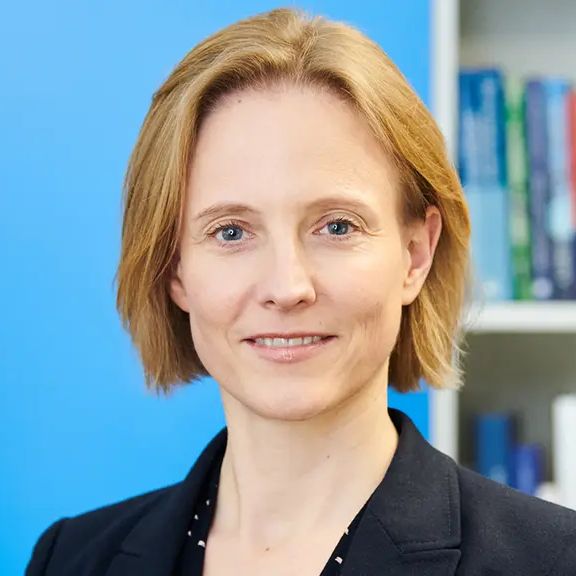
Nonresident Senior Fellow, Carnegie Europe
Gwendolyn Sasse is a nonresident senior fellow at Carnegie Europe. Her research focuses on Eastern Europe, with a particular focus on Ukrainian politics and society, EU enlargement, and comparative democratization.
Recent Work
Gwendolyn Sasse
Gwendolyn Sasse
Carnegie does not take institutional positions on public policy issues; the views represented herein are those of the author(s) and do not necessarily reflect the views of Carnegie, its staff, or its trustees.
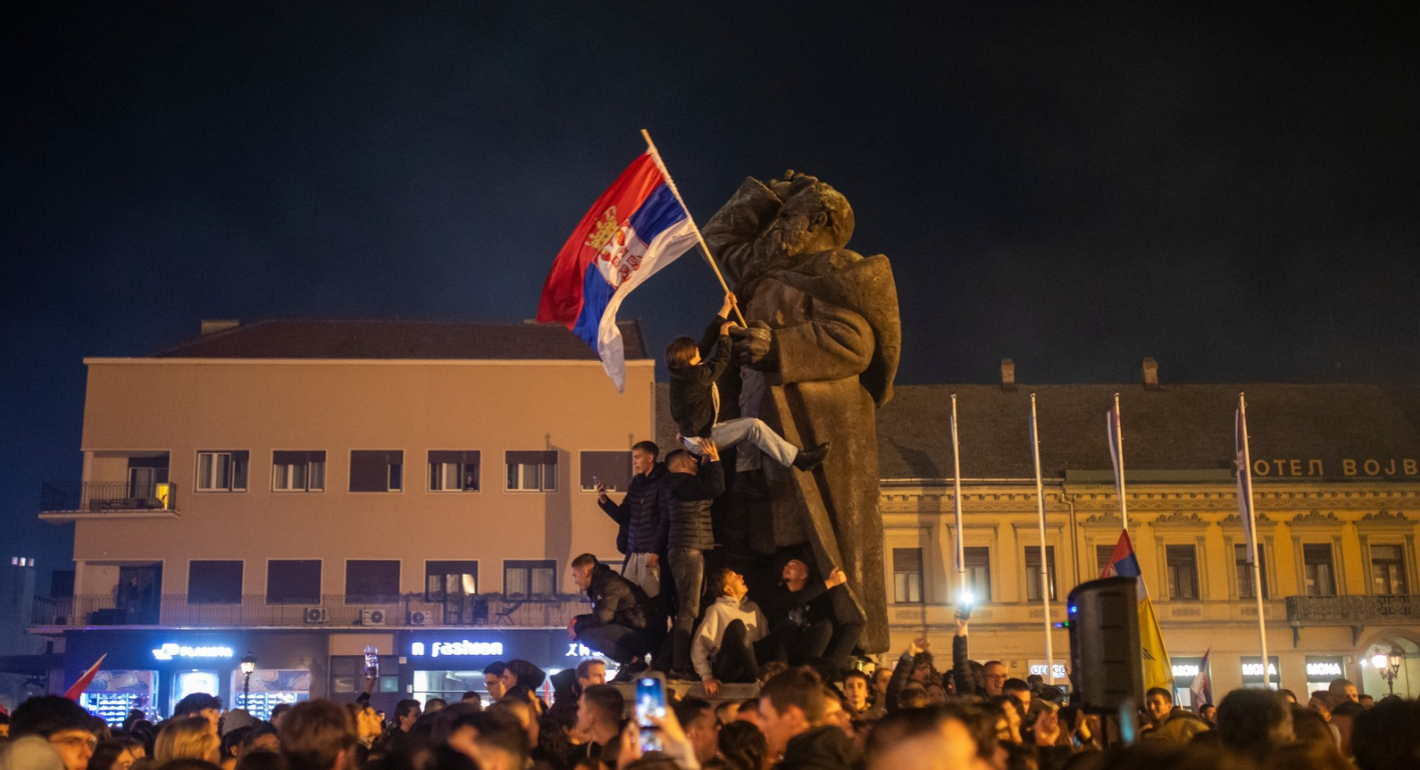
Excitement is in the air following Aleksandar Vučić’s defeat in Serbia. To build a truly democratic state, the movement that unseated the former president must learn from the mistakes of the past.
Ivan Vejvoda

The EU can impose sanctions but struggles to enforce them without the United States. With Washington increasingly disinterested in backing European interests, the bloc must now fend for itself.


Nicu Popescu, Tiago Antunes

Russia is testing the waters of NATO’s mutual defense clause. What do strikes in Romanian territorial waters mean for the alliance’s posture toward Moscow?

Dimitar Bechev

With its public finances in shambles, the far right polling at 35 percent ahead of the 2027 presidential election, and a growing protest movement, is France’s crisis a threat to the EU’s geopolitical awakening?

Rym Momtaz, ed.

Ahead of a tough winter for Ukraine, Donald Trump’s swing back toward Russia bodes ill. But instead of panicking, Kyiv’s European allies are focusing on action.
Rym Momtaz