

Commentary
Thomas de Waal
{
  "authors": [
    "Thomas de Waal"
  ],
  "type": "commentary",
  "blog": "Strategic Europe",
  "centerAffiliationAll": "",
  "centers": [
    "Carnegie Endowment for International Peace",
    "Carnegie Europe"
  ],
  "collections": [
    "EU Integration and Enlargement",
    "Aso Tavitian Initiative"
  ],
  "englishNewsletterAll": "",
  "nonEnglishNewsletterAll": "",
  "primaryCenter": "Carnegie Europe",
  "programAffiliation": "",
  "programs": [],
  "projects": [],
  "regions": [
    "Caucasus",
    "Georgia",
    "Europe",
    "Western Europe"
  ],
  "topics": [
    "EU",
    "Democracy"
  ]
}
Source: Getty
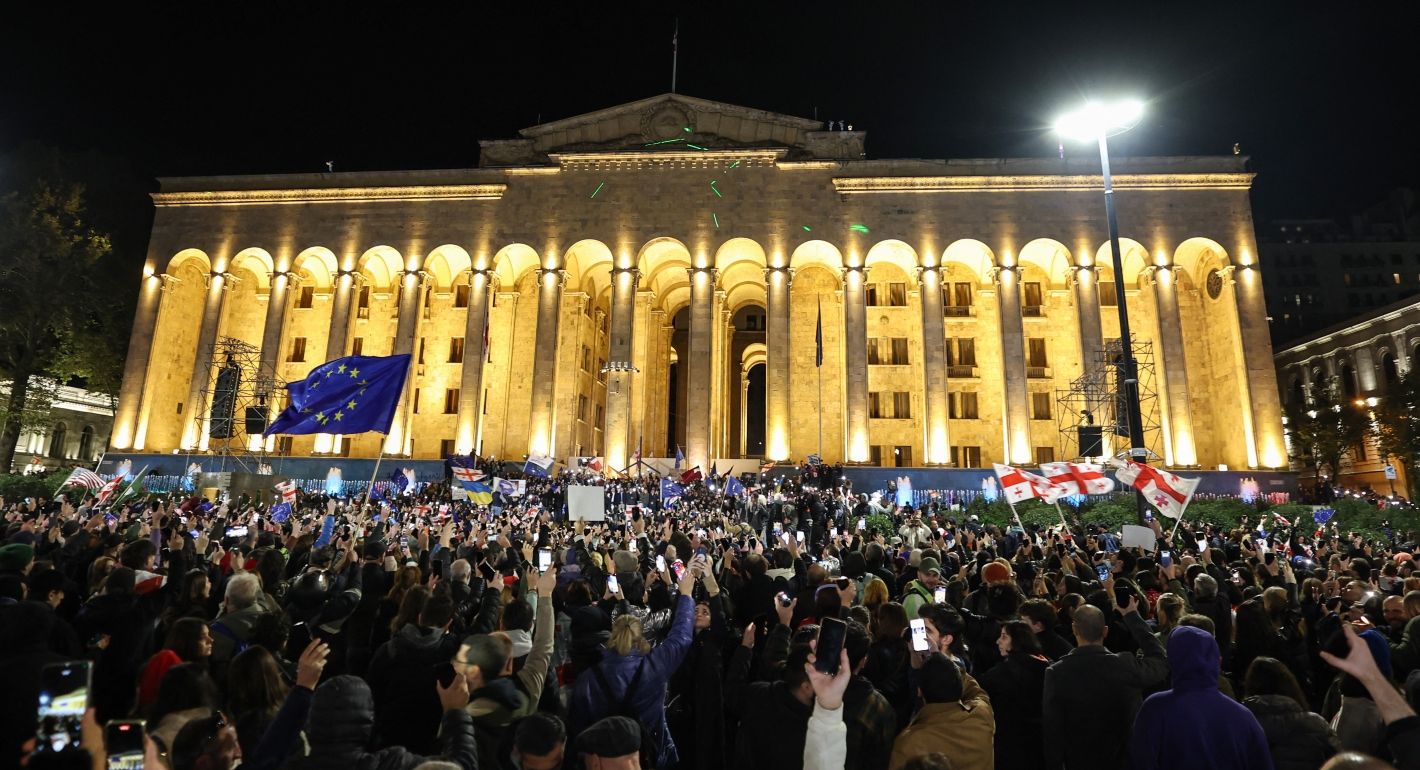
Georgian Dream has claimed victory in a contested election, sparking protests and a constitutional crisis. The EU is now under pressure to support Georgians’ democratic and European aspirations while working to prevent further escalation and potential violence.
Just because you could see it coming, it does not make the situation any better.
Georgian Dream, Georgia’s tired, angry, and increasingly authoritarian ruling party, claimed victory in the country’s October 26 parliamentary election. Officially, the party won 54 percent of the vote and can therefore govern for another four-year term. It is clear, however, that to a greater or lesser degree, the election was stolen.
Georgia is now in a full-blown constitutional crisis fraught with danger. Protesters, backed by the president, whose powers are limited, are demonstrating against the election outcome. Opposition parties are likely to boycott a new parliament. Neither side will want to back down.
For most Georgians, this was more than just a regular election. Ever since the 1990s, Georgia’s processes of democratization and Europeanization have been closely intertwined. For many, this was a referendum on whether to continue on a European path and remain a democracy or to throw in their lot with a government that is rejecting the West, is appeasing Russia, and has more or less openly declared that it will make Georgia a one-party state.
This situation poses a huge challenge for the EU. It must simultaneously question the validity of the election and Georgian Dream’s claim of victory, give positive reassurances to the people of Georgia who aspire to join the union, and do all it can to stop the confrontation getting worse and potentially violent.
Georgia’s move toward the EU is demand driven in society, even if Georgians understand it in different ways. Recent polling suggests that Georgians trust the EU more than they do any domestic institution. Russia and China, by contrast, come at the bottom of the list; they are the preferred partners of business elites, not of wider society.
So ordinary Georgians expect Brussels not to abandon them. Already, however, the EU faces open dissent in the form of Hungarian Prime Minister Viktor Orbán, who sees Georgian Dream as a partner in what political scientists Stephen Holmes and Ivan Krastev have called Eastern Europe’s “anti-liberal revolt.”
Many EU member states and European Commission President Ursula von der Leyen condemned the election results as highly irregular. But even before they were announced, Orbán, whose country holds the rotating presidency of the EU Council, congratulated Georgian Dream on its victory. He flew into Tbilisi on October 28 and declared that “Georgia is a conservative, Christian and pro-Europe state,” which is resisting the EU’s “useless lecturing.”
Orbán’s early congratulation looks to have been a choreographed part of a fairly sophisticated operation by the Georgian government to claim the election and have the result recognized. Months of preparation laid the ground for an election day that saw a host of illegal activities, including intimidation of voters and election observers, cash handouts for voters, and the confiscation of state workers’ ID cards, which were then handed to loyal Georgian Dream activists to vote.
Had this been a fair vote, it would probably have produced an outcome similar to that of Poland’s 2023 election, in which the ruling Law and Justice (PiS) party finished first with 35 percent of the vote but an alliance of opposition parties picked up more than half of the vote and formed a government.
Georgian Dream has undoubtedly lost popularity in the past four years, and the broad coalition it once led has long disintegrated. The party came to power twelve years ago with a mandate to restore democracy after the increasingly authoritarian United National Movement and tackle Georgia’s endemic socioeconomic problems, unemployment, and poverty. Georgian Dream’s record on both issues is poor.
Instead, the party campaigned on a nativist, populist ticket. Barely mentioning the economy, it hammered home a message of anti-LGBTQ propaganda and support for the Orthodox Church. Chiefly—and most effectively in terms of winning the votes that it did—Georgian Dream repeated the message that it was the “party of peace” and that the opposition would allegedly drag the country into war with Russia on the orders of the West.
This dark worldview was crudely imposed on Soviet-style posters that depicted opposition leaders as being on a dog leash manipulated by an unseen (presumably Western) hand or, most offensively, contrasted bombed Ukrainian cities with untouched Georgian ones.
In 2023, the EU offered Georgia candidate country status in language that framed the decision as being a reward for “the genuine aspirations of the overwhelming majority of [the country’s] citizens” rather than for the actions of the government.
This should remain the guiding light of the EU’s response to the crisis. Making the EU’s stance about society as a whole helps European leaders push back against the charge that they are plotting regime change on behalf of Georgia’s opposition parties—rather than seeking to hold individuals responsible for egregious antidemocratic acts. The threat of sanctions and visa bans on senior figures looks more like an effective instrument than a wholesale cancellation of Georgians’ right to visa-free travel to the EU.
This line also helps the Europeans to talk less about Russia. Moscow may have conducted covert operations in the Georgian election, but observers have yet to see much evidence of that—in contrast to Russia’s recent interventions in Moldova. Georgian Dream’s leaders are indeed moving Georgia closer to Russia on several fronts, but their preferred model seems to be a nonaligned, illiberal, sovereigntist state, such as Azerbaijan. For now, at least, the EU’s Orbán problem in Georgia is more pressing than its Putin problem.
As Georgia’s crisis continues to unfold, the immediate priority is to try to deter Georgian Dream from conducting a crackdown similar to the one the Belarusian leader, Aleksandr Lukashenko, waged after Belarus’s fraudulent presidential election in 2020. Many are watching and hoping—and not just in Georgia.

Senior Fellow, Carnegie Europe
Thomas de Waal is a senior fellow at Carnegie Europe, specializing in Eastern Europe and the Caucasus.
Recent Work
Thomas de Waal
Thomas de Waal

Ahead of a tough winter for Ukraine, Donald Trump’s swing back toward Russia bodes ill. But instead of panicking, Kyiv’s European allies are focusing on action.

Rym Momtaz

While the EU and European governments are embracing the much-lauded middle-power moment, this entails three difficult conundrums.

Richard Youngs

Much has been said of the changes Brussels is trying to make to the EU enlargement process. Here’s why gradual integration might—or might not—be the answer.

Dimitar Bechev

The European Commissioner for Trade is headed to China. But after President Xi’s bridge-building visit to Washington, can a more isolated EU overcome Beijing’s stranglehold on critical raw materials? Who will blink first?
Rym Momtaz, ed.

The domestic impacts of how long it is taking to end the war in Ukraine have pushed the French electorate to the political extremes and compromised the country’s diplomatic capacity.
Rym Momtaz