

Commentary
Judy Dempsey
{
  "authors": [
    "Judy Dempsey"
  ],
  "type": "commentary",
  "blog": "Strategic Europe",
  "centerAffiliationAll": "",
  "centers": [
    "Carnegie Endowment for International Peace",
    "Carnegie Europe"
  ],
  "englishNewsletterAll": "",
  "nonEnglishNewsletterAll": "",
  "primaryCenter": "Carnegie Europe",
  "programAffiliation": "",
  "programs": [],
  "projects": [],
  "regions": [
    "Western Europe",
    "Germany"
  ],
  "topics": [
    "Domestic Politics",
    "Economy"
  ]
}
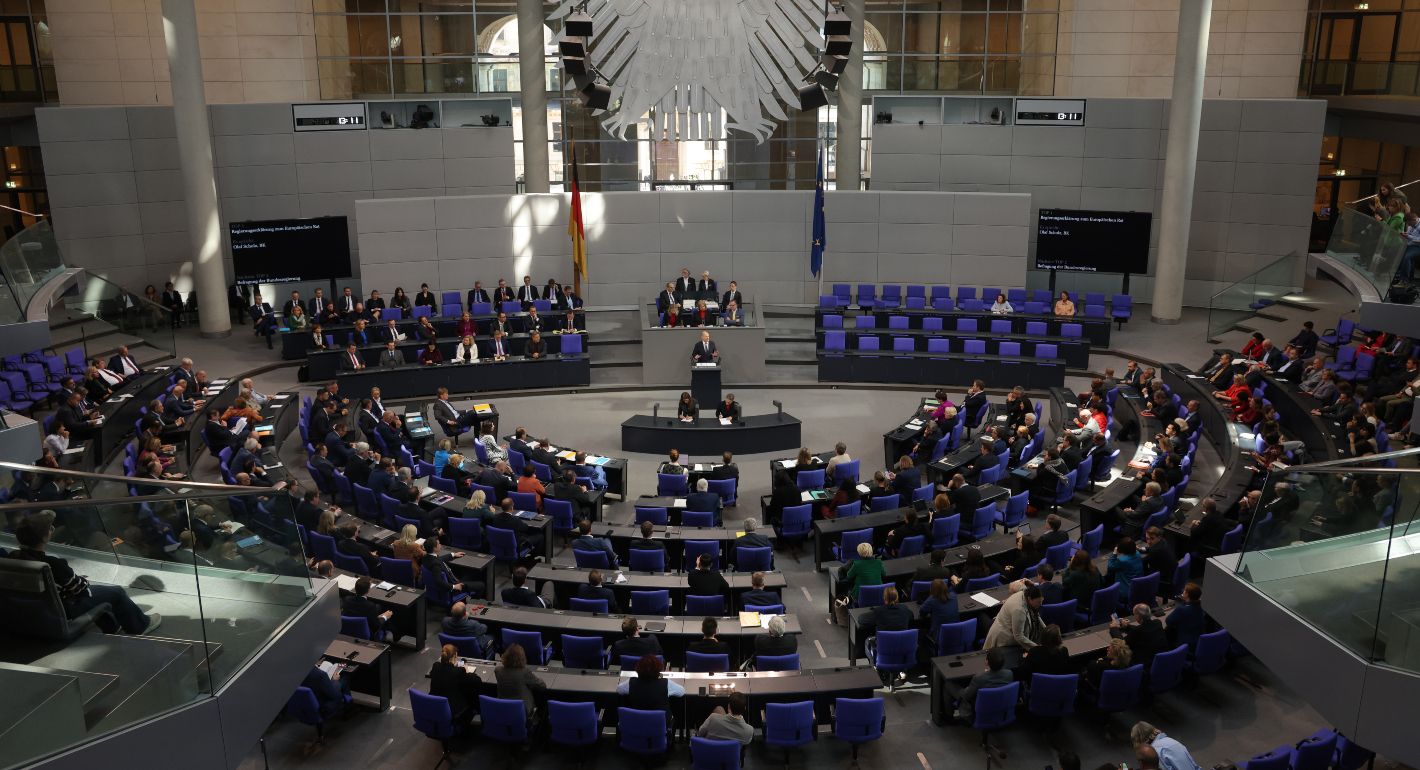
Source: Getty
A change in Germany’s leadership could bring about overdue reforms to the country. By reviving the German economy and investing in defense, Scholz’s successor would benefit all of Europe.
When German voters go to the polls on February 23, they have a chance to reverse the weakening of their country’s economy and foreign policy brought about by the outgoing ruling coalition.
With so many unknowns about the incoming Donald Trump administration in the United States, the future of Syria, and Russia’s aggression against Ukraine and interference in Eastern Europe, the EU desperately needs a new kind of leadership in Berlin. One that will take bold and strategic decisions on economic, foreign, and defense policy.
Germany’s next government will have no time to lose. It must immediately tackle an economy that has been too slow to adapt to deindustrialization and has become a drag on the EU’s economic health. The new chancellor will also have to act strategically on security. That means investing in defense and influencing how Europe can start fending for itself.
If the polls prove right, Friedrich Merz, leader of the opposition conservative Christian Democratic Union (CDU) will succeed Olaf Scholz. Merz already has a leg up on his predecessor: He has signaled his preparedness to loosen the debt brake—at the very least when it comes to defense spending—and seems to have a better connection with French President Emmanuel Macron, the other half of the EU’s central Franco-German engine.
But the task ahead remains a difficult one. The new chancellor will have to press on with major reforms—and a fundamental shift in strategic mindset—even if their coalition partners balk at them.
First, the chancellor will need to convince two thirds of the parliamentary majority to loosen the Schuldenbremse, the fiscal debt brake.
The brake, which restricts structured annual budget deficits to 0.35 percent of GDP, was introduced in 2010 to rein in surging government debt. But it has since hindered critical investments in strategic capabilities such as infrastructure, education, and tech.
The investment gap is estimated to be €600 billion ($623 billion), or 15 percent of GDP. That’s excluding the €30 billion ($31 billion) needed each year to bring Germany’s defense spending up to 2 percent of GDP.
But loosening the debt brake doesn’t guarantee that the money will be spent building up Germany’s strategic capabilities.
Scholz’s Bundestag adieu speech focused on forking out more money to pensioners and those on social welfare instead of strategic assets—an indication of the populist headwinds any new chancellor will have to contend with.
The second big challenge is supercharging the economy. Companies, investors, and individuals face endless red tape and a slow and heavy regulatory framework locally, nationally, and at the EU level. This has sapped the country’s ability to innovate and create wealth at the pace needed to help the union keep up with the United States and China.
A comprehensive reduction in bureaucracy—which costs Germany an estimated €146 billion ($147 billion) a year in economic output—combined with digitalization, could boost competitiveness and significantly increase the GDP per capita.
The third necessity is reforming the social welfare system. That is already on Merz’s radar. During the no-confidence speeches, Merz refused to pander to populists and the left-wing of the SPD. He insisted on creating an incentive to return to work by reducing social aid. The health, construction, manufacturing, and services sectors are already facing chronic labor shortages. About 1.34 million jobs are currently vacant. Moreover, making it easier for asylum seekers to enter the labor market and issuing special green cards or work permits would also help. It would speed up integration and maybe dampen the anti-immigration climate.
The last time major changes were made to the labor market and the economy was two decades ago. Faced with a recession and rising unemployment, Scholz’s Social Democrat predecessor Gerhard Schröder implemented a shake-up of the social welfare system so as to encourage people to enter the work force. It spurred the economy but the unpopularity of the reforms led to a backlash from within his own party. He lost a no-confidence vote in 2005. His successor, the conservative Angela Merkel reaped his reforms but never continued them, and Scholz’s coalition reversed them.
The fourth imperative is to transform German strategic thinking and leadership on Europe’s security.
Germany’s persistent hankering after restoring ties with Russia, not only among pacifist left-wingers but also some CDU officials, is divorced from reality. Putin’s imperialist agenda is a fact and Germany’s thinking on European integration and defense must reflect that.
For now, to Scholz’s credit, Germany is the leading financial supporter of Ukraine in Europe. But, at every juncture, he attempted to resist providing Ukraine with higher end capabilities be they tanks or longer-range missiles, fearing they would be used against Russia. Scholz’s own Social Democrats are staunchly against any such move, as are the far-right and far-left parties.
Nevertheless, Scholz tried to change the country’s view of Russia through his Zeitenwende speech in February 2022. He cut energy ties with Moscow and openly criticized Vladimir Putin. But he didn’t fundamentally change the trajectory of German foreign policy. His speech did not turn him into a conviction- or strategy-oriented politician.
A stronger economy might enable his successor to reorient Germany’s foreign policy and provide substantial leadership. But that would require a change of mindset. Were it to happen, it would be a boon for Europe. A stronger German economy could enable an effective geopolitical EU.
Scholz and his predecessor, Angela Merkel, gave no direction to Europe. They hoped that the status quo—on the transatlantic relationship, defense, and European integration—could persist despite the generational upheaval since 2014. With a new era starting in the United States on January 20, Germany’s new government has a chance to make a difference at home and in Europe.

Nonresident Senior Fellow, Carnegie Europe
Judy Dempsey is a nonresident senior fellow at Carnegie Europe
Recent Work
Judy Dempsey
Judy Dempsey
Carnegie does not take institutional positions on public policy issues; the views represented herein are those of the author(s) and do not necessarily reflect the views of Carnegie, its staff, or its trustees.

The European Commissioner for Trade is headed to China. But after President Xi’s bridge-building visit to Washington, can a more isolated EU overcome Beijing’s stranglehold on critical raw materials? Who will blink first?

Rym Momtaz, ed.

The domestic impacts of how long it is taking to end the war in Ukraine have pushed the French electorate to the political extremes and compromised the country’s diplomatic capacity.
Rym Momtaz

Before the next wave of EU enlargement takes place, the union needs to grapple with thorny questions of how power is distributed among its members.


Emil Sondaj Hansen, Ditte Brasso Sørensen

A summer of escalation in the Black Sea has hurt Ukraine economically and is exacerbating world food security. A truce is needed—as is a broader reframing of Europe’s Ukraine strategy.

Thomas de Waal

Are Germany’s economic, industrial, and political struggles becoming a liability for the EU’s ability to rise to the geopolitical moment?
Rym Momtaz, ed.