

Commentary
- +1
Miloš Pavković, Fitim Gashi, Iliriana Gjoni, …
{
  "authors": [
    "Iliriana Gjoni"
  ],
  "type": "commentary",
  "blog": "Strategic Europe",
  "centerAffiliationAll": "",
  "centers": [
    "Carnegie Endowment for International Peace",
    "Carnegie Europe"
  ],
  "collections": [
    "EU Integration and Enlargement"
  ],
  "englishNewsletterAll": "",
  "nonEnglishNewsletterAll": "",
  "primaryCenter": "Carnegie Europe",
  "programAffiliation": "",
  "programs": [],
  "projects": [],
  "regions": [
    "Western Balkans",
    "Europe"
  ],
  "topics": [
    "EU",
    "EU Enlargement",
    "Democracy"
  ]
}
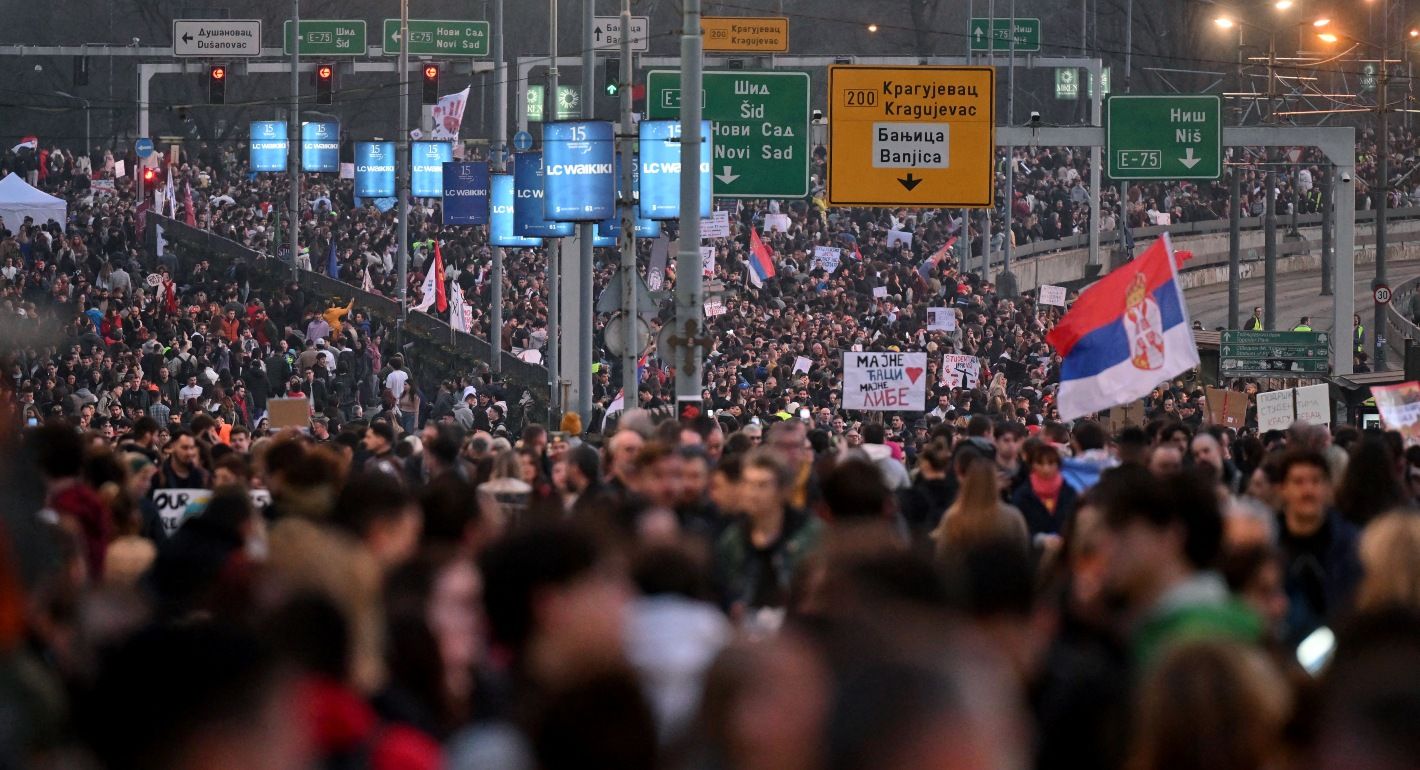
Source: Getty
By refusing to apply pressure on President Vučić, the EU is emboldening the Serbian government. If Brussels is serious about supporting democracy in the Western Balkans, it must empower the Serbian people—not their authoritarian rulers.
For over a decade, the EU’s approach to the Western Balkans has been one of calculated pragmatism—prioritizing the region’s stability to prevent major disruptions across the continent while keeping the aspiring EU members suspended in an accession antechamber. Instead of pushing for real reforms, Brussels has opted for partnerships with strongmen who can guarantee short-term stability.
But now, one of the strongmen it has most appeased, Serbian President Aleksandar Vučić, is facing the most serious challenge to his grip on power—and with him, the EU’s strategy in the region.
Brussels has to decide whether to continue betting on him, despite the potential consequences for Kosovo and Montenegro. It is a choice between continuing a policy of stabilitocracy or finally embracing a merit-based approach to integration.
In Belgrade, the EU also faces the most popular defiance toward it: Unlike in Georgia or Moldova, Serbian protesters, disillusioned with the EU’s appeasement of Vučić, have not carried European flags or appealed to Brussels for support. However, Brussels’ soft spot for Vučić may soon become untenable.
Serbian Prime Minister Miloš Vučević resigned last week, a move widely interpreted as a strategic concession amid growing domestic unrest. His resignation followed massive student-led protests, the largest Serbia has seen since the fall of Slobodan Milošević.
The immediate trigger was public outrage over the Novi Sad train station tragedy in November, where a collapsed canopy killed fifteen people. Yet, this is only the latest wave of discontent. Five months ago, citizens took to the streets, protesting a lithium-mining deal between Serbia and Germany. The agreement was celebrated in the West as a means to reduce dependency on China, but for many Serbians, it symbolized yet another case of unaccountable governance, environmental risks, and foreign interests taking precedence over local well-being.
Against this backdrop, the EU faces a dilemma. As the largest economic power in the region, it cannot simply dismiss Serbia’s government. However, its appeasement of the Vučić administration has had unintended consequences. By refusing to apply pressure, Brussels has given valuable leverage to Belgrade while emboldening it to expand its cooperation with Russia and China, knowing there would be little pushback. The EU has offered economic incentives, but these have come without real enforcement mechanisms—it has been all carrots and no sticks.
Yet Serbia is not just another problematic state; its trajectory shapes the entire Western Balkans region.
Nowhere is this clearer than in Kosovo, whose EU path remains hostage to the stalled Belgrade-Pristina dialogue. Despite Kosovo’s substantial democratization efforts, the EU continues to demand unilateral concessions, even in the wake of the Banjska attack in 2023, when Serbia-backed paramilitaries killed a Kosovar police officer and wounded two others. While Brussels has insisted on de-escalation, it has avoided imposing meaningful consequences on Belgrade. Meanwhile, Kosovo remains the only Western Balkan country without EU candidate country status, reinforcing the perception that EU accession is dictated less by merit than by geopolitical convenience.
Montenegro, often seen as the frontrunner in the EU accession process, is another case in point. Despite cautious optimism that it could be the first to cross the membership finish line, its political stability is frequently disrupted by Serbian interference. Nationalist rhetoric continues to shape Montenegro’s political discourse, making it difficult for the country to focus on EU-driven reforms. A truly European Montenegro would be a success story for the region and for the EU, yet the country remains vulnerable to the same external pressures that have held back its progress for years.
A course correction from the EU is still feasible.
First, Brussels must bring back the sticks, especially when dealing with Serbia. Ignoring election fraud, media suppression, and creeping authoritarianism has not benefited the Western Balkans or the EU. With Brussels seeking to project strength globally, tolerating democratic erosion in its own backyard only undermines its credibility. The idea of tying EU funds to genuine reforms is frequently discussed, but without enforcement, it remains meaningless.
Second, the EU could support efforts to hold officials accused of crimes accountable as in the case of the Banjska attack or in cases of electoral fraud. And it should prioritize continued support for Montenegro and Kosovo, as Serbia’s regional interference is not a stabilizing factor but an obstacle to progress.
Finally, the EU must acknowledge that Vučić’s regime is losing legitimacy. It remains unclear whether Vučić will be able to weather this storm—be it by ramping up repression, thus shifting to Russia, sitting out the wave and playing divide and conquer, or trying to regain credibility and legitimacy by calling for early elections. What is certain is that the recent protests signal a generational shift—one that Brussels can no longer ignore. The Serbian government, in its current form, is not the EU’s strategic partner. If Brussels truly supports democratic values, it must align itself with the Serbian people rather than their authoritarian rulers.
This moment presents a rare opportunity for the EU to reclaim its transformative power in the region. The Western Balkans’ youth, raised in an era of globalization, connectivity, and democratic aspirations, could be the catalyst for long-overdue change. These young people see firsthand the benefits of democratic standards—if the EU empowers them, they could push the region toward a future that aligns with Brussels’ long-term strategic interests.
But will the EU act? So far, its response has been muted. And as with the war in Ukraine, it risks being overtaken and overshadowed by the maneuvering of the Trump administration. The U.S. President’s Special Envoy Richard Grenell has already posted messages online in support of Vučić.
The EU must decide whether to seize this moment and support those truly working to close the chapter of instability, or to let another opportunity slip away.

Research Analyst, Carnegie Europe
Iliriana Gjoni is a research analyst at Carnegie Europe, where she focuses on EU enlargement and Western Balkan politics.
Recent Work

Miloš Pavković, Fitim Gashi, Iliriana Gjoni, …
Iliriana Gjoni
Carnegie does not take institutional positions on public policy issues; the views represented herein are those of the author(s) and do not necessarily reflect the views of Carnegie, its staff, or its trustees.

Russia is testing the waters of NATO’s mutual defense clause. What do strikes in Romanian territorial waters mean for the alliance’s posture toward Moscow?

Dimitar Bechev

With its public finances in shambles, the far right polling at 35 percent ahead of the 2027 presidential election, and a growing protest movement, is France’s crisis a threat to the EU’s geopolitical awakening?

Rym Momtaz, ed.

Ahead of a tough winter for Ukraine, Donald Trump’s swing back toward Russia bodes ill. But instead of panicking, Kyiv’s European allies are focusing on action.
Rym Momtaz

While the EU and European governments are embracing the much-lauded middle-power moment, this entails three difficult conundrums.

Richard Youngs

Much has been said of the changes Brussels is trying to make to the EU enlargement process. Here’s why gradual integration might—or might not—be the answer.
Dimitar Bechev