

Commentary
The EU can impose sanctions but struggles to enforce them without the United States. With Washington increasingly disinterested in backing European interests, the bloc must now fend for itself.
Nicu Popescu, Tiago Antunes
{
  "authors": [
    "Leo Goretti"
  ],
  "type": "commentary",
  "blog": "Strategic Europe",
  "centerAffiliationAll": "",
  "centers": [
    "Carnegie Endowment for International Peace",
    "Carnegie Europe"
  ],
  "englishNewsletterAll": "",
  "nonEnglishNewsletterAll": "",
  "primaryCenter": "Carnegie Europe",
  "programAffiliation": "",
  "programs": [],
  "projects": [],
  "regions": [
    "Western Europe",
    "United States",
    "Europe"
  ],
  "topics": [
    "Foreign Policy",
    "EU",
    "Trade"
  ]
}
Source: Getty
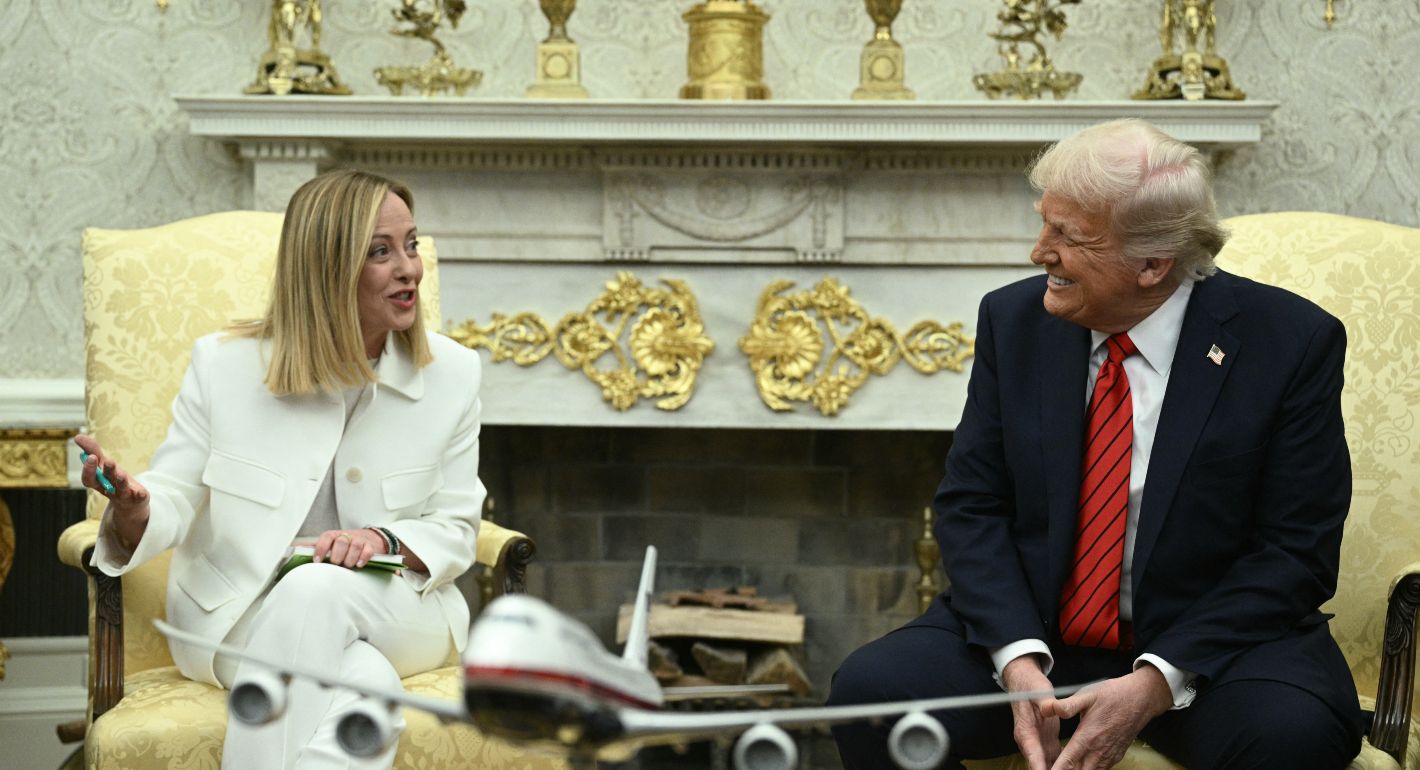
After Donald Trump initiated a global trade war, Italian Prime Minister Giorgia Meloni is leveraging her personal ties with the U.S. president to save the transatlantic alliance. To advance European and Italian interests, Rome should advocate a global order based on shared institutions and norms that maximize benefits for all.
For Italian Prime Minister Giorgia Meloni, Italy’s role amid increasing transatlantic tensions is to work to defend the unity of the West. She finds the notion that Rome must choose between Washington and Brussels “childish” and “superficial.” Instead, she says, it is in “the interest of everyone”—including Italy—that the two sides of the Atlantic stick together.
Meloni’s attempts to help Europe and the United States reset the terms of their alliance since U.S. President Donald Trump’s second inauguration and his aggressive and transactional approach have surprised many. She had been expected to emulate Hungary’s Prime Minister Viktor Orbán and go it alone, scapegoating the EU and leaning into her personal affinities with Trump and billionaire businessman Elon Musk.
But what Meloni is showing is that she has integrated the pillars of Italy’s postwar foreign policy and intends to preserve them as much as circumstances allow. Her motives are not so much ideological as pragmatic. Since 1945, Italy has relied on three fundamentals for its security, prosperity, and influence: the United States as a fundamental security guarantor through NATO, European integration and its single market, and the rules-based multilateral system. As such, Meloni will have to keep walking a tightrope to preserve her warm relationship with Trump while attempting to leverage it to save the transatlantic alliance with the EU, which he abhors.
Rome was one of the original signatories of the 1949 North Atlantic Treaty, which has provided Italy with invaluable security while freeing up budgetary capacities by minimizing the cost of defense. In parallel, Italian companies have massively benefited from the EU’s export market and its now 450 million consumers. And Italy has been a staunch supporter of multilateralism, and not just for normative reasons. As a middle power in relative decline from a strategic, economic, and demographic point of view, Rome’s primary interest is to keep benefiting from the common goods—from security to rules-based trade—that multilateralism has provided to the West in the postwar period.
Where it has gotten challenging is that while Meloni shares some fundamental values and policy preferences with Trump—like the primacy of national interests, antiwokeism, and a civilizational view of social issues—his view of international relations is fundamentally upending and weakening multilateralism, thus endangering the basis of Italy’s role in the world. His approach is highly transactional, rejects long-term commitments to norms and alliances, and is hostile to supranational organizations like the EU. It is also deeply steeped in the idea that strength is the ordering principle of the international state system.
More than the countries of Meloni’s radical-right peers, Italy has much to lose from a global system driven by a law-of-the-strongest mindset in which multilateral norms and organizations have a marginal role. If Trump succeeds in his radical overhaul of the international order, the costs Rome would have to shoulder could be prohibitive.
Take defense, for example. While Washington is asking its European allies to raise their defense spending—and “it’s never enough,” as Trump put it—Rome has been struggling to meet the target of the equivalent of 2 percent of GDP that NATO agreed on over ten years ago. It’s not just a matter of a lack of political will from the Italian government. Italy has the second-highest debt-to-GDP ratio in the EU. The country’s budget is further weighed down by the increased welfare costs of the country’s aging population. This is why Rome advocates EU-wide forms of investment in defense—and other sectors—through common borrowing: It is the only way to access additional financial resources at an affordable cost.
As an export-oriented country that produces high-end goods, Italy benefits from a trade regime based on stable rules, low tariff barriers, and the regulation of production standards to guarantee safety and quality. It is exactly what the European single market has offered the Italian economy—not without contradictions, such as some forms of protection of the agricultural sector—since the EU’s founding Rome treaties were signed in 1957. And while 10 percent of Italian exports go to the United States, the other twenty-six EU countries are the destination for over 50 percent of Italian exports, and the Italian industry is heavily integrated into European supply chains—first and foremost with Germany.
This is why Meloni hasn’t tried to decouple from the EU and broker an Italy-U.S. bilateral trade deal in response to the current trade war that Trump triggered.
Despite her occasional quips at the EU’s overregulation, especially in the field of climate change, Meloni seems to be well aware that Italy can act only within the EU framework. This was quite evident during her recent visit to Washington to meet Trump. Sure, Meloni emphasized her ideological proximity with the U.S. president, for example in the fight against a supposed “woke ideology that would like to erase our history” or in “tackling illegal migration.” But instead of seeking a bilateral deal on Italian goods, she attempted to use her good standing in the White House to enable a direct dialogue between Washington and Brussels. According to the joint statement published after the meeting, Trump is now considering the possibility of meeting EU leaders during an upcoming visit to Rome.
Mimicking Trump’s MAGA rhetoric, Meloni stated that her goal is “to make the West great again,” a vision that she explicitly framed in civilizational terms. But that has its limits. If the history of twentieth-century Europe is any indication, the key to peace and prosperity—especially for a country like Italy—lies not in nationalist politics that focus on essentialist identities but in shared institutions and norms that maximize benefits for all. This, more than ideological battles or zero-sum competition, is what the Italian government should advocate to advance the country’s interests.
Leo Goretti is Head of the Italian Foreign Policy program at the Istituto Affari Internazionali (IAI) in Rome and Editor of The International Spectator.

Leo Goretti
Head of the Italian Foreign Policy program at the Istituto Affari Internazionali (IAI) in Rome and Editor of The International Spectator.
Leo Goretti is Head of the Italian Foreign Policy program at the Istituto Affari Internazionali (IAI) in Rome and Editor of The International Spectator.
Carnegie does not take institutional positions on public policy issues; the views represented herein are those of the author(s) and do not necessarily reflect the views of Carnegie, its staff, or its trustees.

The EU can impose sanctions but struggles to enforce them without the United States. With Washington increasingly disinterested in backing European interests, the bloc must now fend for itself.


Nicu Popescu, Tiago Antunes

Russia is testing the waters of NATO’s mutual defense clause. What do strikes in Romanian territorial waters mean for the alliance’s posture toward Moscow?

Dimitar Bechev

With its public finances in shambles, the far right polling at 35 percent ahead of the 2027 presidential election, and a growing protest movement, is France’s crisis a threat to the EU’s geopolitical awakening?

Rym Momtaz, ed.

Ahead of a tough winter for Ukraine, Donald Trump’s swing back toward Russia bodes ill. But instead of panicking, Kyiv’s European allies are focusing on action.
Rym Momtaz

While the EU and European governments are embracing the much-lauded middle-power moment, this entails three difficult conundrums.

Richard Youngs