

Commentary
Rym Momtaz, ed.
{
  "authors": [
    "Rym Momtaz"
  ],
  "type": "commentary",
  "blog": "Strategic Europe",
  "centerAffiliationAll": "",
  "centers": [
    "Carnegie Endowment for International Peace",
    "Carnegie Europe"
  ],
  "englishNewsletterAll": "",
  "nonEnglishNewsletterAll": "",
  "primaryCenter": "Carnegie Europe",
  "programAffiliation": "",
  "programs": [],
  "projects": [],
  "regions": [
    "United States",
    "Europe"
  ],
  "topics": [
    "Foreign Policy",
    "Security",
    "Military",
    "NATO"
  ]
}
Source: Getty
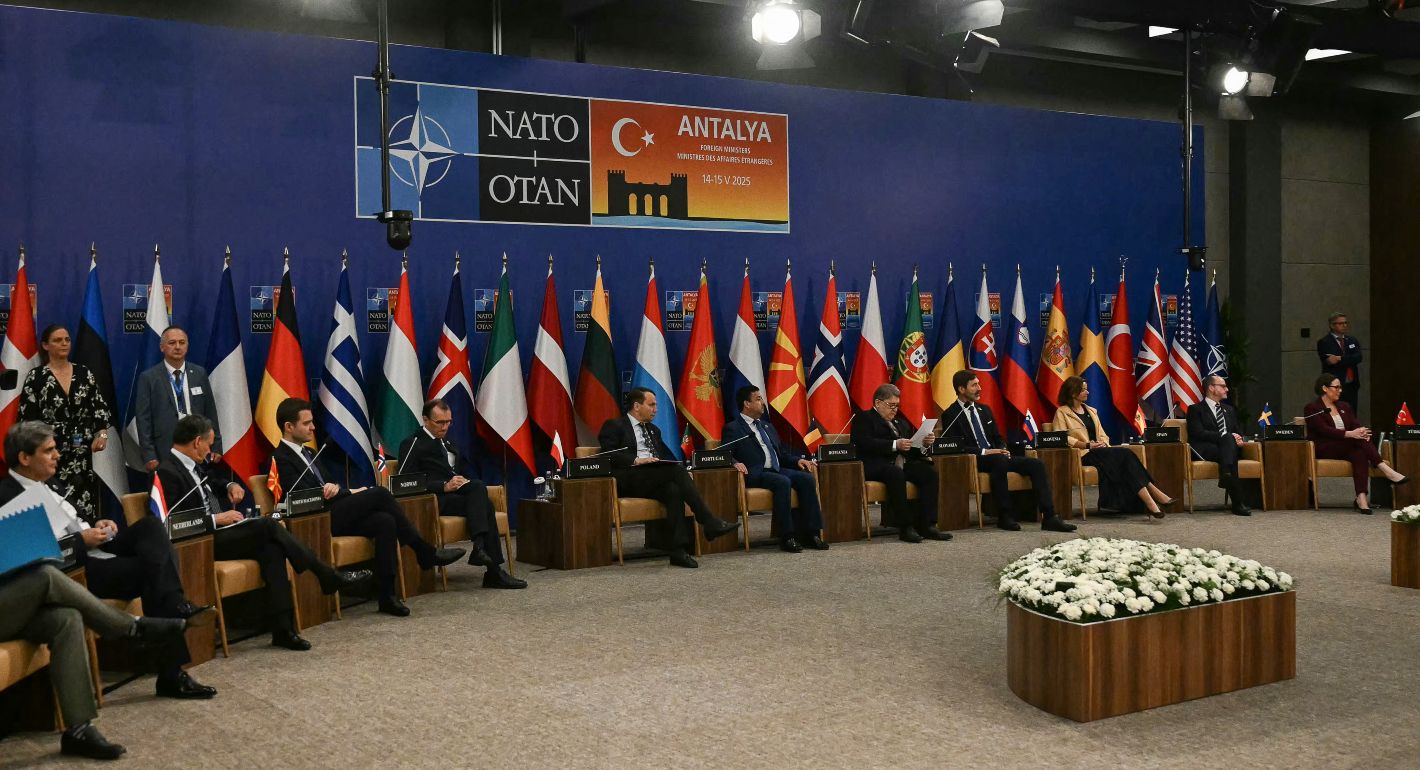
At the next NATO summit, Europeans have an opportunity to set new conditions for decades to come. They can strengthen the alliance by committing to a timeline that allows for a U.S. drawdown while preserving American strategic enablers.
The NATO alliance is at that moment every relationship eventually struggles with. One side knows the other wants to make changes, but keeps pretending like they can avoid having the tough conversation and hence facing the necessary changes.
Many European allies are trying hard to avoid discussing with the United States the capabilities drawdown that could result from the ongoing American Strategic Posture review. The good news is that it is certainly not all Europeans, and fewer of them are in denial than in 2016, when U.S. President Donald Trump was first elected.
But with a month to go before the next NATO Summit, Europeans would collectively improve their stature and value in Trump’s mind if they engage with the U.S. administration on how to coordinate a reduction in American military presence in Europe. Framing burden-shifting in these terms would be evocative for Trump. The idea would be for Europeans to commit to a timetable over the next six to ten years to ramp up capabilities and readiness, to fill the gaps that would remain if the United States chose to withdraw most of its nonstrategic capabilities.
This time around, success won’t be just about maintaining unity on Russia’s threat and avoiding a blow up with Trump: It will be about whether the allies manage to lay stronger and fairer foundations to carry the NATO alliance forward for decades to come. If the Europeans succeed, this summit could become a landmark moment of strength.
This would show Trump that Europeans are committed, capable, and worthy allies, who are useful in pursuing his goals—and not just engaging in creative accounting to placate him. For a president who does not view alliances favorably, it would be no small feat. Europeans would also benefit: They would be much better equipped to face the growing Russian threat. It would strengthen the NATO alliance and make it more durable because it would be going forward on a fairer footing.
It would also help strengthen the case within the Trump administration for maintaining U.S. leadership in force generation and integration. And it would also help preserve U.S. strategic enablers such as the unrivaled American ability to gather and process intelligence and convert it into actionable military targets, as well as long-range precision fires and the extended nuclear deterrence. These are not capabilities the Europeans could replace over the next ten years.
Admittedly, this discussion is not without risk. It could lay bare the very gap the planning aims to avoid: the speed with which the administration may want to draw down some capabilities that Europeans will need more time to generate.
But those in Europe who say broaching the topic and presenting a plan would encourage the Trump administration to abandon the Europeans infantilize their American counterparts. Also, Europeans cannot keep pretending that every single capability the United States provides is irreplaceable and unattainable. It undermines their own credibility and desirability as allies. If everything is vital, nothing is.
The Trump administration, disruptive and bombastic style aside, is assessing its posture based on strategic imperatives. One may agree or disagree with them, but presenting the desire to shift capabilities to other theaters as a whimsical enterprise does not serve either side of the Atlantic.
The status quo cannot go on and it is better to have a plan to minimize any adverse impacts on all allies. A hasty uncoordinated U.S. withdrawal would endanger U.S. troops, creating vulnerabilities and opportunities for America and Europe’s adversaries to take advantage of.
The good news is twofold. First, the alliance has managed fluctuations in U.S. postures in the past. Second, this time, Europe’s strategic awakening means Europeans can generate many of the capabilities the United States would want to reduce in the event of a coordinated drawdown.
What’s more is that even Trump cannot compress the logistical realities the U.S. military will have to face. Beyond the surge forces sent after Russia’s invasion of Ukraine, withdrawing the more permanent U.S. capabilities in Europe will take years and cannot be accomplished in a safe and orderly manner before the end of Trump’s term. Infrastructure will need to be built wherever the American capabilities will be sent, and legal frameworks will need to be agreed with new host countries if they were to be sent to Asia for example. This gives Europeans a reasonable amount of time to step up.
This kind of discussion is not the responsibility of the NATO Secretary General Mark Rutte or his staff. Together with national leaders, they are doing a good job of getting allies to commit to the overarching numbers Trump wants to hear: 5 percent of GDP on defense—including 3.5 percent on core defense. Allies are heading to the summit with considerably less angst over the United States walking out than they had in January.
These achievements notwithstanding, this kind of burden-shifting will need to be backed by difficult domestic budgetary choices that will have political repercussions for every ruling party. As a result, it is the responsibility of national leaders to formulate a proposal.
As hard as it may seem now, bridging the capabilities gap is the easier part of the reposturing. The truly challenging issue that lurks behind talks of U.S. reposturing is the potential loss of the leadership role America has played since NATO’s inception. The United States has been the glue of the NATO alliance, the nervous system making the different parts connect and communicate. That is something Washington must see as an asset: It is a component of continued American might.
By lightening the required U.S. footprint, the Europeans would make it more palatable for the United States to maintain its essential role in domain integration with dual-hatted commanders, including the supreme allied commander for Europe position.
With such a coordinated plan agreed, Trump would have achieved an epochal shift within NATO: minimizing European free riding while allowing U.S. national security to continue to benefit from the strategic depth Europe offers.

Editor in Chief, Strategic Europe
Rym Momtaz is the editor in chief of Carnegie Europe’s blog Strategic Europe. A multiple Emmy award-winning journalist-turned-analyst, she specializes in Europe and the Middle East and the interplay between those two spaces.
Recent Work
Rym Momtaz, ed.
Rym Momtaz
Carnegie does not take institutional positions on public policy issues; the views represented herein are those of the author(s) and do not necessarily reflect the views of Carnegie, its staff, or its trustees.

Before the next wave of EU enlargement takes place, the union needs to grapple with thorny questions of how power is distributed among its members.


Emil Sondaj Hansen, Ditte Brasso Sørensen

A summer of escalation in the Black Sea has hurt Ukraine economically and is exacerbating world food security. A truce is needed—as is a broader reframing of Europe’s Ukraine strategy.

Thomas de Waal

Are Germany’s economic, industrial, and political struggles becoming a liability for the EU’s ability to rise to the geopolitical moment?
Rym Momtaz, ed.

European Commission President Ursula von der Leyen is about to give her annual address on the state of the EU. Here’s what she won’t—but should—say.
Rym Momtaz

The aftermath of the Ceuta crisis shows Europe has drawn the wrong lessons. Rather than doubling down on failed migration policies, the EU needs to address the underlying roots of such episodes.

Richard Youngs