

Commentary
Rym Momtaz, ed.
{
  "authors": [
    "Rym Momtaz"
  ],
  "type": "commentary",
  "blog": "Strategic Europe",
  "centerAffiliationAll": "",
  "centers": [
    "Carnegie Endowment for International Peace",
    "Carnegie Europe"
  ],
  "collections": [
    "EU Integration and Enlargement"
  ],
  "englishNewsletterAll": "",
  "nonEnglishNewsletterAll": "",
  "primaryCenter": "Carnegie Europe",
  "programAffiliation": "",
  "programs": [],
  "projects": [],
  "regions": [
    "Eastern Europe",
    "Russia",
    "Europe"
  ],
  "topics": [
    "Foreign Policy",
    "Security",
    "Defense",
    "EU",
    "Military"
  ]
}
Source: Getty
In recent weeks, Russia has tested NATO by sending drones and fighter jets into the alliance’s territory. NATO has opted so far for a restrained response, but should it have done more to deter Moscow?
Deputy Director at the Centre for Eastern Studies (OSW)
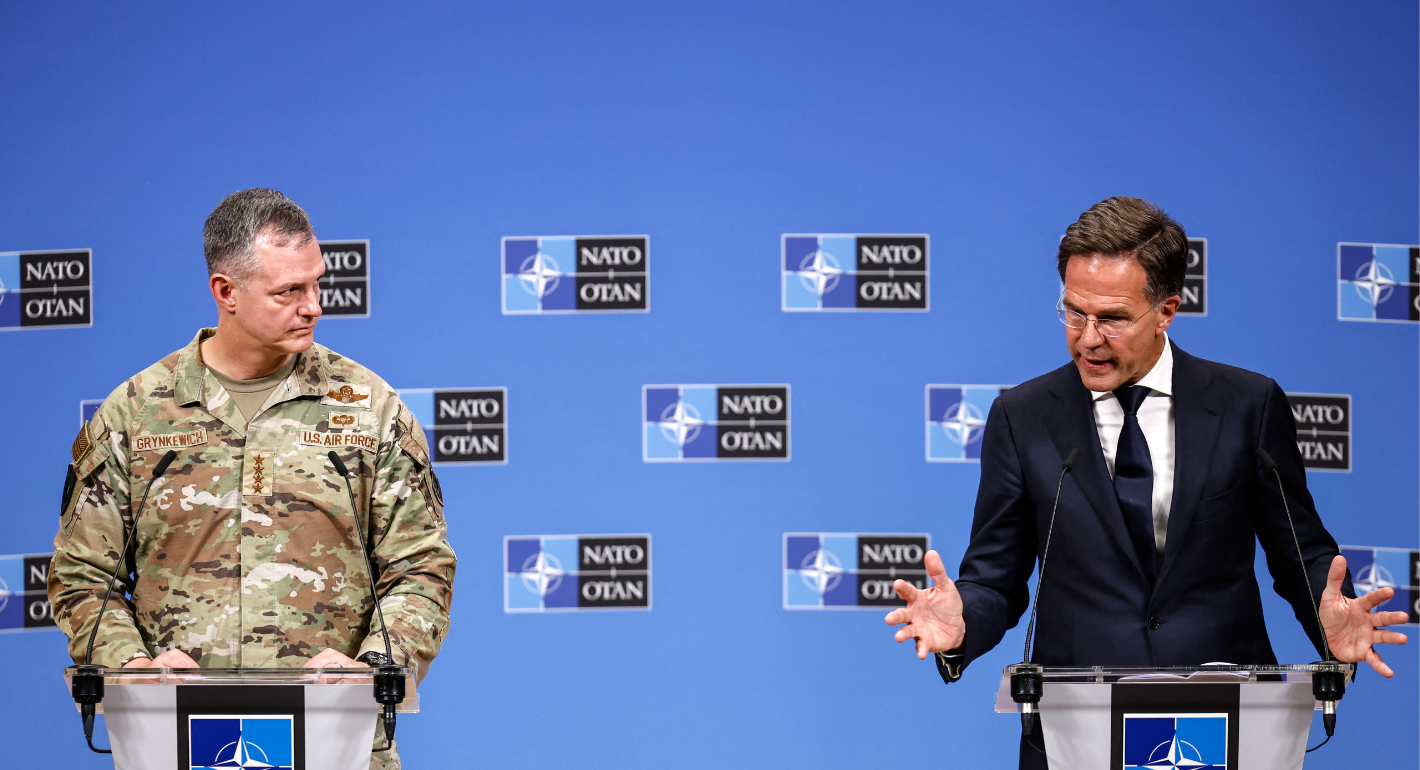
NATO responded quickly, in a coordinated manner, and in line with pre-agreed procedures, to both the drone incursions into Poland and the fighter jets over Estonia. It is clear, however, that Russia is testing the alliance and seeing a wobbly political response from U.S. President Donald Trump, even if it was the Supreme Allied Commander Europe (SACEUR) General Alexus G. Grynkewich who responded to the provocations. The Kremlin clearly wants to show the United States and NATO that the war can spill over if they don’t agree to Putin’s demands on Ukrainian and European security.
Russia might aim to stage further provocations in order to fragment NATO allies, as any national decision to shoot down Russian planes risks triggering divisions that should be avoided. However, this should be a pre-agreed option against aggressive actions in specific scenarios. Overall, allies must think of how to reinstate deterrence against threats under Article 5. It should not only be about enhancing defense on the Eastern flank, but also about imposing economic sanctions and delivering military instruments capable of striking Russian drone facilities and airfields to Ukraine. Every Russian provocation should have painful consequences.
Visiting Lecturer at the Estonian Academy of Security Sciences
Estonian skies are guarded by the NATO Air Policing mission and, under current rules of engagement, the Russian MiGs that violated airspace in this case should not have been shot down. Situations can differ, but comparing this incident to Turkey’s 2015 downing of a Russian Su-24 is misleading. That took place in a combat environment after repeated warnings, not during a de jure peacetime patrol. Tallinn was right to call for consultations under Article 4, and this should lead to further measures both to strengthen the alliance’s defense and attach a clear price tag to Russian violations.
In a hybrid war, responses need not be symmetrical: Each hostile act should trigger a penalty, whether through deductions from frozen Russian assets, the provision of new significant long-range capabilities to Ukraine—including long-range strike systems—or the imposition of significant new sanctions.
Distinguished Fellow at the Royal United Services Institute (RUSI), former NATO Spokesperson (2010-2023)
Under NATO’s defense plans, activated on the day Russia launched its full-scale invasion of Ukraine, the SACEUR (who happens to be a U.S. Air Force pilot), has broad authorities. This was demonstrated when NATO jets recently downed a number of drones over Poland.
But each situation is different depending on the threat, potential intent, and collateral damage. Not all countries interpret the rules of engagement as expansively as Poland. Shooting down Russian manned combat jets also carries a higher risk of escalation. In this case, NATO’s Baltic Air Policing mission did its job, safely escorting the planes out of Estonian airspace.
Baltic states have no air forces of their own, so other NATO allies have been taking turns to police their airspace since 2004. Last year, NATO Air Policing forces conducted around 400 scrambles across Europe, mainly responding to Russian aircraft approaching allied airspace without flight plans, transponders, or communication.
As Moscow’s recklessness grows, NATO needs to deploy more air defense capabilities along the whole Eastern flank. It is now doing that. All allies must also work with General Grynkewich to ensure he has the maximum flexibility when Russia next tests the alliance’s defenses.
Deputy Director at the Fondation pour la Recherche Strategique
No, but it should threaten to do so next time. There was no immediate reason to shoot down the three Russian aircraft that entered Estonian airspace on September 19. The direction of their flight path was unchanged and they did not appear to immediately threaten Tallinn or any other objective.
Though every country is sovereign in deciding its air defense policy, the rules of engagement for common NATO Air Policing operations do not include—at this time—immediate takedown of any military aircraft that violates the alliance’s common airspace. But after several consecutive violations, it is time to take the gloves off.
Unless the alliance makes it clear that it is ready to shoot down any aircraft penetrating the airspace of a NATO country, Russian escalation will continue. As Lenin said, “You probe with bayonets: if you find mush, you push. If you find steel, you withdraw.” This is a test. Let us not fail it.
The task ahead requires not only the right rules of engagement but also political credibility. It is not certain that the NATO communiqué issued on September 23, 2025, which merely recalls that NATO will use any “necessary military tools,” is enough.
Nonresident Senior Fellow at the Atlantic Council
In 2015, after repeated warnings, Turkey shot down a Russian Su-24 fighter that violated Turkish airspace over its border with Syria. The incident caused immense tension between NATO and Russia, but Ankara sent a clear message: “Violate our airspace, ignore our warnings, and there will be consequences.”
Today, Russia is acting in an increasingly reckless fashion, violating Polish airspace with dozens of drones, and violating Estonian airspace with three MiG-31 fighter jets. Although it was the fourth time that the country’s airspace has been similarly violated this year, this time the jets flew for twelve minutes without filed flight plans, with their transponders off, greatly increasing the risk of danger and miscalculation.
While Moscow faced little pushback for the drone incursions, repeated and increasingly blatant manned aircraft violations should be treated as unacceptable. The only way to establish clear and effective deterrence is for actions to follow warnings.
If Putin continues to test NATO’s resolve in this particular manner, the allies—especially those whose airspace is being violated—must set a clear red line and be willing to stand by it, even if that means shooting down a Russian jet.
CEO of the Geopolitics and Security Studies Center (GSSC)
Russia’s latest incursions test allied credibility, posing two questions: Did the immediate response work? Yes. Is deterrence credible overall? The mounting frequency and audacity of probes say no. Credibility must be restored.
Playbooks written for a calmer era strain under the unprecedented scale and brazenness of Moscow’s moves. Updating them is overdue. Procedures must be reviewed against this new reality.
This does not necessarily mean ordering an automatic shoot-down of jets absent an imminent threat, and deterrence is political as well as military. Polish Foreign Minister Radosław Sikorski has stated that no further intrusions will be tolerated. That clarity forces choices in the Kremlin; without it, incentives to escalate—and the risk of accidents—grow.
A core step will be to upgrade Baltic Air Policing to true air defense. NATO allies should shift from logging violations to preventing them: pre-agreed decision chains, integrated sensors, ground-based air defense on standby, and automatic non-kinetic penalties when lines are crossed. Signal these measures publicly and apply them consistently.
The goal is stability, not theatrics: clear rules, enforced consistently, backed by allied unity. Firm but measured posture narrows Moscow’s room for maneuver while keeping escalation under control. Otherwise, the alliance will invite trouble.
Senior Programme Manager in the Future of Security Programme at GLOBSEC
A little less than two weeks after NATO launched Eastern Sentry—the major air policing and surveillance operation to reinforce the Eastern flank—Russian jets entered Estonian airspace. This sends a clear signal that the drone incursions over Poland were not an isolated incident. NATO effectively intercepted the jets, demonstrating that such provocations will not go unanswered.
The alliance certainly demonstrated its willingness to act but refused to take direct action. The latest statements from U.S. President Donald Trump that “if necessary, NATO should shoot down Russian incursions into its airspace,” prove how in this arena, Moscow only understands the language of power.
Some may argue that these actions are designed to provoke a response; that by not shooting down the three Russian MiG-31s, the alliance avoided the risk of direct military confrontation with Moscow. But repeated provocations allow Putin to assess how far he can go while avoiding forceful consequences.
As it stands, Article 4 consultations have been triggered twice in just two weeks. Two breaches of NATO airspace in such rapid succession highlight the urgent need for unity, readiness, and a zero-tolerance approach to Russia’s aggressive behavior.
Alexander Baunov gives his take on Russian drone strikes in NATO states in the Carnegie Russia Eurasia Center’s Politika here

Editor in Chief, Strategic Europe
Rym Momtaz is the editor in chief of Carnegie Europe’s blog Strategic Europe. A multiple Emmy award-winning journalist-turned-analyst, she specializes in Europe and the Middle East and the interplay between those two spaces.
Recent Work
Rym Momtaz, ed.
Rym Momtaz
Carnegie does not take institutional positions on public policy issues; the views represented herein are those of the author(s) and do not necessarily reflect the views of Carnegie, its staff, or its trustees.

With its public finances in shambles, the far right polling at 35 percent ahead of the 2027 presidential election, and a growing protest movement, is France’s crisis a threat to the EU’s geopolitical awakening?
Rym Momtaz, ed.

Ahead of a tough winter for Ukraine, Donald Trump’s swing back toward Russia bodes ill. But instead of panicking, Kyiv’s European allies are focusing on action.
Rym Momtaz

While the EU and European governments are embracing the much-lauded middle-power moment, this entails three difficult conundrums.

Richard Youngs

Much has been said of the changes Brussels is trying to make to the EU enlargement process. Here’s why gradual integration might—or might not—be the answer.

Dimitar Bechev

The European Commissioner for Trade is headed to China. But after President Xi’s bridge-building visit to Washington, can a more isolated EU overcome Beijing’s stranglehold on critical raw materials? Who will blink first?
Rym Momtaz, ed.