

Commentary
Judy Dempsey
{
  "authors": [
    "Judy Dempsey"
  ],
  "type": "commentary",
  "blog": "Strategic Europe",
  "centerAffiliationAll": "",
  "centers": [
    "Carnegie Endowment for International Peace",
    "Carnegie Europe"
  ],
  "englishNewsletterAll": "",
  "nonEnglishNewsletterAll": "",
  "primaryCenter": "Carnegie Europe",
  "programAffiliation": "",
  "programs": [],
  "projects": [],
  "regions": [
    "Europe",
    "United States"
  ],
  "topics": [
    "Foreign Policy",
    "EU",
    "Security"
  ]
}
Source: Getty
The Trump administration has slammed the EU’s political and social policies, which it claims are undermining Europe’s identity. The stark language of the new U.S. security strategy helps Europeans to recognize new realities and to devise their own response.
Whatever European officials may say about it, U.S. President Donald Trump’s new National Security Strategy (NSS) is good news for Europe. Europe and the rest of the world now know how poorly this U.S. administration regards them and they cannot keep pretending otherwise.
The NSS is not about values. It is not about supporting democracy. It is not about defending principles that the Europeans have taken for granted since the end of World War II. It is about projecting power that should reflect American economic interests. Full stop.
In foreign policy terms, that definition of a power is based on a transactional premise that should benefit Americans and authoritarian regimes. For the latter, conditionality has taken on a new meaning: deliver goods and stability—not human rights (and often hectoring) which is a European criterion. As the NSS states: “The United States will prioritize commercial diplomacy.”
In practice it means that countries in the Middle East and elsewhere can pursue their own traditions, religions, and cultures as long as they don’t threaten the United States. As the NSS states: “The key to successful relations with the Middle East is accepting the region, its leaders, and its nations as they are while working together on areas of common interest.”
This is not bad news either for tech-savvy Taiwan that remains essential for American AI companies but vulnerable to saber-rattling by China. “Deterring a conflict over Taiwan, ideally by preserving military overmatch is a priority,” states the NSS. “The United States does not support any unilateral change to the status quo in the Taiwan Strait.”
It’s a different matter for Europe, America’s post–1945 ally and the backbone of the Western alliance during the Cold War. The NSS’s section on Europe doesn’t pull punches.
The strategy plainly declares the United States’s lack of interest in NATO, which it says is not a “perpetually expanding alliance,” a line that will please Russia—which is staunchly opposed to further expansion—and disappoint Ukraine and other aspiring members.
The NSS calls on Europe to take “primary responsibility for its own defense, without being dominated by any adversarial power.” That possible adversarial power is not stated.
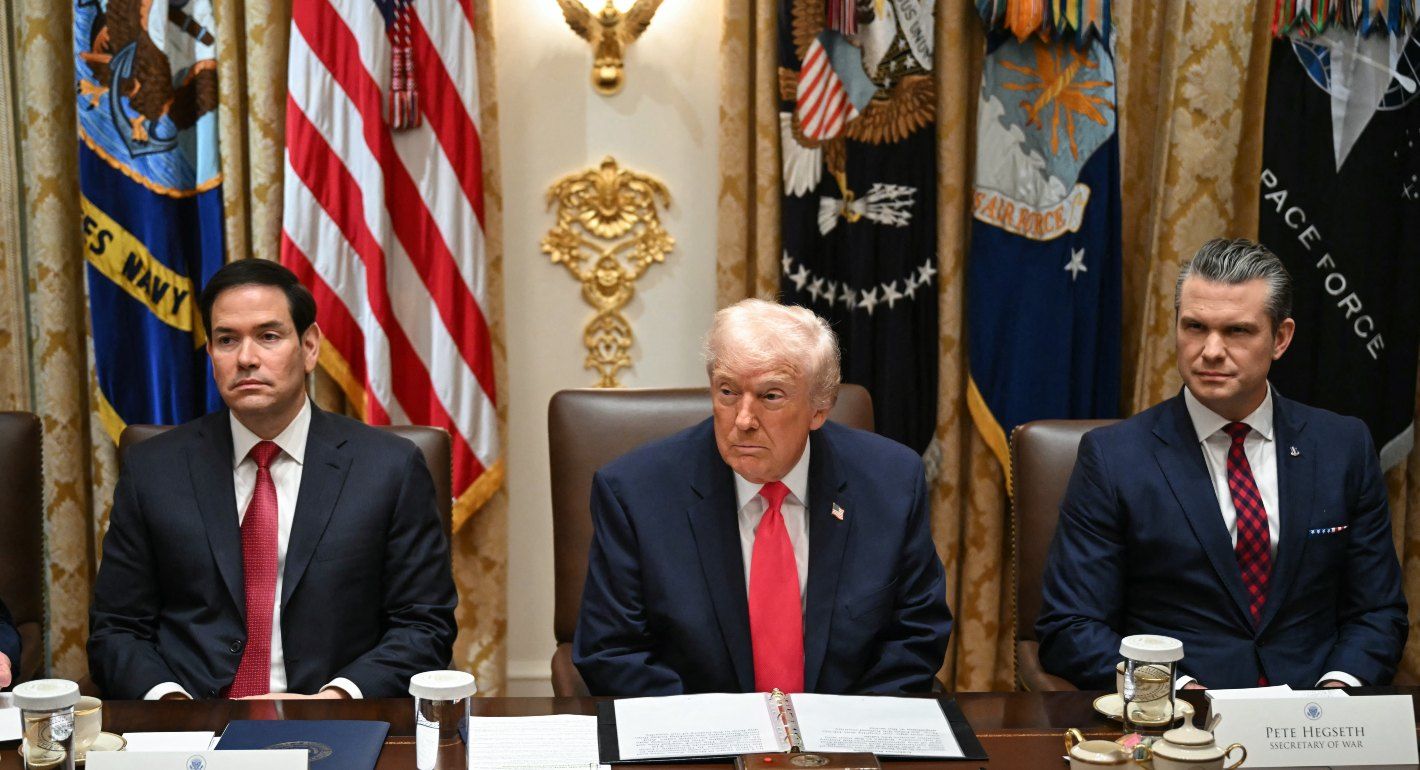
The intention to pull back from NATO commitments confirms a recent report of a Pentagon meeting, in which U.S. officials allegedly told Europeans they must take over the majority of NATO’s conventional defense capabilities, from intelligence to missiles, by 2027. The plan to shed responsibilities in Europe will no doubt be reflected in the forthcoming National Defense Strategy, which Secretary of War Pete Hegseth outlined in a recent speech.
The NSS accuses Europeans of a “lack of self-confidence” toward Russia. European allies, it declares, “enjoy a significant hard power advantage over Russia by almost every measure, save nuclear weapons,” even as “many Europeans regard Russia as an existential threat.” The United States could help “reestablish conditions of strategic stability across the Eurasian landmass.”
And this is what irks Europe. The strategy states that it is “a core interest” of the United States to “reestablish strategic stability with Russia, as well as to enable the post-hostilities reconstruction of Ukraine to enable its survival as a viable state.” Most Europeans are not convinced of the sincerity of this sentence, nor do they support the implicit calls for a Europe-wide security architecture that involves Russia. They see this as a long-held ambition by the Kremlin to decouple Europe from Washington and weaken NATO.
The strategy reveals an obsession with identity politics, framed in the far-right civilizational language that is now shared by much of the Trump administration. It is more than plausible, it states, “that within a few decades at the latest, certain NATO members will become majority non-European.” Does that mean non-white or an identity not compatible with Europe?
The document does champion Europe—just not the kind of liberal diverse Europe, which is still promoted by most of the EU. The Americans, however, “want Europe to remain European, to regain its civilizational self-confidence, and to abandon its failed focus on regulatory suffocation.” In adversarial language, the strategy goes on to decry “the activities of the European Union and other transnational bodies that undermine political liberty and sovereignty, migration policies that are transforming the continent and creating strife, censorship of free speech and suppression of political opposition, cratering birthrates, and loss of national identities and self-confidence.”
Yes, Europe does lack self-confidence. Yes, it does lack a security and strategic outlook. Yes, it has far too long relied on the United States as a security guarantor. Yes, it has failed to listen to the grievances of the far right. Yet, its leadership in the institutions and the members states won’t take the leap to deal with these major issues that reflect the post–Cold War era. These failings weaken Europe as a credible global player. That makes criticism of the NSS a rhetorical exercise.
Against this background of weakness, it is hardly surprising that Trump and particularly his vice president, JD Vance, is hell-bent on further weakening Europe. This administration sees Europe as a threat if not a competitor, however incompetent it may be. Vance’s disdain for Europe’s democratic system and its values, coupled with his open support for far-right movements, threaten American interference that undermines the essence of the Western alliance. That is the message to which Europe has no choice but to respond.

Nonresident Senior Fellow, Carnegie Europe
Judy Dempsey is a nonresident senior fellow at Carnegie Europe
Recent Work
Judy Dempsey
Judy Dempsey
Carnegie does not take institutional positions on public policy issues; the views represented herein are those of the author(s) and do not necessarily reflect the views of Carnegie, its staff, or its trustees.

The EU can impose sanctions but struggles to enforce them without the United States. With Washington increasingly disinterested in backing European interests, the bloc must now fend for itself.


Nicu Popescu, Tiago Antunes

Russia is testing the waters of NATO’s mutual defense clause. What do strikes in Romanian territorial waters mean for the alliance’s posture toward Moscow?

Dimitar Bechev

With its public finances in shambles, the far right polling at 35 percent ahead of the 2027 presidential election, and a growing protest movement, is France’s crisis a threat to the EU’s geopolitical awakening?

Rym Momtaz, ed.

Ahead of a tough winter for Ukraine, Donald Trump’s swing back toward Russia bodes ill. But instead of panicking, Kyiv’s European allies are focusing on action.
Rym Momtaz

While the EU and European governments are embracing the much-lauded middle-power moment, this entails three difficult conundrums.

Richard Youngs