{
  "authors": [
    "Sufyan Alissa"
  ],
  "type": "event",
  "centerAffiliationAll": "dc",
  "centers": [
    "Carnegie Endowment for International Peace"
  ],
  "collections": [],
  "englishNewsletterAll": "democracy",
  "nonEnglishNewsletterAll": "",
  "primaryCenter": "Carnegie Endowment for International Peace",
  "programAffiliation": "DCG",
  "programs": [
    "Democracy, Conflict, and Governance",
    "Middle East"
  ],
  "projects": [],
  "regions": [
    "Middle East",
    "Jordan"
  ],
  "topics": [
    "Economy"
  ]
}
Economic Reform in Jordan
Wed, September 12th, 2007
Washington, D.C.
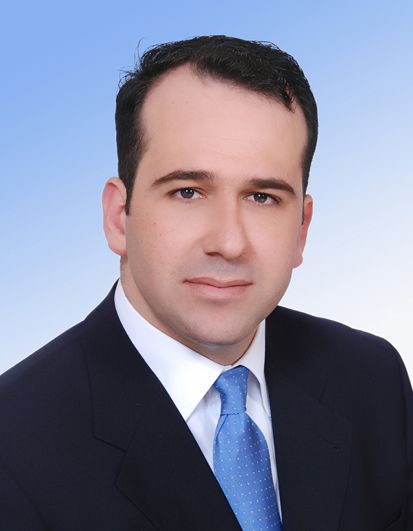
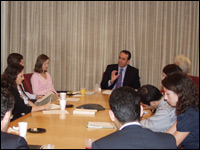
IMGXYZ769IMGZYXThe Carnegie Endowment for International Peace organized a discussion in which Sufyan Alissa, Associate at the Carnegie Middle Easter Center, presented the findings of his recent paper Rethinking Economic Reform in Jordan: Confronting Socioeconomic Realities. The presentation was followed by a Q&A session. Marina Ottaway, Director of the Middle East Program, moderated the discussion.
Alissa suggested that reform in Jordan is yet to recover from an incessant absence of public support, and the government’s inability to implement deep and genuine structural reform. He described the main phases of reform in Jordan and highlighted the elements which constitute the basic engine of growth in the country. These include international aid and remittances from abroad. Alissa explained that those two elements have helped thrust the state into the forefront of reform efforts, allowed the country as a whole to live beyond its means, and relieved policy makers from imposing adequate taxes on the population. The fact that the state was central in the reform enterprise facilitated corruption and caused political forces to overlook the need to coagulate popular participation in delineating the terms of this reform. This has engendered a devastating chasm between policy initiatives and popular expectations.
Alissa concluded by outlining the terms of reform that Jordan needed urgently. First, he emphasized that policy should aim for far reaching reform that includes improving modes of governance by encouraging popular participation and assuaging the negative influence of elites on economic decision making. Reform efforts should also recognize the limitations of foreign aid and instead focus on promoting labor intensive and high value added economic ventures. Such reform is imperative because the current growth model in Jordan is not sustainable.
During the Q&A session, some of the attendees asked about the contradictory results of studies conducted by the World Bank and the IMF, which suggested that Jordan’s growth is in good standing. Alissa reiterated that the problem is not the present growth rates in the country, but their sustainability. He argued that in the absence of international aid, severe problems would arise in the Jordanian economy.
Alissa’s study can be accessed online at: http://www.carnegieendowment.org/files/cmec4_alissa_jordan_final.pdf
Carnegie does not take institutional positions on public policy issues; the views represented herein are those of the author(s) and do not necessarily reflect the views of Carnegie, its staff, or its trustees.
Event Speaker
Former Associate, Middle East Center