

{
  "authors": [
    "Thomas Hegghammer",
    "Stéphane Lacroix",
    "Laurent Bonnefoy",
    "Christopher Boucek"
  ],
  "type": "event",
  "centerAffiliationAll": "dc",
  "centers": [
    "Carnegie Endowment for International Peace"
  ],
  "collections": [],
  "englishNewsletterAll": "menaTransitions",
  "nonEnglishNewsletterAll": "",
  "primaryCenter": "Carnegie Endowment for International Peace",
  "programAffiliation": "MEP",
  "programs": [
    "Middle East"
  ],
  "projects": [],
  "regions": [
    "Saudi Arabia",
    "Yemen"
  ],
  "topics": [
    "Political Reform",
    "Security"
  ]
}
Da’wa, Jihad, and Salafism in Saudi Arabia and Yemen
Mon, November 24th, 2008
Washington, D.C.
Salafi groups in Yemen and Saudi Arabia are engaged in important internal debates about the extent and nature of their political participation. In order for Middle Eastern and Western governments to adopt proper policy responses in the region, it is vital to understand the similarities and differences among local Salafi groups and how they compare to organizations like al-Qaeda in Saudi Arabia and Yemen.
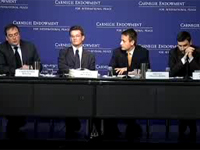
Thomas Hegghammer, Senior Research Fellow at the Norwegian Defence Research Establishment (FFI) in Oslo; Stéphane Lacroix, Postdoctoral Scholar at Stanford University; and Laurent Bonnefoy, CNRS/ANR Postdoctoral Fellow at the Institut de Recherches et d’Etudes sur le Monde Arabe et Musulman in France, addressed these topics in a discussion moderated by Carnegie’s Christopher Boucek.
Similarities and Differences:
Thomas Hegghammer argued that al-Qaeda in Saudi Arabia and in Yemen did not grow organically, but rather was the product of specific events: the return of the fighters in Afghanistan to Saudi Arabia and the escape of a number of Islamist radical prisoners in Yemen. Al-Qaeda’s discourse in Yemen is revolutionary, while Saudi al-Qaeda adopts less anti-regime rhetoric. Al-Qaeda is more dangerous in Yemen, and has better prospects for survival because of Yemen’s weak institutions compared to the Saudi state’s, and the severe grievances many have with the Yemeni government.
Apolitical Salafism:
Stéphane Lacroix argued it is important to examine the role that apolitical Salafis play in Saudi Arabia, mainly the Ahl al-Hadith group, because they have a large presence in the West. The apolitical Ahl al-Hadith group blurs the traditional line between moderation and radicalism – its rejection of politics makes it surprisingly moderate on political issues, yet it remains strictly conservative on social and religious issues.
Pluralism and Funding:
Laurent Bonnefoy stated that despite being influenced by Salafis in Saudi Arabia, Yemeni Salafi groups emerged as distinct actors that shape their agendas in accordance to local circumstances and contexts. Saudi Arabia is best understood as a plural actor; the state itself is shaped by pluralism, diversity of strategies, and competition between different Islamist groups. Focusing solely on analyzing sources of funding is not useful in understanding various Salafi groups because they do not require high levels of funding.
Questions and Answers:
In the question and answer session the speakers further addressed the importance of defining Salafism and Jihad in their proper academic contexts, and the possibility of seeing changes in the types of extremist groups emerging in Yemen. The speakers also debated the usefulness of using the term “salafism” as it does not explain a group’s political motivations, goals, or orientation.
Carnegie does not take institutional positions on public policy issues; the views represented herein are those of the author(s) and do not necessarily reflect the views of Carnegie, its staff, or its trustees.
Event Speakers
Thomas Hegghammer
Stéphane Lacroix
Stéphane Lacroix is an associate professor at the Paris School of International Affairs (PSIA) of Sciences Po and a researcher at the Centre for International Studies and Research.
Laurent Bonnefoy
Former Associate, Middle East Program
Boucek was an associate in the Carnegie Middle East Program where his research focused on security challenges in the Arabian Peninsula and Northern Africa.