

{
  "authors": [
    "Ananth Padmanabhan",
    "Sundeep Khanna",
    "Tanvi Ratna",
    "Yatin Thakur"
  ],
  "type": "event",
  "centerAffiliationAll": "",
  "centers": [
    "Carnegie Endowment for International Peace",
    "Carnegie India"
  ],
  "collections": [],
  "englishNewsletterAll": "",
  "nonEnglishNewsletterAll": "",
  "primaryCenter": "Carnegie India",
  "programAffiliation": "",
  "programs": [],
  "projects": [
    "Political Economy"
  ],
  "regions": [
    "South Asia",
    "India"
  ],
  "topics": [
    "Economy"
  ]
}
Cinema, Culture, and Policy: Entrepreneurship in India
Wed, December 20th, 2017
New Delhi
Building a more conducive regulatory environment for businesses has been a critical reform area for India, particularly in an innovation-led economy increasingly dependent on entrepreneurship. India’s recent thirty-point jump in the World Bank’s 2017 Ease of Doing Business rankings gives cause for optimism.
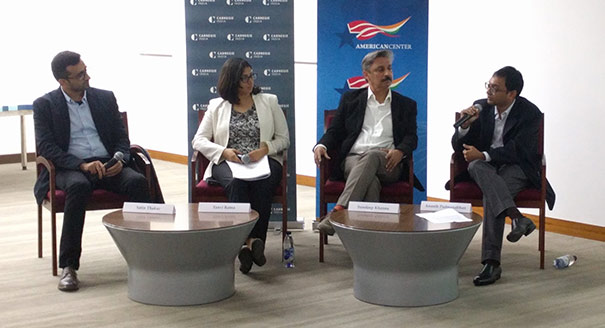
As part of the Cinema, Culture, and Policy series, Carnegie India, in partnership with the American Center in New Delhi, hosted Sundeep Khanna, consulting editor for Mint, Tanvi Ratna, senior consultant for Ernst and Young LLP, and Yatin Thakur, founder of CoWorkIn and managing director of GEN India, for a panel discussion. Carnegie India’s Ananth Padmanabhan moderated. Discussants considered the 2007 movie Guru, loosely based on the life of Dhirubhai Ambani, the founder of Reliance Industries, and the challenges entrepreneurs face when contending with diverse stakeholders, the evolving relationship between regulations and entrepreneurship, and the ways in which government policies can be tailored to unlock entrepreneurial energy.
Discussion Highlights
- Creating Indian Entrepreneurs: Discussants examined how conceptions of entrepreneurship, as perceived both by entrepreneurs themselves and by the public, government, the media, and other stakeholders, have evolved significantly over the years in India. All panelists agreed that the transition to an Initial Public Offering (IPO) culture has been instrumental in creating a deeper bond between the entrepreneur and the public. The success of such entities in both Indian and global markets has made entrepreneurship a worthy career option, they said, and largely removed the inertia and stigma associated with doing business in the pre-liberalization days of the Indian economy.
- Policy and Entrepreneurship: The panelists agreed that India has become a relatively easier place to do business in the last couple of decades, with economic liberalization serving as a tipping point. However, they noted that there are certain sectors in India, including agriculture and manufacturing, where the pace of entrepreneurship has been slow due to an absence of a coordinated strategy across policymaking departments. Discussants noted that while certain state governments have become actively involved in framing policies, especially those related to digital governance, severe budget constraints hamper effective implementation.
- Innovation and Entrepreneurship: All panelists agreed that innovation serves as a good marker for economic progress. They noted that Indian companies were previously focused more on achieving scale rather than innovation for its own sake. But, with the ongoing technology and information boom, supported by increasing levels of access to venture capital, Indian entrepreneurs are slowly transitioning to innovation-led business and growth models. Panelists also pointed out the need to foster such innovation-led growth within small and medium enterprises through effective policy design and implementation.
This event summary was prepared by Rhea Menon, an intern at Carnegie India.
Carnegie does not take institutional positions on public policy issues; the views represented herein are those of the author(s) and do not necessarily reflect the views of Carnegie, its staff, or its trustees.