

{
  "authors": [
    "Stephen Smith",
    "Peter Varghese",
    "Rudra Chaudhuri"
  ],
  "type": "event",
  "centerAffiliationAll": "",
  "centers": [
    "Carnegie Endowment for International Peace",
    "Carnegie India"
  ],
  "collections": [],
  "englishNewsletterAll": "",
  "nonEnglishNewsletterAll": "",
  "primaryCenter": "Carnegie India",
  "programAffiliation": "",
  "programs": [],
  "projects": [
    "Security Studies"
  ],
  "regions": [
    "South Asia",
    "India",
    "Oceania",
    "Indo-Pacific"
  ],
  "topics": [
    "Foreign Policy"
  ]
}
New Delhi and Canberra: An Indo-Pacific Partnership
Mon, September 9th, 2019
New Delhi
India and Australia have shared interests in ensuring the peaceful development of an open, inclusive, and prosperous Indo-Pacific. In recent years, both sides have ramped up political, diplomatic, economic, and military cooperation in the region. Given the growing strategic competition among major powers and a gamut of non-traditional security issues in the region, how can India and Australia work together to shape the evolving regional order?
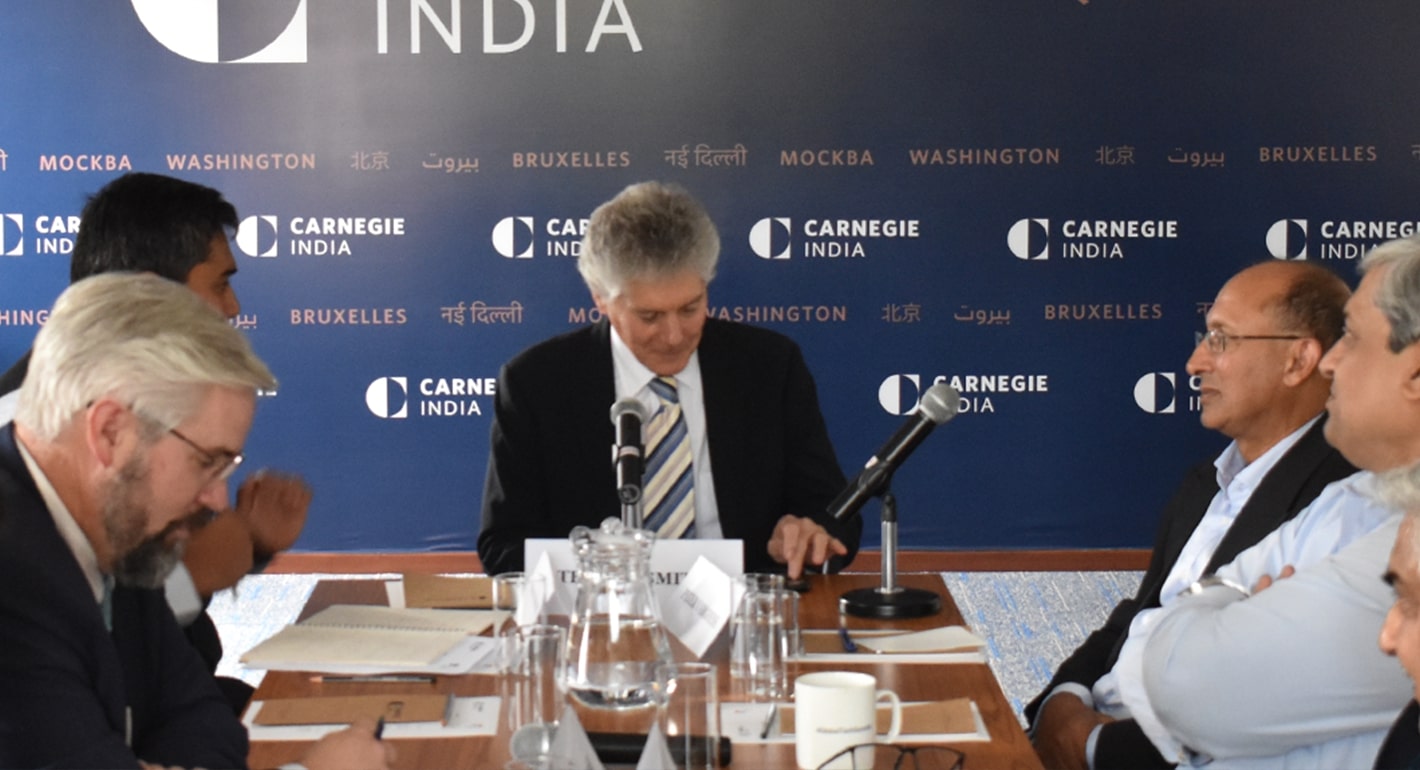
Carnegie India, in partnership with the Perth USAsia Centre, hosted a private roundtable to examine this question.
DISCUSSION HIGHLIGHTS
- Emergence of the Indo-Pacific: Participants highlighted that the Asia-Pacific region consolidated as a result of trade agreements among countries across the region over the past two to three decades, before which this geographical area was divided into smaller subregions such as East Asia, Southeast Asia, and Oceania, among others. They explained that the Indo-Pacific construct has now emerged as a result of the rising importance of India and of maritime transport through the Indian Ocean, both of which had been excluded from the Asia-Pacific. Participants defined the Indo-Pacific as an artificial geographical construct that stretches from the east coast of Africa to the western shores of the United States.
- Converging Indo-Australian Interests: Participants explained that bilateral ties between India and Australia have a strong foundation, underpinned by double-digit growth in both trade and the Indian student population in Australia. They added that the Indian diaspora is among the fastest growing in the country. Participants identified opportunities for cooperation in the areas of education, scientific research, critical minerals and rare earth, as well as cybersecurity. At the regional and global levels, they highlighted that India and Australia are brought together by the importance of maintaining a rules-based order and a multipower system in the Indo-Pacific, particularly as the United States and China compete for predominance in the region. Some participants, however, cautioned against assuming that China’s growing influence in the region will progress in a linear trajectory. Participants also emphasized that, to further expand cooperation, India and Australia must discuss and identify overlaps between their perceptions of the principal threats facing their nations.
- Bilateral Security Cooperation: Participants noted the increased frequency and complexity of defense exchanges. They underlined that this year’s bilateral naval exercise included submarines from both sides, alongside other maritime and air assets. This reflects a high level of trust, they added. They further stated that several exchanges between the special forces of both sides, with a focus on urban warfare and mountain warfare. Participants emphasized that Australia is among very few countries actively pursuing a logistics agreement with India. They further highlighted cooperation in maritime domain awareness, particularly information sharing on white shipping and cybersecurity, with a focus on the internet-of-things. Further, participants emphasized that it is important to expand the traditional scope of security cooperation to also include food, health, and environmental security.
- Regional Cooperation: Participants also drew attention to cooperation between India, Australia, and Indonesia within the framework of the Indian Ocean Rim Association (IORA) and underscored the potential for building on this momentum. However, some participants argued that, given the vast size of the Indo-Pacific, region-wide initiatives such as the IORA are not sustainable. As a result, they suggested focusing on cooperation at the bilateral and trilateral levels instead. Among the latter, in addition to the India-Australia-Indonesia framework, they added that cooperation among India, Australia, and France is promising. Participants also discussed regional economic agreements. They argued that India’s renewed interest in negotiating the Regional Comprehensive Economic Partnership (RCEP), which has a bottom-up approach and focuses on rationalizing existing trade agreements, is beneficial for other members. They added that, contrary to popular belief, the RCEP complements Trans-Pacific Partnership (TPP). The latter, they highlighted has now been resurrected as the Comprehensive and Progressive Agreement for Trans-Pacific Partnership (CPTPP), as a result of Japanese and Australian efforts.
This event summary was prepared by Sharanya Rajiv, a senior program coordinator and research assistant at Carnegie India.
Carnegie does not take institutional positions on public policy issues; the views represented herein are those of the author(s) and do not necessarily reflect the views of Carnegie, its staff, or its trustees.
Event Speakers
Stephen Smith
Peter Varghese
Former Director, Carnegie India

Rudra Chaudhuri was the director of Carnegie India. His research focuses on the diplomatic history of South Asia, contemporary security issues, and the important role of emerging technologies and digital public infrastructure in diplomacy, statecraft, and development. He and his team at Carnegie India chair and convene the Global Technology Summit, co-hosted with the Ministry of External Affairs, Government of India.