

Article
Marina Ottaway, Omar Hossino
{
  "authors": [
    "Marina Ottaway"
  ],
  "type": "legacyinthemedia",
  "centerAffiliationAll": "dc",
  "centers": [
    "Carnegie Endowment for International Peace"
  ],
  "collections": [],
  "englishNewsletterAll": "democracy",
  "nonEnglishNewsletterAll": "",
  "primaryCenter": "Carnegie Endowment for International Peace",
  "programAffiliation": "DCG",
  "programs": [
    "Democracy, Conflict, and Governance"
  ],
  "projects": [],
  "regions": [],
  "topics": [
    "Economy"
  ]
}
REQUIRED IMAGE
Source: Carnegie
Global Governance, September 2001
In February 1998 an organization called the World Commission on Dams was launched at a ceremony in Cape Town, South Africa. An independent commission including members of NGOs opposed to the construction of large dams, engineering and business groups favoring it, and other experts, the WCD was the outcome of years of international protests about the ecological and social impact of dams. The protest, which in many cases slowed down or completely halted work on specific projects, alarmed the World Bank and the corporations involved. The result was a tripartite meeting of representatives of the World Bank, civil society (NGOs) and business, which led to the organization of the World Commission on Dams.
In January 1999, speaking at the World Economic Forum in Davos, Switzerland, United Nations Secretary-General Kofi Annan proposed a "global compact" between the UN, business, and civil society to tackle the crucial and contentious issues of environmental protection and human and workers' rights. The tripartite model-an international organization, civil society (NGOs and labor organizations) and business-was evident in this initiative as well. A year later, again during the meeting of the World Economic Forum, the first modest step to make the global compact a reality was taken, with the official launch of a website, dubbed as the world's most comprehensive resource center on global citizenship. More important than the website was the symbolism of the launching ceremony. At hand were the UN High Commissioner for Human Rights, the director of the International Labor Organization, the executive director of the UN Environmental Program, the CEO of BP-Amoco, and the General Secretary of the International Confederation of Free Trade Unions. Big business, big labor organizations, and international organizations: the global compact was an attempt to recreate at the global level the corporatist tripartite arrangements including government, business and labor unions familiar to many European and Latin American countries.
The above examples are not isolated ones: similar initiatives are multiplying rapidly. As the international community tries to come to grips with the challenge posed by new issues of regulation and control that can only be tackled at the transnational level and by the militancy of NGO networks seeking to impose their solutions, the tripartite corporatist model of participation is being reinvented. Global corporatism is an idea whose time has come.
But global corporatism is also a dangerous idea, to be approached with less enthusiasm and greater caution than prevail now. International organizations, business and civil society networks all have much to contribute to the solution of the growing number of problems that transcend national boundaries, but they contribute in different ways, bringing different assets and relying on different strengths. Trying to tie the three types of organizations into close cooperative relations may weaken the contributions each can make, while at the same time creating new bureaucratic structures. And despite the claims that tripartite agreements will introduce greater democracy in the realm of global governance, it is doubtful that close cooperation between essentially unrepresentative organizations-international organizations, unaccountable NGOs and large transnational corporations-will do much to ensure better protection for, and better representation of, the interests of populations affected by global policies.
In the two examples mentioned above and in many similar ones, the word corporatism is not mentioned. The operative word today is "partnership." World Bank President James Wolfensohn has made partnership with NGOs into a hallowed concept. A visit to the World Bank website offers a panoply of links to seminars, special events, partnership opportunities, information kiosks, and discussion groups on NGOs and their role in international governance. Reality inevitably falls short of theory: a study commissioned by the World Bank itself found the organization's commitment to work with NGOs to be "disjointed, lukewarm and fickle-or altogether non-existent." Nevertheless, NGOs now have a recognized place in the activities of the World Bank, with little open opposition. The concept of partnership is also emphasized by United Nations Secretary-General Kofi Annan, although in his organization as well rhetoric runs far ahead of real commitment. While not talking of partnership yet, even the most reluctant and opaque international organizations such as the International Monetary Fund and the World Trade Organization are beginning to accept the necessity to establish links to NGOs.
Whatever the language used, a large number of proposals for including NGOs in the work of international organizations is taking a corporatist form, calling for direct representation by functional interest groups in the process of decisions-making. The most explicitly corporatist proposals call for the formation of tripartite councils that include business representatives alongside those of NGOs and international organizations. "Partnership" is hailed by its proponents as a bold innovation introducing an unprecedented element of democracy into the international system. The enthusiasm is unwarranted. While this system of representation for functional groups is indeed new at the international level, corporatism has a long history at the national level, particularly in Europe and Latin America, where governments have often brought labor unions and business organizations into tripartite councils to address economic and social issues. The outcome of such corporatist arrangements has been mixed. Corporatism has broadened representation and helped maintain social peace in some countries on some occasions, but it has become an instrument of repression under different circumstances. Nowhere has it proved to be an unmixed blessing. Nor has it ever drastically altered power relations. And invariably, corporatism has raised serious questions about the representativity of corporatist institutions, and the extent to which they function as instruments of co-optation rather than representation. In general, corporatist arrangements have worked best when they have been temporary responses to a critical period of tensions, for example in maintaining stability in a moment of economic crisis, but they have not proven successful over the long run in providing meaningful representation for all interest groups. Attempting to transfer systems of corporate representations from the national to the international levels, furthermore, is creating a host of new problems and tensions: international organizations do not have the clear jurisdiction and control over transnational problems national governments had over domestic ones; the representativity of civil society organizations is even more questionable when ephemeral transnational networks of NGOs spread around the world take the place of the national labor unions with large and well-defined memberships; and ad hoc assemblages of transnational corporations are not the equivalent of an organized national level business associations.
Re-examining Corporatism
As a political issue, corporatism has fallen into oblivion recently. It is thus worth starting this discussion with a brief examination of what corporatism is, why it arises, and what are its benefits and costs.
Conceptually, corporatism is a system that gives a variety of functional interest groups-most prominently business organizations and labor unions-direct representation in the political system, defusing conflict among them and creating instead broad consensus on policies. Corporatism is thus an answer-not necessarily a good one-to the question of democratic participation. Direct participation by all citizens in decision-making is possible only in very small polities, no matter what marvels the information revolution is producing. Representative democracy is the usual alternative, but it has its own shortcomings, particularly in deeply divided societies. It creates majorities and minorities, and if these are based on interests or identities that are not likely to change, certain groups will be perpetually in the minority, and thus their interests will not be adequately represented. Numerically weaker economic interest groups or ethnic minorities may never gain a meaningful voice. Furthermore, representative democracy is a conflictual model of governance, with competition among parties and candidates, and it produces winners and losers.
Corporatism provides an alternative model of participation: direct participation not by the far too numerous individual citizens, but by a limited number of corporate groups to which they supposedly belong. In the classic corporatism that developed in the European countries of the early 20th century, corporate groups were defined essentially in terms of social class, with labor organizations and business councils-supplemented by associations of farmers and other occupational groups-as the key components of the system. More recently, similar proposals for direct representations of different population groups in ethnically divided societies have been set forth under the name of "consociationalism." The conceptual similarity between corporatism and consociationalism is often overlooked, however, or it is deliberately ignored by proponents of consociationalism because corporatism is a controversial idea.
The corporatist model claimed to do more than ensure the representation of major interest groups. It supposedly also promoted reconciliation among them. The classes that the socialist movements saw as pitted against each other in unavoidable struggle were deemed by the proponents of corporatism as having common, reconcilable interests. They were not inevitably enemies, but parts of an organic body politics that needed all its components to function, its arms and its legs, its heart and its lungs. And above all, in order to function harmoniously, it needed the head to control and coordinate the entire body. In the body politics, this head, and thus the vehicle for coordination and reconciliation, was the state. For the proponents of corporatism, the state represented neither the ruling committee of the bourgeoisie nor the dictatorship of the proletariat, but it was the force that could bring all parts of the society together for the maximum benefit of all.
If conceptually corporatism is a system that provides representation for interest groups and reconciliation among them, politically it has often, although not always, been much less benign. In the most extreme forms it assumed in the fascist regimes, it was an attempt to replace representative democracy based on universal participation by individuals in free multi-party elections with so-called participatory democracy based on compulsive membership in corporate groups over which individuals had no say. Essentially, the government picked the corporate groups deserving representation as well as the organizations and individuals speaking for them. Corporatism in its fascist, authoritarian form thus turned from a system of representation to one of control, with the government as the gatekeeper that allowed a few carefully chosen, compliant organizations at the table, excluding and indeed repressing all others.
In a more benevolent form, elements of corporatism entered the political systems of many democratic European countries at various times since the end of the World War II. In these democratic versions, corporatism did not replace representative democracy but supplemented it. In countries like Germany, Britain, the Netherlands, Austria, and others, tripartite councils including representatives of government, labor unions and business associations existed alongside democratically elected parliaments, ensuring that the voices of the major interest groups would be heard on the decisions that affected them more directly. In this form, corporatism was an attempt to remedy the shortcomings of "simplistic majoritarianism" without subverting the basic principle of democracy. Such corporatist arrangements worked best, and had the greatest credibility, in countries where associations existed that included in their membership a very large proportion of people in a specific category: labor unions enrolling 80-90 percent of workers, associations of manufacturers to which most manufacturing enterprises belonged, or farmers' associations with mass membership.
This democratic corporatism tended to be most effective as a temporary device to carry the country through a period of social or economic turmoil. In the long run, corporatist systems have trouble ensuring the legitimacy of the organizations speaking for workers and employers, as the organizations included in the councils risk growing closer to the government and to each other than to their members, and working together to keep out new organizations.
Corporatism was invented in the 1920s as a response to the problem of how to incorporate into the political system new political actors that could not be eliminated or ignored, but that were also threatening to the political status quo. It was a response to the growth of a strong labor movement, which, together with the socialist and communist parties to which it was affiliated, had the potential to subvert the existing economic and political system. Corporatism in its authoritarian version sought to eliminate independent unions and socialist parties altogether. In its liberal version, corporatism sought to promote social peace by giving the labor movement a role in governance, but also by co-opting its leadership and diluting its influence through the formation of tripartite councils.
Global corporatism is being reinvented now for the same reasons: international institutions and transnational corporations are being challenged by NGOs, and particularly by the emergence of transnational NGO networks that have proven quite skillful at pushing new agendas and at stopping or delaying projects of which they disapprove. The NGO movement shares the concern for equity and justice that characterized socialist movements in the past, but adds new concerns, particularly environmental ones. Organizationally, the NGO movement is completely different; it is highly decentralized, based on networks of small organizations with specialized interests, rather than centralized and hierarchical as socialist movements were. But like the socialist movement, NGO networks claim to represent the true voice of the people, "civil society" in the current terminology, against those of indifferent or repressive governing institutions and greedy private businesses.
The growth of the NGO sector has been spurred by the changes in the international economy usually subsumed under the rubric "globalization." But the new NGOs are challenging the new global trends that allowed them to emerge in the first place, much as the labor movement challenged the socio-economic consequences of the process of industrialization of which it was a product. They accuse international organizations, especially the IMF, the World Bank and the WTO, of encouraging economic globalization with total disregard for its impact on people. NGOs also take on transnational corporations directly, accusing them of following environmentally and socially damaging practices in order to increase their own profits. Global corporatism is an attempt to respond to these challenges. Thus, like the corporatism of old it has both a progressive aspect to it-the attempt to provide innovative solutions for new problems-and a defensive one-the attempt to defuse the criticism of radical opponents by co-opting more moderate groups.
The Emergence of Transnational NGO Networks
Non-governmental organizations with an international agenda are not a new phenomenon, but they have increased in number as well as broadened the focus of their activities and the way in which they operate in the last twenty years, and in particular during the last decade. The ranks of well-established humanitarian and human rights organizations based in the industrialized countries-known as northern NGOs-have increased. New organizations focusing on environmental issues, women's rights, and a broad range of specific causes-from banning anti-personnel mines, to eliminating developing countries debt or protecting animal rights-have been formed. New groups have emerged in developing countries (the southern NGOs); although many owe their existence to the support and funding provided by northern NGOs, southern NGOs are increasingly seeking to carve out a more independent and assertive role for themselves.
The exponential growth in the number of NGOs and in the variety of causes they espouse has been accompanied by improved communications among organizations operating in different countries. NGOs are learning to network to an unprecedented extent. The growth of transnational NGO networks can be traced to several factors. One is the growth of environmental NGOs, which deal with problems that cross-political boundaries and thus must be addressed regionally or even globally. Since deforestation in the Amazon basin may impact the global climate and acid rain does not respect political boundaries, it would make little sense for NGOs to restrict their activities to individual countries. But the formation of transnational networks has spread beyond environmental concerns, extending to issues that are transnational only in a moral sense. Women's rights, for example, can enjoy strong protection in the United States while being systematically violated in Afghanistan, yet transnational networks of women's organizations are among the most mobilized and successful, based on moral principles and solidarity rather than on absolute necessity.
Many other factors have contributed to the growth of transnational NGO networks. Changes in communications technology have made it easier and cheaper to disseminate information and to maintain contacts among groups sprinkled around the world. The renewed interest in democracy that has followed the demise of socialist regimes has prompted donor countries to launch civil society assistance programs, resulting in the formation of tens of thousands of NGO across the world. Such donor-supported NGOs, furthermore, are almost always supplied by their sponsors with computers and whenever possible with internet access. Northern NGOs have supported the formation of southern NGOs in their respective areas of interest, providing them with information and with linkages outside their own countries. The wave of world conferences organized by the UN during the 1990s, in particular the 1992 Rio conference on the environment and the 1995 Beijing conference on women, also helped the process by providing a catalyst for NGOs to organize and network. Growing doubts about the impact of economic globalization in many industrialized and developing countries provided another incentive for NGOs to network. The spectacular success of some NGO networks, above all the International Campaign to Ban Landmines that spearheaded a treaty banning antipersonnel mines, encouraged others to follow suit. Finally, national NGOs too weak to have an impact on the policies of their governments learned the value of being part of a transnational network that could publicize the issue abroad and create international pressure-what Keck and Sikkink have called the "boomerang pattern."
By the end of the 1990s, the change in the NGO scene was not only quantitative but qualitative as well. NGOs were not only more numerous, but also more vocal. Organizations that had long been influential at the United Nations because of their technical expertise or their capacity to deliver services were being challenged by upstarts that saw themselves as representatives of civil society, not service organizations. Northern NGOs, operating in physical proximity to the headquarters of international organizations, and with easier access to funding and means of communications, were being challenged by southern NGOs reacting against what they considered to be the paternalistic, condescending attitude of northern organizations. Furthermore, most of the new NGOs were determined to challenge the basic principle on which the work of most international organizations rest, the principle of non-interference in the internal affairs of sovereign countries.
The new NGOs started as outsiders to the world of governments and international organizations, indeed often as opponents to that world and its practices. NGO networks emerged as sharp critics of the industrial countries' neglect of environmental problems, of the economic policies promoted by the World Bank and the IMF, and of economic globalization as represented by the WTO. But in the end only a minority of groups took an adamant position against these organizations, calling, for example, for radical reform of the Bretton Woods institutions or the elimination of the WTO. Most groups recognized both the limits of what they could accomplish as die-hard opponents and the power of the major institutions to bring about change, thus they became lobbyists. They succeeded in convincing or embarrassing democratic governments and international institutions to pay more attention to human rights and environmental issues. They also succeeded in instilling in transnational corporation sufficient fears of bad publicity and possible consumer boycotts to convince them to improve their labor and environmental practices. The success they obtained as outsiders lobbying for change in turn led to rethink their role and tactics.
At present, it is possible to identify three patterns of engagement between NGOs and their transnational networks on one side and national governments and international institutions on the other. One is confrontation. The show-down in Seattle between NGO and labor activists and the World Trade Organization in November 1999 was a prime example of what can happen when mobilized networks meet an unyielding international institution: much unpleasantness, bad publicity for all, and no discernible gain for either side. The second pattern is simply the continuation and intensification of the lobbying efforts made by NGOs in the last decade: small associations in developing countries put pressure on local councils; national NGOs seek to influence their governments; and transnational networks lobby international organizations, governments, and, increasingly, multinational corporations. In addition, a third pattern of engagement is emerging: more formal inclusion of NGOs in the decision-making process, not as lobbies working in the corridors of power, but as participants at the table where decisions are made-the reinvention of corporatism. It should be noted that these three patterns are not necessarily mutually exclusive. Individual NGOs may use different tactics on different occasions and networks usually embrace a wide range of groups, some confrontational, some more apt to lobby or even cooperate.
Global Corporatism At Work
Can global corporatism work? What costs and benefits will it have on the participants and what impact on the problems it purports to ameliorate? The trends are too recent to provide clear answers, and the sanguine claims made by those promoting partnership schemes among international organizations and states, transnational corporations, and business are no indication of what can be expected in practice. But some indications can already be gleaned from ongoing experiments. I will consider three very diverse examples, chosen because they highlight different aspects of the problems involved in bringing together such diverse organizations as bureaucratic international institutions, fluid, somewhat ephemeral NGO networks, and, in one case, business.
The first example examined here is the controversy still unfolding at the UN concerning an expanded role for NGOs in the Economic and Social Council (ECOSOC). This example shows how a large bureaucracy forces all organizations dealing with it to submit to bureaucratic practices. This raises the question whether corporatist solutions that provide official representation for NGOs will undermine the characteristics that gave them their strength in the first place. Since these efforts to increase NGO participation at the UN have been underway for some time, this case offers some clear, substantive evidence.
The second example follows on the first. It looks at the presence of corporatist concepts in some proposals for UN reform. One of the proposals considered here is supported by a network of NGOs, the other from a group close to the leadership of the UN and other international organizations. Both see corporatist inclusion of NGOs as the means to increase the relevance and effectiveness of the UN and other international organizations. One of the proposals calls more directly for the inclusion of business as well in "trisectoral networks." Both cases raise important issues.
The third example looks at one full-fledged corporatist body, the World Commission on Dams, which is often touted as a bold, innovative experiment. Closer analysis suggests a strong similarity between the World Commission on Dams and earlier ones, such as the Brandt and Brundtland commissions. In theory, the new organization is structured in a different way, in practice it is not. There is thus little reason to believe that the World Commission on Dams will have a more dramatic impact on policies than its predecessors.
All three examples illustrate different facets of the process through which established governments and international organizations are trying to come to grips with the new transnational NGO networks. These experiences show the reemergence of some of the problems typical of corporatist systems as well as some new challenges that emerge as corporatist experiments are replicated at the international level. They highlight the positive impact corporatist solutions can have, but also demonstrate their limits and their problematic aspects.
NGOs and the United Nations: The Triumph of Bureaucracy
A mechanism to recognize "consultative status" with the Economic and Social Council has existed at the United Nations since the organization was formed. But in the mid-1990s, the system was shaken up by a sharp increase in the number of NGOs seeking consultative status and their increasing diversity. The system devised half a century earlier proved unable to cope with the new challenge, but attempts to reform it have resulted less in a dramatically different role for NGOs than in a bureaucratic nightmare that has done little either to make the UN more democratic or to strengthen NGOs. In this particular instance, the encounter between the bureaucratic behemoth and civil society concluded with the bureaucracy forcing civil society to accept its rules and parameters.
The process of revising the rules governing the relationship between NGOs and the UN started in 1993, triggering a controversy that has not subsided yet. The dispute hinges on several issues: whether NGOs are simply lobbies or stakeholders with a right to be consulted; which NGOs have a right to be recognized; and, more fundamentally, how to keep the process open and equitable.
NGOs were given consultative status with the Economic and Social Council in 1945 in recognition of the role they played in the difficult years after World War II and of the experience they could share with officials of the new organizations. At the time, relatively few organizations had consultative status. They were large organizations based in the West-above all in the United States-and they were engaged primarily in relief and humanitarian work. Today over 1,600 organizations have consultative status at the UN, but the number of those clamoring to gain recognition is much larger. They are a much more diverse group. Many are smaller, many are southern NGOs, and they embrace a much greater variety of causes. At the same time, the UN has turned from a fledgling, pioneering organization in need of help into a fearsome bureaucracy resistant to innovation.
NGOs were included in the work of ECOSOC because of the expertise they could bring on certain issues, not because they were thought to speak for the world's people and to represent them in front of the governments that controlled the United Nations. The early NGOs with consultative status at ECOSOC were mostly top down organizations, involved in helping people rather than representing them. By the 1990s, however, new organizations had come into existence that saw themselves as representative of "civil society." An obscure concept long relegated to the writings of Marxist scholars, the term "civil society" by this time had replaced the term "the people" as the choice word in the language of democracy. NGOs portrayed themselves as the embodiment of that civil society. As such, they started pushing for more access to information, more access to those making the decisions, even for the right to be consulted. And demands continued to escalate: by the year 2000, the most ambitious organizations were planning a Millenium Forum that aimed "to suggest new possibilities for an organizational structure whereby the peoples of the world can participate effectively in global decision-making in the context of the United Nations system."
Even the new organizations' more modest goal of gaining consultative status created conflict, both between the NGOs already enjoying that position and those seeking entry and between NGOs in general and UN officials. The conflict between old and new NGOs was centered on two groups. On the one hand was the Conference of NGOs in Consultative Status with the UN (CONGO), an organization controlled by the international (but Western-based) NGOs that had a long, strongly established relations with the UN and were fearful of seeing their position undermined and their influence diluted by the influx of new organizations. On the other side were the new organizations clamoring to get in. They were often more radical and critical than better-established ones, and prone to consider the NGOs with consultative status to be an elite trying to protect its position. To complicate matters, the groups well-established at the UN tended to be northern-based NGOs that functioned at the international level, the new comers were southern NGOs that operated mostly in one country. Northern NGOs could not fight to exclude southern NGOs; however, "international" NGOs could and did fight for the exclusion or at least a more limited role for "national" NGOs.
The outcome was essentially a triumph of bureaucracy. After three years of acrimonious debate, rules governing the granting of consultative status to NGOs were amended. They confirmed the privileged position of the international NGOs by giving them "general" consultative status-they had the right to put items on the agenda of ECOSOC, present to it lengthy written submissions, and address the meetings. Well established national NGOs won the right to "special" consultative status, with more limited rights. A third category of NGOs was put on the "roster" of groups that might occasionally make useful contributions, but had limited access to the work of the Economic and Social Council. The 1996 rules did not amount to the revolution in the NGO role some of them demanded. In many ways, the new rules were the antithesis of what was giving NGOs their growing strength: the networking among far-flung organizations, large and small, national and international. Instead, the new system divided and classified organizations into carefully defined compartments. Nevertheless, many NGOs involved in the controversy saw the new rules as a positive beginning, particularly since it was accompanied by a commitment on the part of some UN officials to explore the possibility of NGO representation at the General Assembly.
But the battle to enlarge representation also created a backlash and new tensions between the UN and the NGOs. NGOs, officials complained, were invading physical space, slowing down proceedings through their endless interventions, flooding committees with their written submissions, and above all making demands many member governments-not only those of authoritarian countries-deemed unacceptable. The resentment was also fed by the egregious abuses of some NGOs that gave partisan political figures access to the UN under the guise of NGO representatives-anti-Castro Cuban activists on one occasion, the leader of the Sudanese armed opposition John Garang on another, for example. This led to attempts, so far unsuccessful, to limit the number of representatives NGOs could send to meetings, to increased security checks, and in general to the imposition of more restrictions on their access to delegates.
After 1996, the process stalled altogether. The pro-NGO rhetoric of the Secretary-General and his frequent call for "partnership" did not translate into action. Delegations that had appeared to be strong NGO supporters became more guarded. The UN's financial problems and the push by the United States to control expenditure and reform the system became further obstacles: the UN started imposing substantial fees for access to its electronic information system, while at the same time reducing the printing of documents, and even threatened at one point to charge NGOs for all the costs their presence entailed. Furthermore, under pressure from the United States, the Secretary-General announced in 1997 that the UN would not hold any more global conferences-the US Congress considered them to be a waste of resources. This was a blow to NGOs that had relied on such conferences to gain visibility and influence.
In the end, the attempt to enhance NGO presence at the UN achieved little. It increased the number of NGOs with consultative status, but did not produce a dramatic change in their role and influence. It divided them into separate categories, carefully regulating the number of words they could write and the number of minutes they could speak. The cost of inclusion was not more democracy, but more bureaucracy.
The outcome of the NGOs' battle to gain enlarged "consultative status" at ECOSOC should not be dismissed as of little importance. To be sure, the Council is not the most influential part of the UN, and the organization as a whole has lost influence, with the World Bank, the IMF and most recently the WTO gaining a dominant role. But as the idea that NGOs and business should be included intimately in the work of international organizations continues to gain support, the unhappy outcome of this experiment provides a reminder of the difficulty of making global corporatism work in a meaningful way. NGOs have not gained influence at the UN, but they have been forced to conform to the rules and style of its bureaucracy. The infighting among NGOs and the triumph of bureaucracy do not result from the peculiarities of the UN, but from the logic of partnership between large bureaucracies and decentralized NGOs. Since no international organization can recognize an official role for an unlimited number of NGOs, any partnership agreement inevitably entails a selection process among NGOs, thus classifications, criteria, and inevitably infighting. As in most corporatist experiments, in the end it is the governing institutions, the "head" in the image of the theoreticians of corporatism, that dominates the arrangement.
Proposals for UN Reform: Revolution from Below and Control from Above
As the process for enlarging NGO participation fizzled, the corporatist concept paradoxically continued to gain support. The rhetoric of partnership became pervasive; Secretary General Kofi Annan launched the Global Compact, declaring: "The United Nations once dealt with governments. By now we know that peace and prosperity cannot be achieved without partnerships involving governments, international organizations, the business community, and civil society." At the same time, a new NGO network launched the Millenium Forum, a very ambitious project to include NGOs ever more deeply in the functioning of the UN. Finally, the UN Vision Project on Global Public Policy Networks proposed corporatism as the system that would close the UN "governance gaps."
The goal of the Millenium Forum is clear: the democratization of the United Nations through the inclusion of NGOs in all parts of the organization and in a more influential role. The organizing process is somewhat elusive. The Millenium Forum and its project of UN reform are a typical product of NGO networking and as such extremely difficult to pin down with any precision. The networks' lack of boundaries and hierarchical structures, as well as their inherent fluidity make it difficult to judge how many organizations are involved, how many networks are focusing on this issue, to what extent they overlap, and ultimately, how much support the idea has. Nonetheless, it is clear that the project has generated many international meetings in various countries.
The Millenium Forum is represented by its sponsors as a means "to suggest new possibilities for an organizational structure whereby the peoples of the world can participate effectively in global decision-making in the context of the United Nations system." The Forum has organized a series of regional meetings, leading to the projected gathering of thousands of NGO representatives in New York at the end of the year 2000. The language of entitlement is strong in the Forum's documents. NGOs have a right to be included because they are the embodiment of civil society, and including civil society means giving real meaning to the UN charter, which starts, as the NGOs like to point out, with "We, the peoples," not "We, the states."
The concept of representation that underlines the Millenium Forum is essentially corporatist in that it calls for direct participation by organizations selected to speak for civil society, but without giving individuals a voice concerning who will represent them. Like all corporatist systems, representation is based instead on the inclusion of organizations deemed to represent groups. The list of the types of organizations to be included, however, is more bureaucratic then functional. The list tries to include a broad spectrum of organizations, rather than a broad spectrum of people to be represented. It mentions "NGOs with consultative status, DPI (UN Department of Public Information) NGOs, local and national NGOs, thematic networks, coalitions and other organizations of civil society." It is not obvious how this list translates into representation for "We, the peoples" rather than "We, the organizations." Since representation is based on types of organizations, rather than functional social groups, business is not mentioned by the Millenium Forum as a possible participant.
The Millenium Forum is an NGO project and it is not surprising that it should seek to maximize the role of those organizations, to the exclusion of others. Less visionary proposals coming from groups closer to the United Nations, other international organizations, or even reformers within the UN propose a more classical corporatist approach. An example is provided by the "UN Vision Project on Global Public Policy Networks," which was launched in July 1999 with the backing of UNDP, the World Bank, major foundations, and the support of a high-powered advisory board of officials of other international organizations, governments around the world, and major international NGOs. The project, which issued its report in May 2000 under the ambitious title Critical Choices: The United Nations, Networks, And The Future Of Global Governance proposed corporatism as the solution to the problem of global governance: the creation of "trisectoral" structures "including the public sector (states and international organizations), civil society (NGOs and the like), and the for-profit private sector (corporations, other businesses, and their associations)." Trisectoral global public policy networks, the report concludes, would help close two gaps that exist, and are growing, in global governance. These are a knowledge gap, which emerges when international institutions are faced with new and rapidly changing issues, and a participatory gap, which leaves important stake-holders isolated from the discussion of issues that affect them.
The corporatist elements are quite clear: the trinity of state (enlarged to include the international organizations), business, and civil society (which includes labor); the assumption that the three sectors can, indeed must, work together in an organic, harmonious fashion; and finally the idea that global public policy networks require "care and tending" by a head, with the UN, "the only truly universal world organization," best qualified to do the job. While acknowledging that public policy networks have arisen spontaneously in the past, and have been strong because they have been fluid, the report concludes that networks requires a head, a manager, and proposes the UN bureaucracy as manager. The UN should "act as facilitator of and platform for public policy networks," and "play an intermediary role between states, whose rationale and legitimacy for the foreseeable future will remain constrained by territorial sovereignty, and business and civil society, which, taking advantage of open markets and the technological revolution, have long escaped those constraints." This is the future of the UN and also the future of the global policy networks.
I have contrasted so far the full corporatism proposed by the UN Vision Project and the imperfect corporatism that transpires from the demands of the Millenium Forum. The difference, however, is much more fundamental. The Millenium Forum is a project to change drastically the way in which power is exercised in the United Nations. It is visionary and radical in scope, but it has no chance of achieving what it wants, because the organizations involved lack the clout and the support to bring about such a dramatic change in the nature of the United Nations and the way in which it is governed. The Vision project, despite its name, is not visionary, nor does it propose radical change. Rather it suggests bringing public policy networks, which have shown they can become influential and obtain results, firmly under the aegis of existing international institutions, where they can have some impact on policy, but also strengthen and preserve the institutions. And this is what corporatism has always done: it absorbs groups that challenge the status quo in the political system, where they can have some impact on policy reform, but are neutralized as vehicles for radical change. The Millenium Forum, were it to succeed, would lead to a revolution. The Vision Project, like the Global Compact launched at Davos, aims at bringing all groups together, hopefully improving global governance but also avoiding the challenge to existing institutions.
The World Commission on Dams: A New Model or Déjà Vu?
The World Commission on Dams represents an example of the reinvented international corporatism at work. It provides a glimpse of both its strengths and its flaws, raising a number of important questions about what can be expected from the likely increase in trisectoral cooperation. The World Commission on Dams is not a representative body in the sense of speaking for a clearly definable constituency or set of constituencies; it has neither a popular nor an institutional mandate to make recommendations. Nevertheless, it sees it as its jobs to establish standards that governments, international organizations and construction companies must respect in the construction of large dams.
The Commission, formed in 1998, owes its existence to the escalating controversy surrounding the building of large dams. Hailed by many as a major contribution to agricultural development through irrigation and to industrialization through the production of hydroelectric energy, by the 1980s large dams were facing a frontal attack by some environmentalists, who considered them to be damaging to ecosystems, threatening to endangered species, disruptive to the lives of people displaced by flooding, and even contributing to global warming through the emission of greenhouse gases by the biomass decaying in the water.
Dam opponents organized into a network capable of halting, or at least slowing down, construction on many projects. They were pitted against governments, banks, electricity companies, and large, often international construction companies. Both sides claimed to speak not just for themselves but for the affected and largely silent populations affected by dam construction-anti-dam activists for communities whose land would be flooded, and pro-dam spokespersons for those who would gain access to irrigated land, electricity and the benefits of modernity.
Activist NGOs did their best to portray the complex issues surrounding the pros and cons of large dams as a struggle between big greedy corporations and downtrodden peoples. The controversy thus took on the undertone of a classical confrontation between the haves and have-nots. Projects were delayed and costs mounted as a result. Banks, governments and construction companies were anxious to find an accommodation.
The solution was provided by the World Bank, which emerged as the mediator between the opposing groups, turning the confrontation into a process for negotiating a mutually acceptable compromise. The World Bank was not a major player in the construction of large dams. It had provided some financing for 50 large dam projects over the years, but its contribution only amounted to 3-4 percent of the capital expended on such projects around the world. But the Bank was an easy target for protesters, being visible, rich, powerful and committed to market economics, thus to capitalism. Even better, it was also an essentially liberal organization, with a long history of responding to critics by incorporating some of their recommendations in its own policies. Furthermore, the Bank was deliberately trying to shed the image of the juggernaut destroying people by imposing market reforms that it had acquired since the 1980s, and as a result it sought partnership with NGOs, not confrontation. Typically, the Bank's reaction to the mounting controversy over dams was to carry out a study assessing the impact of the dam projects it financed over the years.
The elements for a corporatist experiment were thus present: civil society, in the guise of a transnational network of activists; business, in the guise of the construction companies involved in the building of large dams, and finally a government-like organization, the World Bank, seeking harmony and compromise. The fact that the Bank could provide the initial financing for the World Commission on Dams also helped the process.
In April 1997 the World Bank and the World Conservation Union (IUCN), the largest international network of environmental groups, called a small meeting in Gland, Switzerland, to discuss the results of the Bank's study of large dams. The thirty-nine representatives of environmental groups, populations affected by the construction of dams, international agencies and private corporations could not agree on the Bank's conclusion that the benefits of dams outweighed their costs. Instead, they decided the issues required further study and discussion. The outcome was the World Commission on Dams, launched in February 1998. Its "mandate," the documents it issued asserted, was to produce a report to be submitted to the World Bank, the IUCN, the "reference group" established at Gland, and the "international community" by June 2000. The Commission would then disband, although it was assumed by all concerned that one report was unlikely to solve all outstanding issues and that other initiatives would follow.
The Commission had a "mandate," but there was no "mandating" authority. Its recommendations could not be binding on any party. It was a group of individuals backed by a network, and took upon itself the task of making recommendations on the issue, with no power to enforce them. There are precedents for such commissions. For example, there is the Independent Commission on International Development Issues, better known as the Brandt Commission by the name of the former German Chancellor Willi Brandt who spearheaded the initiative. The Brandt Commission was launched in September 1977, at the suggestion of then World Bank President Robert McNamara and with the moral support of the United Nations, and it was charged with issuing recommendations on how to improve North-South relations. The Brandt Commission did not pretend to be a representative body giving a voice to all stakeholders, although there was an understanding that persons coming from the "South" should constitute a majority of members. Much more honestly, the commission saw itself as an eminent persons' group, a sort of international Council of Elders lending their experience and vision, and the authority they had gained in their official capacity elsewhere, to the project. Sadly, the commission had no impact on the policies of industrial countries, developing ones, or international organizations. Formed at the height of the debate on a "New International Economic Order" in the mid-1970s, the commission was slow to organize and issue its report. By the time "North-South: A Programme for Survival" was published in 1980, the debate on development had changed drastically, the World Bank had switched from poverty alleviation to market-oriented economic reform, and the commission's recommendations were promptly forgotten amidst mounting concern about the international debt crisis.
A few years later, the World Commission on Environment and Development (the Brundtland Commission) was only slightly more influential. It, too, was dubbed an independent commission, although the initiative originally came from the UN Secretary-General and the General Assembly adopted a resolution in 1983 establishing the Commission. "Our Common Future," the report issued in 1987, helped place environmental issues on the agenda of the UN and other international organizations. It is difficult, however, to separate the impact of the commission from that of the pressure brought to bear by environmental organizations.
Currently, a Commission on Global Governance, many of whose members were also part of the Brandt or the Brundtland commissions, is in existence now. After issuing its report "Our Global Neighborhood" in 1995, the commission focused its attention more closely on the issue of UN reform. This endeavor, too, is unlikely to result in more than a set of recommendations.
I have stressed the modest impact of the Brandt and Brundtland commissions as an antidote to the exaggerated claims that have been made about the World Commission on Dams. This is not an unprecedented initiative, but the continuation of a well-established trend. The Brandt and the Brundtland commissions had greater official standing-the Brundtland Commission had a real mandate from an international organization. In theory, the World Commission on Dams is different from the preceding ones because it is not an eminent persons' group, but it represents the stakeholders through its corporatist structure. In reality, it, too, is only a group of people with expertise in the area. And since it has no authority, it can only issue recommendations, as it predecessors have done. Its influence, in the end, will depend on the willingness of the groups directly involved to accept the recommendations. Judging from the preceding examples, it will also depend on whether other organizations continue their protest.
The World Commission on Dams thus calls attention to a problem, which appears to be peculiar to global, as opposed to national corporatism. National corporatist bodies were authoritative-the problem was that they were often authoritarian as well. Backed by the power of the governments that set them up, they could make implementable decisions, not just issue recommendations. The global corporatism of transnational NGO networks loosely associated with international organizations and concerned businesses is a far cry from the official, authoritative corporatism centered on the sovereign government of a nation state. In the form represented by the World Commission on Dams, global corporatism appears less at risk of turning authoritarian than of remaining ineffectual.
Conclusions
Corporatism is being revived as a solution to new problems of global governance, and also as a response to the growth in the number and militancy of transnational NGO networks. The trend is accelerating. New initiatives that seek to involve NGOs, business and national governments or international institutions are appearing with increasing frequency. But the cases examined here suggest that, despite the claims made about the benefits of "partnership," the costs of global corporatism are likely to exceed its benefits.
Consider, first, the benefits. Corporatist arrangements can add an element of pluralism to the work of international organizations and to the discussions of issues that do not fall clearly under the jurisdiction of existing international organizations or national governments. They can ensure that more information will be brought to bear on the issues and more groups will be heard in the debate. The World Commission on Dams is neither representative nor democratic, and relations among the groups backing it are unbalanced. But when finally completed, its report will reflect a greater variety of issues and points of views than the report prepared earlier by the World Bank alone. When tripartite councils can avoid sterile confrontations and work out compromise solutions for a variety of problems, their creation should be welcomed. Corporatism has the potential for delivering positive results in defusing tensions, broadening discussion of difficult issues, and finding compromises at the international level as it did in some individual countries. To be sure, this pluralism falls far short of making international organizations democratic, or bringing about radical changes in global governance. Global corporatism does not represent "We the Peoples." NGOs are not representative organizations in any meaningful sense of the world; furthermore, they are highly selective in terms of whose interests they represent. In the debate on dams, there are NGOs speaking in the name of indigenous people who would be displaced, but not NGOs speaking in the name of farmers whose crops would increase because of irrigation, who presumably are also stakeholders. Nevertheless, some pluralism is better than none.
The old threat associated with corporatism at the national level, authoritarianism, fortunately does not appear to be a serious danger at the global level, at least not in the foreseeable future. As noted earlier, international organizations wield limited power, they are divided, and they still play a narrower role than national governments. To be sure, some corporatist proposals are authoritarian in conception; the Vision Project, for example, advocates placing the United Nations in a controlling position over NGOs and business through its network management role. In reality, the chances that the United Nations, or any other international organization for that matter, might be able to manage transnational networks of NGOs and businesses, let alone control them in an authoritarian fashion, are not high enough to be a matter for concern. Global corporatism is bound to remain more fluid than national corporatism ever was.
But global corporatism has other costs, likely to become much more evident if tripartite arrangements become formalized. First, the increased pluralism resulting from the formation of tripartite councils is limited. Relations in tripartite councils are far from balanced-the World Bank and a network of NGOs are not equal partners, and throwing large corporations into the mix makes the disparities even more obvious.
Furthermore, tripartite councils dealing with global issues are not representative in any meaningful sense of the term. Participants in such groups are selected, or select themselves, on the basis of their capacity to mobilize and be vocal, of their willingness to participate in such cooperative undertakings, and of the opinion of international organizations' officials about who should be included. This is not a major problem in the case of ad hoc, voluntary tripartite organizations, which can express opinions and issue reports, but not make binding decisions. It becomes a problem if the councils have real power. The World Commission on Dams is not a representative body, but at present it can at best identify "best practices" and make recommendations. But if the same commission had the power to impose and enforce standards, its composition would be unacceptable. Who or what gave the self-selected group of thirty-nine participants at the Gland meeting the right to set up an international commission, let alone to give it a mandate? The Commission would have to be made representative-but how, and by whom? In the world of international organizations where what passes for representativity is ensured not by elections but by negotiations among governments, the specter of bureaucracy looms large in any attempt to create authoritative tripartite councils.
The price of bureaucratization, furthermore, could be higher for NGOs than for other organizations. The growth in the influence of NGOs in recent years has come from their flexibility and their capacity to mobilize without resorting to formal organization, lengthy processes of incorporation and registration, and other bureaucratic hassles. Networks have been effective because they could concentrate on the task at hand, rather than on the running of an organization. The classical example is the International Campaign to Ban Landmines, which achieved remarkable success without the benefit of a formal organization but as the name says, through a campaign. In fact, when the Campaign was awarded the Nobel Peace Prize in 1997, it had to go through a lengthy, conflictual process of formal incorporation before it could receive the prize money, because a check cannot be written out to a campaign. The cost of closer, more formal inclusion in the work of international organizations and tripartite council is the necessity to become more formal, more bureaucratic. The struggle for "consultative status" at the UN is a cautionary tale that needs to be taken seriously.
But tripartite agreements can also have the opposite effect, namely to give disproportionate influence to well-organized, tactically astute NGOs freely interpreting where the interests of silent populations lie. Well-organized, non-representative NGOs can intimidate both international organizations and major corporations into policies that may serve the goals of the NGOs better than those of the populations affected by the decisions. One example is an agreement reached in June 2000 between the World Bank, Exxon-Mobil and a number of environmental NGOs, with the support of the US government. The agreement opened the way for the World Bank's financing of a pipeline from Chad to the coast of Cameroon, which had incurred the opposition of environmental and anti-poverty NGOs. Because of the protest and inherent instability of the two countries, Exxon-Mobil had insisted on World Bank participation in the project. According to the agreement worked out among these groups, the revenue from oil sales will not be paid directly to the two countries, but put in an escrow account, to be spent on health, education, development and the creation of national parks-it is not evident that the population of the two countries would have given priority to the latter goal. Such an agreement pushes the concept of corporate representation to a new extreme, giving foreign NGOs the right to speak for a population that has not been consulted in any meaningful sense of the word.
Formal tripartite councils are also likely to create the same distortions of power and the same rigidities at the global level as they did nationally. Groups are included in corporatist arrangements on the basis of their influence at the time. But in any system that provides a formal role for some organizations, those already included have a vested interest in perpetuating their position and in keeping possible new entrants out. Again, the battle at ECOSOC provides an example. The more official tripartite arrangements become, the more serious the distortion risk becoming. This is why corporatism always worked better as a short-term solution to a crisis than as a lasting system.
But if global corporatism, with the emphasis on partnership and global compacts, is not a good idea, what is the alternative? The institutions of international governance are not democratic at present, and this is becoming even more glaring as they preach the virtues of democracy and good governance to others. The idea of turning international institutions into democracies governed by elected bodies, as some organizations advocate, is not a vision likely to become reality anytime soon. Yet, there has already been an increase in the functioning of many international organizations because of the growth of the NGO sector and of the pressure it has put on them and on international business. But we should not forget that this change is emerging not as the result of new cooperative relations among international relations, NGOs and business, but because of the adversarial, conflictual relations among them that is forcing international organizations, transnational business, and even NGOs to modify their behavior and redefine their expectations. The prevailing model is essentially one in which non-governmental interest groups, including NGOs but of course business as well, seek to influence the policies of international organizations and national government.
Lobbying is a democratic, open process, in which there is room for any organization able to mobilize support and thus assets. There is no limit to the number of organizations that can seek to halt the building of a dam or lobby for the cancellation of developing country's debt. New organizations cannot be excluded, if they can get support. Furthermore, the system remains open because lobbies never gain influence once and for all, in the way in which an organization can get included permanently in a tripartite council. Lobbies function in a competitive environment and need to constantly renew their support and acceptance. If they lose support, they lose their influence as well. This is not formal democracy, but it is closer to it than corporatist solutions. And lobbying is a game that allows each type of organization to rely on its own type of assets. Corporations have greater financial power, but NGO networks can mobilize powerful constituencies-if they indeed speak for more than themselves.
NGO networks have been quite successful as lobbies in recent years, too successful some would argue, mobilizing their knowledge and their supporters to put pressure on international organizations to address neglected issues and modify policies on other. As lobbies, they have been able to play to their strength, that is their flexibility and their capacity to include in their ranks of all sorts of groups, big and small, well established or just being formed, from the north and the south. They have been able to put pressure not only on international organizations but also on corporations, denouncing their labor practices and the environmental degradation they cause, boycotting their product, embarrassing them into taking corrective action. Indeed, it is because of the pressure and bad publicity from NGOs that corporations are willing to at least discuss partnership with international organizations or participation in corporatist councils.
There has been no revolution, but international organizations are changing. It is doubt that they will change faster, or more deeply and democratically, if global corporatism takes hold.
From Global Governance: A Review of Multilateralism and International Organizations, Volume 7, No. 3. Copyright c 2001 by Lynne Rienner Publishers. Used with permission of the publisher. To order a copy of this journal, or to subscribe, visit www.rienner.com/gg.htm.

Former Senior Associate, Middle East Program
Before joining the Endowment, Ottaway carried out research in Africa and in the Middle East for many years and taught at the University of Addis Ababa, the University of Zambia, the American University in Cairo, and the University of the Witwatersrand in South Africa.
Recent Work
Marina Ottaway, Omar Hossino
Marina Ottaway
Carnegie does not take institutional positions on public policy issues; the views represented herein are those of the author(s) and do not necessarily reflect the views of Carnegie, its staff, or its trustees.

Direct democracy is the political wildcard in the state’s midterm election.


Mark Baldassare, Ian Klaus
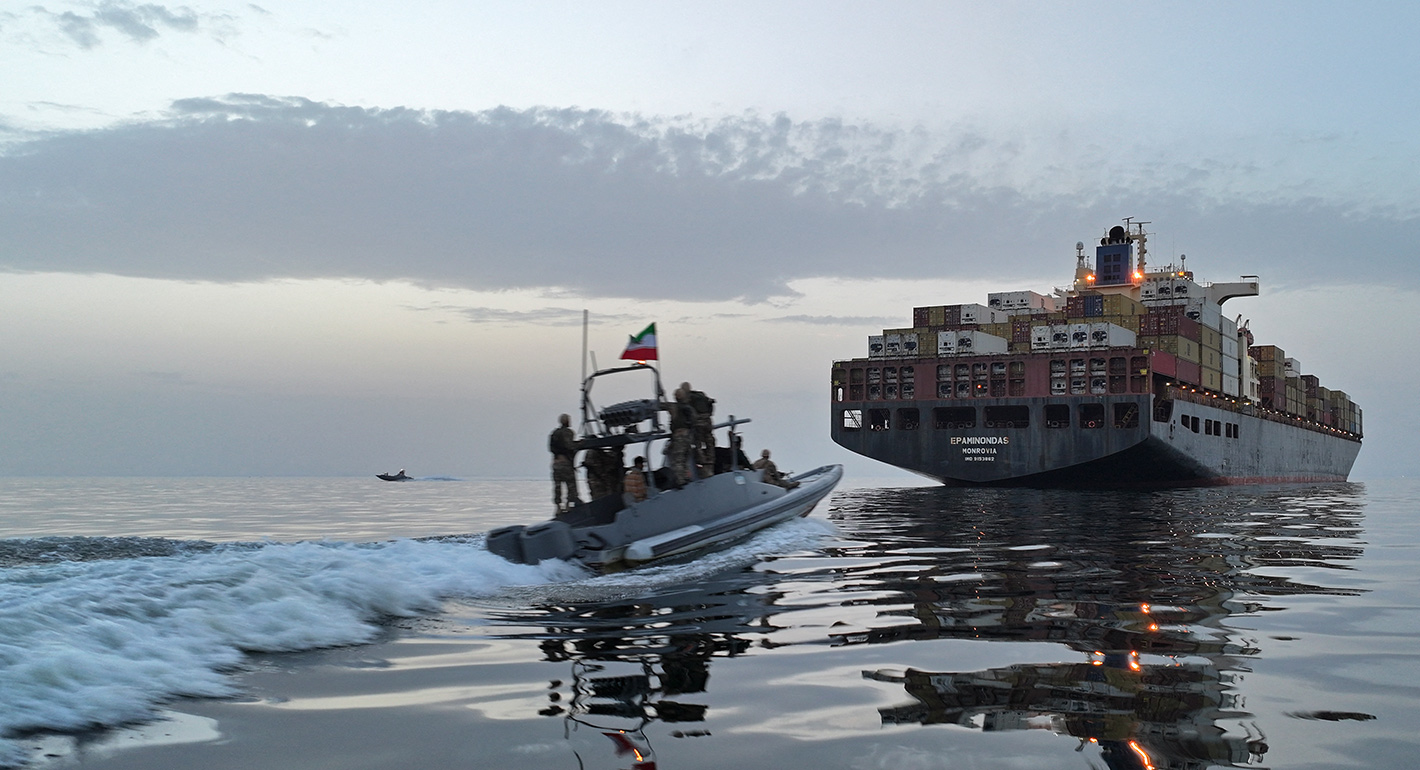
Potential Strait of Hormuz transit “fees” and Iran’s renminbi use are bringing attention to Beijing’s push to become a “financial power,” particularly in energy markets. Underdeveloped aspects of China’s financial system and its dollar dependencies still constrain the renminbi’s geoeconomic significance, but recent events may spur policy shifts aimed at changing these dynamics.

Robert Greene

The armed forces champion a form of capitalism that is generating revenue, but its reliance on rent faces diminishing returns, leaving the country with massive sunk costs and deferred returns, deepening dependency on external borrowing.

Yezid Sayigh

Networks—from international payments platforms to key economic sectors—underlie many aspects of U.S. power. But they are suffering under an extractive approach to foreign policy.
Daniel W. Drezner

Middle powers in the region will keep hedging between Washington and Beijing. It’s in the great powers’ interests to play along.

Amr Hamzawy, Kathryn Selfe