

Paper
Noah Gordon, Liana Schmitter-Emerson
{
  "authors": [
    "Noah Gordon"
  ],
  "type": "commentary",
  "blog": "Emissary",
  "centerAffiliationAll": "dc",
  "centers": [
    "Carnegie Endowment for International Peace"
  ],
  "collections": [
    "Clean Energy Transition",
    "The Iran War’s Global Reach"
  ],
  "englishNewsletterAll": "ctw",
  "nonEnglishNewsletterAll": "",
  "programAffiliation": "SCP",
  "programs": [
    "Sustainability, Climate, and Geopolitics"
  ],
  "topics": [
    "Economy",
    "Climate Change",
    "Energy"
  ]
}
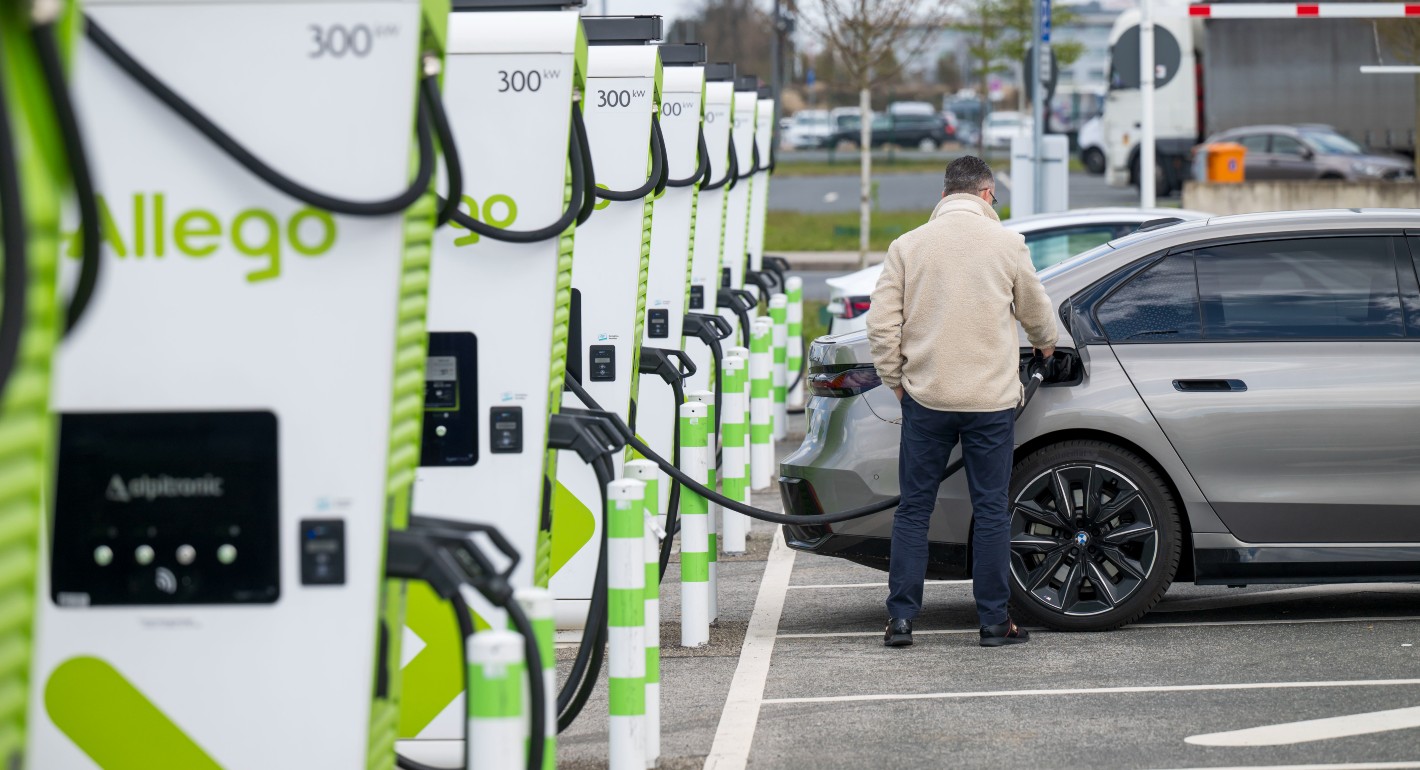
Electric cars charge at a public charging station by the company Allego at Frankfurt Airport on April 01, 2026 in Frankfurt, Germany. (Photo by Thomas Lohnes/Getty Images)
As the Iran war shocks oil prices, countries that have invested in renewables, EVs, and battery development since the 2022 Russian invasion of Ukraine are seeing the value of their investments.
With the Strait of Hormuz still effectively closed, the world faces a severe economic crisis. One-fifth of global trade of oil and natural gas is blocked in. Prices and borrowing costs are rising in the United States, while countries across Eurasia are cutting fuel consumption by decree: Egypt is closing restaurants early, the Philippines is closing public offices on Fridays, and Bangladesh is closing its universities altogether. Europe fears it must ground planes for lack of fuel, while South Koreans are hoarding plastic bags. Their president, Lee Jae Myung, said he “can’t sleep at night.”
This energy supply shock, with 11 million barrels a day missing from markets, is the inverse of the COVID-19 demand shock, when oil demand fell by 9 million barrels a day in the lockdown-marred year of 2020. At nearly $120/barrel, oil prices are reaching the heights of the last major energy shock in 2022.
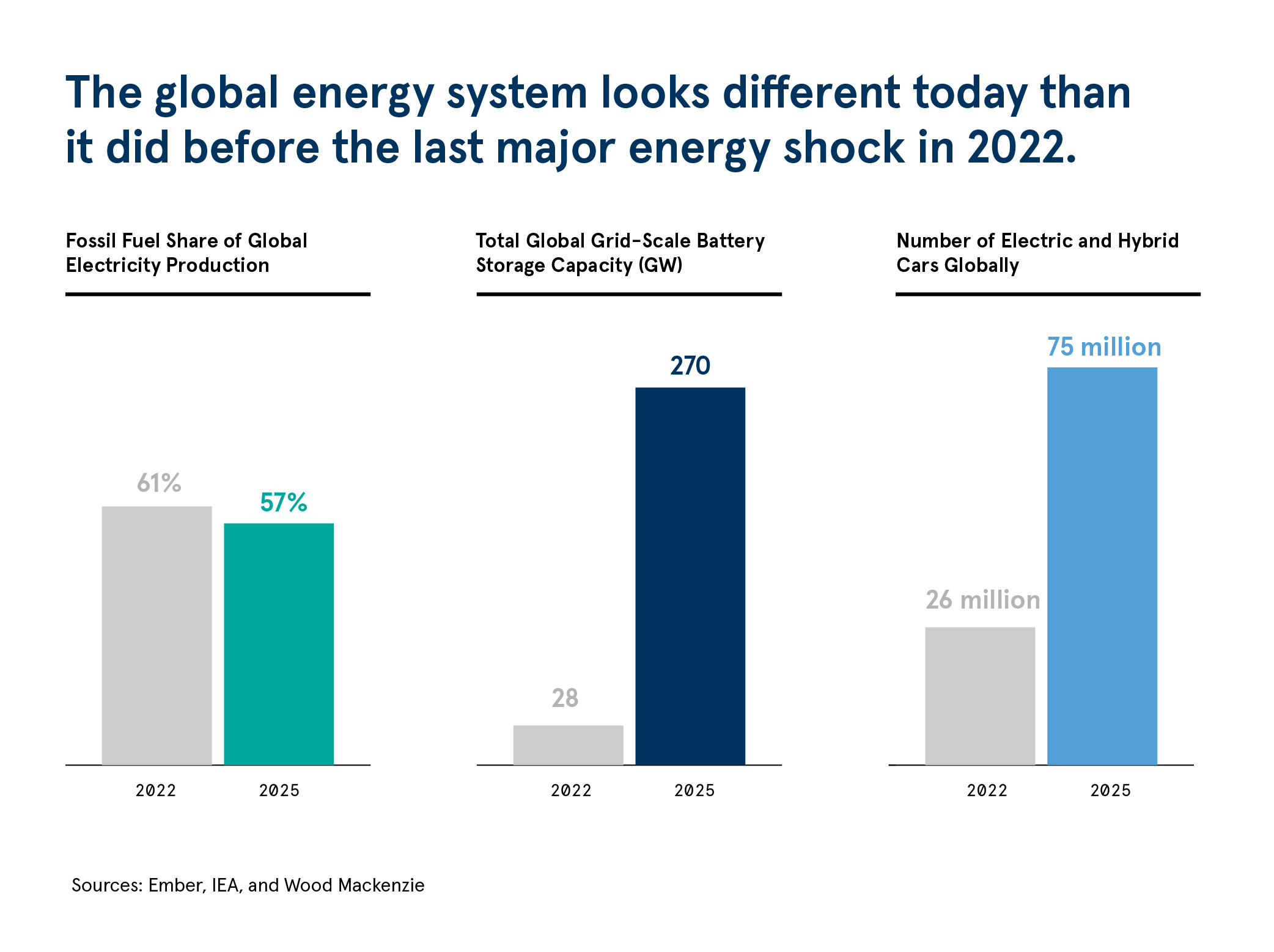
The global energy system does, though, look slightly different today than it did four years ago, when energy demand outpaced supply in the wake of the COVID-19 shutdowns and when Russia’s invasion of Ukraine triggered sanctions and scrambled markets. Look at clean electricity, electric vehicles (EVs), and batteries. Whereas fossil fuels provided 61 percent of global electricity in 2022, that number fell to about 57 percent in 2025, as more countries captured their own sun and wind (which foreign powers can’t interfere with). There were about 26 million electric cars (including hybrids) on roads in 2022; by the end of 2025 there were more than 75 million, around 5 percent of the global automobile stock. These cars keep running even when the petroleum fails to arrive. Global grid-scale battery capacity stood at 28GW in 2022 but grew to 267GW in 2025, helping energy systems make better use of those newly added renewables.
Sure, it’s minor progress on a global scale, mostly limited to the electricity and road transport sectors—and absolute consumption of oil, gas, and coal has never been higher. But the global figures mask how some countries have been able to install enough clean energy technologies to make themselves more resilient this time around.
China has installed the most clean energy technologies since the last crisis, ensuring that its consumption of petrol and diesel fuels for road and air transport peaked in 2023. With 12 percent of the Chinese vehicle fleet now electric, the only reason Chinese oil demand hasn’t declined is the growth of the petrochemicals sector. The progress in the power sector is impressive, too. China’s fossil electricity generation actually fell in 2025, even as overall electricity demand increased by 5 percent, a feat made possible by massive additions of renewables and batteries. On a smaller scale, the countries of the EU, those most directly affected by the loss of Russian gas in 2022, were able to reduce gas consumption by 18 percent from 2022 to 2024, largely on the back of energy efficiency investments and a boom in renewables, notably in Spain.
As impressive as the Chinese and European stories are, other countries have seen greater transformations because they used less oil and gas to begin with. Pakistan has enjoyed a stunning solar boom. It has imported about 42 GW of Chinese solar panels since 2022—nearly doubling its electrical generation capacity in that time. Chinese products are also transforming the daily experiences of many residents of African countries like the Democratic Republic of the Congo and Mozambique, whose solar imports are skyrocketing. Having more solar panels on more roofs does not protect these countries from what the head of the International Energy Agency calls “the greatest global energy security threat in history.” But it can give businesses enough power to run factories during the day and residents enough to run a fan at a time when diesel generators are becoming unaffordable.
Who else has gone all-in on EVs? In Norway the stock of electric cars surpassed petrol cars in 2024, and the gap keeps widening now that fully electric EVs are 96 percent of new sales. This is a rich, oil-producing country that has subsidized electric vehicles for decades. Developing countries were later adopters. Nepal imported over 30,000 four-wheeled electric vehicles from 2022 to mid-2025, which will make a difference in a country with fewer than 400,000 total four-wheelers and so short of hydrocarbons that it’s rationing cooking gas. Ethiopia’s leaders, tired of spending 6 billion of the country’s scarce dollars annually to import fuel to a land with abundant hydropower, banned the import of fossil-fueled cars in 2024. It has tens of thousands of EVs on its roads already.
These decisions were made in service of resilience and electrification, rather than decarbonization, with any concerns about greenhouse gas emissions largely incidental. That’s why so many measures to protect against fossil fuel shortages have entailed making more fossil fuels available, for example by storing them or diversifying sources of supply. When Goldman Sachs highlights how China is well-positioned to weather this energy storm, it notes not only the clean energy buildout but also the major expansion of oil stockpiles. India, meanwhile, responded to the 2022 shock by boosting its domestic coal production to reduce reliance on gas. The early responses to the 2026 volatility have brought mixed news for the emissions forecast, with some countries opting to stick with coal for longer and others opting to restart nuclear energy projects (like Taiwan) and buy solar and EVs in bulk (like the UK and Germany).
From China to Chile, some governments got the message in 2022 and swapped out some imported oil and gas for domestic sun and wind. Still, they remain very exposed. Despite those new EVs in Ethiopia, for example, fuel is still so scarce that the government has told nonessential public employees to stay home. The clean energy forerunners may have put some family heirlooms in a fireproof safe, but the longer the Strait of Hormuz stays shut, the more of the house will burn down.
The latest from Carnegie scholars on the world’s most pressing challenges, delivered to your inbox.

Former Fellow, Sustainability, Climate, and Geopolitics Program and Fellow, Europe Program
Noah J. Gordon was a fellow in the Sustainability, Climate, and Geopolitics Program at the Carnegie Endowment for International Peace in Washington, DC.
Recent Work
Noah Gordon, Liana Schmitter-Emerson



Sophia Besch, Eric Ciaramella, Steve Feldstein, …
Carnegie does not take institutional positions on public policy issues; the views represented herein are those of the author(s) and do not necessarily reflect the views of Carnegie, its staff, or its trustees.

Rubio’s recent visit brought welcome attention, but more capital requires governance changes that may be a hard sell for regional governments.

Jennifer B. Murtazashvili

Despite public disputes over trade and immigration, the strategic partnership’s foundations remain sturdy.

Sameer Lalwani

Despite its flop at the box office, the film raises important questions for the climate community to answer.

Leonardo Martinez-Diaz
They face an uphill climb, but they could draw on a strategy that other diplomats have used in the past.


Shana Tabak, Alejandro Martin Rodriguez
U.S. trading partners in Asia are closely watching the dispute for signs of how it may affect their own interests.

Barbara Weisel