• Research
  • Emissary
  • About
  • Experts
Carnegie Global logoCarnegie lettermark logo
DemocracyIran
  • Donate
{
  "authors": [],
  "type": "pressRelease",
  "centerAffiliationAll": "dc",
  "centers": [
    "Carnegie Endowment for International Peace"
  ],
  "collections": [],
  "englishNewsletterAll": "menaTransitions",
  "nonEnglishNewsletterAll": "",
  "primaryCenter": "Carnegie Endowment for International Peace",
  "programAffiliation": "MEP",
  "programs": [
    "Middle East"
  ],
  "projects": [],
  "regions": [
    "Palestine"
  ],
  "topics": []
}
REQUIRED IMAGE

REQUIRED IMAGE

Press Release

Deepening division in Palestine threatens diplomatic progress

The widening division between Fatah and Hamas threatens any chance for a diplomatic breakthrough on the Israeli–Palestinian conflict. Neither Palestinian faction is moving closer to reconciliation with or capitulation to the other side.

Link Copied
Published on Aug 24, 2009
Program mobile hero image

Program

Middle East

The Middle East Program in Washington combines in-depth regional knowledge with incisive comparative analysis to provide deeply informed recommendations. With expertise in the Gulf, North Africa, Iran, and Israel/Palestine, we examine crosscutting themes of political, economic, and social change in both English and Arabic.

Learn More

WASHINGTON, Aug 24—The widening division between Fatah and Hamas threatens any chance for a diplomatic breakthrough on the Israeli–Palestinian conflict. Neither Palestinian faction is moving closer to reconciliation with or capitulation to the other side, concludes a new commentary from Nathan J. Brown.

Security and economic gains in the West Bank are temporary and unsustainable—and unlikely to inspire a broader Palestinian rejection of Hamas. Recent championing of Palestinian Prime Minister Salam Fayyad’s efficient governance style as a new model for democracy in the region ignores the inherent shortcomings of governing only half of the Palestinian Authority.

Key Conclusions:

  • Fayyad’s achievements are dependent on massive international assistance and an unpopular crackdown on Hamas, which has further aggravated the discord within Palestine.
  • Fatah leaders have no plan to move past the current stalemate and are focused on outmaneuvering each other.
  • Hamas leaders have transformed their movement into a party-state after seizing Gaza in 2007, but have failed to articulate any strategy to expand beyond their entrenchment there and govern a united Palestine.
  • Hamas is starting to resemble Fatah in the 1990s, a party that systemically captures a weak proto-state. But it has managed to avoid so far the extreme disarray and corruption that beset Fatah.
  • The United States has locked itself in a policy of sanctions against Hamas that are unlikely to produce desired results.

Brown concludes:

“The grim reality is that the Palestinians now have two political systems that are lurching farther away from each other, and neither one seems to have a viable strategy for realizing its vision or building a better future for the people it purports to lead.”

###


NOTES

  • Direct link to the PDF: www.carnegieendowment.org/files/palestine_schism1.pdf
  • Nathan J. Brown is a professor of political science and international affairs at the George Washington University, a nonresident senior associate at the Carnegie Endowment, and a distinguished scholar and author of four well-received books on Arab politics.
  • The Carnegie Middle East Program combines in-depth local knowledge with incisive comparative analysis to examine economic, socio-political, and strategic interests in the Arab world to provide analysis and recommendations in both English and Arabic that are deeply informed by knowledge and views from the region.
  • The Carnegie Middle East Center based in Beirut, Lebanon, aims to better inform the process of political change in the Middle East.
  • Carnegie's Arab Reform Bulletin offers a monthly analysis of political and economic developments in Arab countries.
  • Press Contact: Jessica Jennings, 202/939-2265, jjennings@ceip.org
Palestine

Carnegie does not take institutional positions on public policy issues; the views represented herein are those of the author(s) and do not necessarily reflect the views of Carnegie, its staff, or its trustees.
More Work from Carnegie Endowment for International Peace

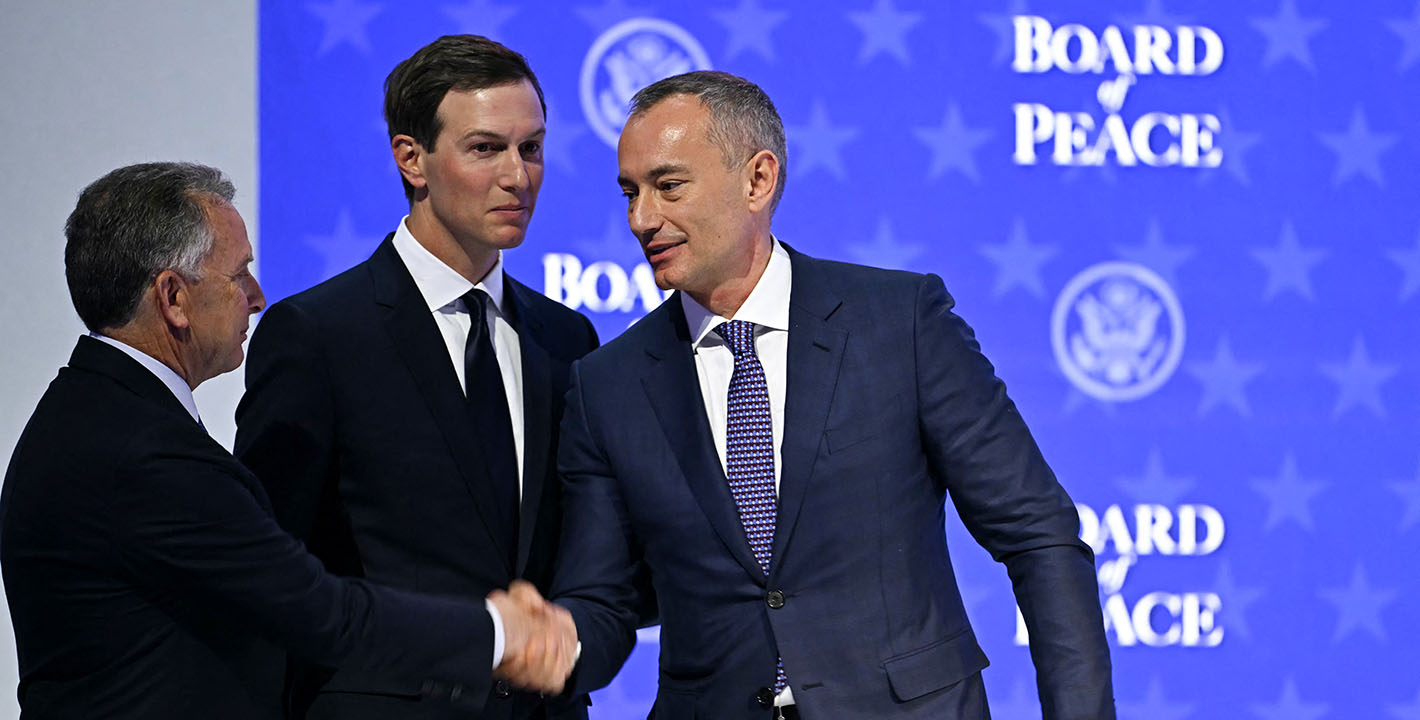
  • US President Donald Trump presides over the inaugural meeting of the âBoard of Peace,❠a newly established body focused on efforts for Gaza, at the US Institute of Peace in Washington, DC, United States, on February 19, 2026.
    Article
    The Board of Peace and Funding for Gaza Reconstruction: On Whose Account?

    Stakeholders must demand major restructuring of the Board of Peace and robust oversight and transparency before engaging with it. Until then, rights-respecting existing platforms and mechanisms for multilateral peacemaking should be supported.

      Zaha Hassan, Charles H. Johnson

  • Photo of an Israeli soldier walking behind young women in school uniforms, some wearing hijabs.
    Article
    For Younger Palestinians, Crisis Has Become a Way of Life

    Young people in Palestine are accused of being ignorant of their past. But the truth may be that they are more aware of their present than anyone else.

      Nathan J. Brown

  • Commentary
    Diwan
    All or Nothing in Gaza

    Implementing Phase 2 of Trump’s plan for the territory only makes sense if all in Phase 1 is implemented.

      Yezid Sayigh

  • Trump pointing at Netanyahu while the two shake hands
    Commentary
    Emissary
    There’s Never Been a President Like Trump on Israel

    Trump’s unmatched leverage over Netanyahu gives the prime minister little room to maneuver.

      Aaron David Miller, Daniel C. Kurtzer

  • Commentary
    Diwan
    The Perils of the Palestinian Authority’s New Party Law

    The objective is to lock Hamas out of political life, but the net effect may be negative indeed.

      Nathan J. Brown

Get more news and analysis from
Carnegie Endowment for International Peace
Carnegie global logo, stacked
1779 Massachusetts Avenue NWWashington, DC, 20036-2103Phone: 202 483 7600Fax: 202 483 1840
  • Research
  • Emissary
  • About
  • Experts
  • Donate
  • Programs
  • Events
  • Blogs
  • Podcasts
  • Contact
  • Annual Reports
  • Careers
  • Privacy
  • For Media
  • Government Resources
Get more news and analysis from
Carnegie Endowment for International Peace
© 2026 Carnegie Endowment for International Peace. All rights reserved.